By David Clarke
Come with us if you will to a dim and distant past, to England in 1978. There was no internet, no world wide web, no digital cameras, mobile phones, or CD recorders and certainly no established Neil Young fan groups. Margaret Thatcher’s conservative Britain was looming on the horizon and I had moved from the English Midlands down to London to take up a new assignment as divisional accountant for our company’s plastics division.
Also gainfully employed within that same organisation was a certain expatriate Scot named Paul Makos. I duly bought a house in South East London and found myself living less than a mile from Paul. With typical Scottish canniness on his part, I found myself giving him a lift to and from work each day – a journey of about 5 miles, but as this was South East London the journey always took a good 35 minutes – in other words the best part of a Neil Young album. Needless to say, we spent a good proportion of those tedious journeys listening to and discussing the man.
I had not seen Neil on his 1976 tour of Europe, and news of Neil (and new albums) at that time were sparse. Communication was not what it is now, email was not yet available to the general public. And as neither of us knew many other Neil Young fans, we started to consider ways of rectifying the situation. Gradually the germ of an idea grew, and sometime around 1980 Paul and I set about the creation of what was to become the Neil Young Appreciation Society, or NYAS for short. Initially the founding fathers included the owner of a local second-hand record store where we bought a number of Neil Young bootleg records – about six I recall. I forget what they cost but I contributed half. Unfortunately, I do not have many of them today. But the record store guy soon dropped out of the project anyway, and that left the two of us.
A plan was conceived, and a little thought was even given to how the project was to be financed – a thought which was quickly dismissed as being too worrying at that time. Paul and I between us put sufficient money up front to place adverts in the music press, and a bank account was opened. In due course the first replies to our small ads arrived – first at a trickle and later at less than a trickle! Nevertheless, we ploughed on, full of optimism. Each reply was sent an information sheet promising six issues per year of the fan magazine – which we had not even produced yet, a badge, and an information folder. The folders proved to be prohibitively expensive, however, and were soon abandoned.
Saddle Up The Palamino
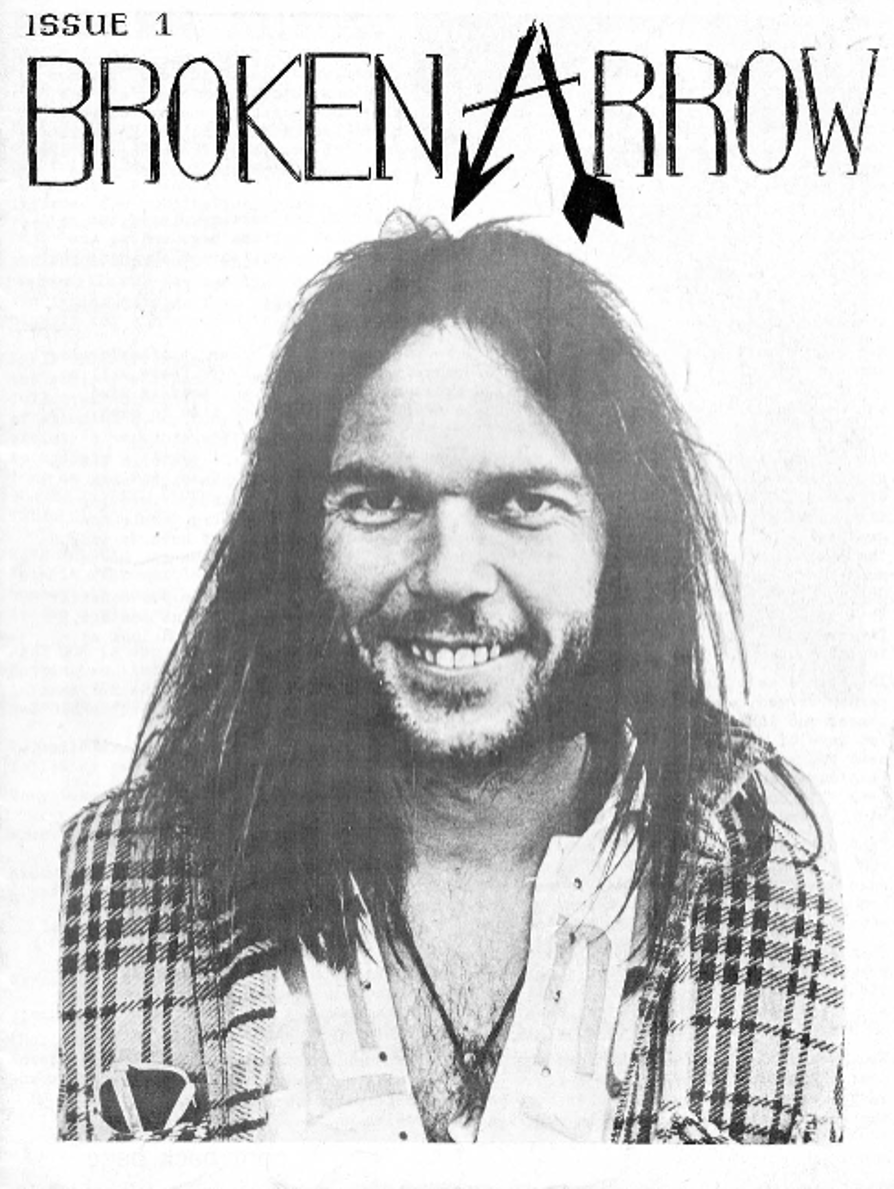
It soon became apparent that finances would indeed become a major concern. We had set the annual membership fee at a munificent £3.50 per annum and yet Paul was determined to produce six issues of our proposed magazine each year. The magazine was christened “Broken Arrow”. I don’t think I remember exactly how we chose the name or whose idea it was. Preliminary enquiries at various printers revealed that each issue would cost around £100 to produce. From memory, we had a print run of around 150 for issue #1, 300 for issue #2 and probably 350 to 400 for issue #3. By the third issue the society membership had grown to the extent that virtually the entire print run was actually sent out to members. For the first two issues there had been copies left over which could be utilised for back issue sales. In fact, back copies of issue #1 were still being offered as late as issue #7 for the princely sum of 50p each – including postage and packing. We also had to purchase badges for members so that they could identify each other when out in public, and for this we found an excellent supplier – Marc (surname forgotten) who resided in nearby Forest Hill.
In order to finance our various promises, alternative methods of raising money were soon considered. First, we did what any self-respecting embryonic organisation does and we roped in as many family members, friends, acquaintances and work colleagues as we could, persuading them to part with £3.50, or better still £5 for joint membership. Paul Makos was member #1, his wife Ann #2, I became #3 and my wife Margaret #4.
The first run of advertisements in the music press had produced a reply from Andy Cox, who was then living in Nottingham. Andy struck an immediate rapport with Paul and me, and he came to visit us in London prior to the production of Broken Arrow’s first issue.
Discussions also led to the formation of a merchandising concept. A T shirt was designed, photos purchased for resale, and as many other relevant fan articles as could be found were assembled. We had been fortunate enough to purchase a batch of LPs of Neil’s soundtrack of “Where The Buffalo Roam” and made a fair profit margin on those. The T shirts involved a lot of phone calls and driving around South London to get quotes and pick up the orders. As these things always had to be paid cash on delivery, a large part of our finances was therefore invested in the first issue and the merchandise.

Already One
The next task was actually to produce the first issue of the magazine. We obviously had no stock of articles already written, or a team of writers on hand who could actually produce the magazine. So it inevitably became a bit of a hit or miss affair. Our first intention was to be generally informative in order to appeal to the whole spectrum of subscribers. For the first issue, therefore, a discography seemed an obvious choice, as did a list of available bootlegs. Bootlegs were not easy to find in those days, and the proliferation of record fairs and other unofficial outlets was only just beginning. Listening to or buying bootleg albums seemed more an innocent pastime then. The legal considerations were buried by the burning desire to hear more of our beloved artists. Remember, there were few radio stations and TV channels in those days, at least in Europe, and few other means to hear and share music except live performances and, well, bootlegs. Unfortunately, our ‘innocent’ or perhaps naïve discussion of bootlegs eventually alienated us from Neil and his management. I can only say it was not our intention to promote them actively – there was no commercial interest involved on our part at least. For us they were just an accepted part of the regular fan scene and we simply wanted to put them on the public record as a facet of the fan items which were then available.
The first issue of Broken Arrow magazine was thus planned and written out by hand in preparation for the production stage. With our lack of funds and expertise, the only route open to us was to use typewriters, although none of us could actually type! Remember, this was late 1980-early 1981 by now and basically no one owned a personal computer. ‘Word processing’ software was hardly known and the first version of Microsoft Word wouldn’t come out until 1983. So I ‘borrowed’ a typewriter from the offices where I was working, an old electric machine which had the disconcerting habit of shedding its rubber band each time the carriage return was pressed. This was patently not going to work. I therefore borrowed (with permission this time) a more modern IBM golfball machine and this was what we used for the first issues. As nobody had told Paul Makos that the IBM typewriter ribbon could only be used for one set of impressions and had to be discarded after use, he initially set about rewinding and reusing it. This explains the patchy nature of the print in the first issue! The IBM machine did however have that most valuable of features – a correction ribbon.
The original Broken Arrow production team was made up of Paul, his wife Ann who did the typing, myself, and Paul’s sister-in-law Kate who provided artwork. The completed magazine was thus prepared and duly sent off to the printers. Paul with his typical impatience sent it off before it had been properly proof-read and managed to misspell my name in the process. The printed copies were duly delivered and a feverish evening was spent addressing and stuffing envelopes with the magazine, a badge, a membership card and the other documents. In August 1981, the historic first edition was sent out to our very first members.
Paul’s editorial in that first issue stated that we considered ourselves to be “good amateurs” and I suppose that is what we hoped to be. The intended aim of the Neil Young Appreciation Society was to be a genuine society and not ‘just’ a fan-club, to bring together like-minded people to share and pool knowledge about the object of our shared interest. In hindsight the first issue was sparse and certainly looks amateurish when compared to later issues. But I and no doubt Paul too make no apologies for this. It was the first step in these waters and it was produced on a shoestring with all the inevitable mistakes we made on the way.
Originally published in its original version under the title ‘Hold Back The Years’ in the Neil Young Appreciation Society’s Broken Arrow Magazine issue no. 100. Revised here by the original author David Clarke. Published with permission.
Part 2 of David’s article will follow the period up to the anniversary issue #100 of Broken Arrow and beyond- And we will also look at what has happened to David and those earliest pioneers of the Neil fan scene since then.
All back issues of Broken Arrow have been archived on the Sugar Mountain website as PDFs and can be read at https://www.sugarmtn.org/ba/. There is also a search function on the index page which allows you to search for specific articles, and you can also order back copies of some issues.
RB