
Senior Chief Update
Dear listeners and writers,
There are several items that have come to my attention from your letters to the NYA
“letters to the editors” section of the Times Contrarian. And of course they were
interesting queries that I wasn’t able to easily answer without doing some research as
opposed to just knowing off the top of my head, which is my preferred method of
interaction with people. You know, “contempt prior to investigation” follows me around more
often than not.
The first deals with the album titled Fuckin’ Up released on April 26, 2024 just over two
years ago. Someone actually looked at the Source logo on the inside of the album jacket (or
vinyl labels) and saw that it said “Mastered in analog from 48/24 digital”.
This alone is a departure from our norm of having the album or CD source logo that usually
always says “SOURCE – Mastered from original analog tapes” or “from 192/24 digital” or any
other sample rate and bit depth that the album and CD audio were mastered from at
Grundman Mastering in Hollywood where I master all of Neil’s albums. It could even be
sourced from a cassette.
With rare exception, Chris Bellman always runs the audio, even the digital source (as
opposed to analog tapes) through his analog mastering console in the cutting room. So it is
converted to analog for level and/ or equalization changes in the analog domain as opposed
to digital signal manipulation. And this, because it simply sounds better.
We all know that a CD will always be encoded with 44.1k/16 bit digital audio so it couldn’t
technically be at 48/24 but that could easily have been the original digital source sample
rate. But, in this case it was not. The letter writer duly notes that the streaming audio on
Neil’s NYA website is for this album presented in and displayed at 96/24 digital.
It was in fact a 96/24 digital Atmos binaural source supplied from the Surf Shack where I
mixed the record for stereo.
So quite simply, I will refer anyone who questions this discrepancy to the aptly named title
of said record….Fuckin’ Up. That is exactly what happened with the source logo. A fuck up
occured and I have no idea how! But good catch Will!
Secondly, this other letter regarding Mirror Ball is much easier to answer.
Neil and I determined that four of the songs on the original Mirror Ball album master
analog tapes were in fact mixed to digital DAT tapes and then transferred to the analog
master ½” tapes many moons ago such that the first release of the album in June 1995
contains those four digital sourced mixes.
This probably happened as a result of Neil and Brendan O’Brian (his producer) deciding that
the feel of the DAT mix, be it rough or final, was superior to the first tape mix of those
four songs. And those four were “I’m The Ocean”, “Big Green Country”, “Truth Be Known”
and “Throw Your Hatred Down”.
Since the other seven songs were mixed to tape, it was decided to have an “All Analog
Original” re-release and consequently Neil asked me to remix from the original 2” 24 track
tapes these four (previously digital format) songs to the same ½” format 30ips audio tape
that the rest of the masters sat on.
This was done so that when we mastered the Mirror Ball album for the ORS boxed set of
albums it could have all its audio be from analog mixes right to the lathe without ever having
gone to any digital format.
The ORS boxed set of Harvest Moon, Unplugged, Sleeps With Angels and Mirror Ball was
released in October 2025. The so-called breakout versions will be released soon. Both the
standalone and box set version of Mirror Ball have the exact same content ie; my analog
remixes of those four songs listed above.
I trust this will clarify any questions regarding this version of Mirror Ball.
John Hanlon
12/5/25
Mirror Ball live!
And here’s another project I’m finishing mastering today at Grundman’s. It’s Neil playing with Pearl Jam at coincidentally enough Dublin Ireland again but from Simmonscourt in August 1995 almost a full eight years before the Vicar Street solo concert of Neil’s I just wrote about.
This is going to be three sides of vinyl comprising seven songs. These are all mixed from two 24 track Studer analog tape machines locked together, and mixed down to 1/4” analog tape at 15 ips at The Village Studios D on their Neve 88R console.
The band were all on the first 24 track and the vocals and audience tracks were on the second multitrack. This will be an “analog original”. All but one song are from the Mirrorball album and are Big Green Country, Song X, and Act of Love on the A side; Downtown, Mr. Soul and Throw Your Hatred Down on the B side; and finally a 19 minute version of Scenery comprising all of the C side. This album rocks pure and simple with three guitar players and the rest of Pearl Jam.
The studio crew were not used to seeing large 5,000’ two inch tape reels and four tape machines all rolling at once. Nowadays everyone but me is on digital almost all of the time. Analog rules even if it’s unwieldy. All the editing is done with a splicing block and rocking tape reels on the machine and cutting the tape. This analog domain gives the same sensation of listening to the rock ‘n roll records we grew up on. It feels good and is not tiring to listen to at loud playback levels. You know, when bands like the Stones used to put right on the back cover of the record, “This record made loud – to be played loud!”
I built the three 1/4” master reels to assemble songs without any digital segues between them by matching the audience out levels to incoming audience levels on the next song. It gets tricky to cut the tape in the middle of the ambience of a clapping audience to match without noticing an edit point
Editing is obviously much easier when cutting sections of songs together when you can cut on the backbeat snare, as it’s usually the loudest peak in a track on the tape.
Tonight’s The Night 50th!
While here in the mastering room we also tackled finishing touches on the Tonight’s The Night 50th Anniversary release of that album which includes six more songs on a third side of vinyl now, that were not on the original album. We replaced the original Lookout Joe (tracked at the Ranch in ‘72) that was on the B side of the album with the take that was actually recorded with all the other songs at Studio Instrument Rentals in 1973. There is a continuity now that previously didn’t exist. It might be rougher than the original album’s Lookout Joe recorded in Neil’s studio, but it’s got the vibe of all the other performances now. Party time and playing in the same room in Hollywood with that particular atmosphere of comraderie.
The third side of unreleased music are the six songs previously recorded on these same sessions at SIR or in the same time period; Walk On, Wonderin’, Everybody’s Alone, Raised On Robbery, Speakin’ Out Jam, and another outtake of Tonight’s The Night.
This is a raucous record of a rock ‘n roll attitude that captures the time and puts you in the room with these musicians when they created this amazing art!
Next week I will describe the other projects I’m working on with Neil, several of which me and Tim Mulligan are working on together. Specifically they are Berlin, Homefires and Island In The Sun.
John
8/28/25
It’s been a while my friends since filling you in on all my Archives work in progress.
I needed a break after working nearly simultaneously on around nine NYA projects for Neil. Mixing, editing, assembling and mastering and recutting master lacquers for various vinyl re-releases that always come up.
So I went to my cabin in the Maine woods about a half hour from the Canadian border province of New Brunswick. Hanging out and camping with my two brothers, and then went hiking in the White Mountains of New Hampshire, my home state. In Maine there are only fish, squirrels, bear and moose. Where I was there’s no electricity, internet, cell service and most importantly I got to clear my head of everything and listen to the music of the silence of nature punctuated only by loons calling out to each other on the lake.
And now I’m at Grundman Mastering in Hollywood writing while Chris Bellman is in the cutting room mastering the 48k audio of the May 13th 2003 Vicar Street Dublin show of Neil’s solo acoustic performances of the Greendale album songs.
The Greendale album itself was recorded at Broken Arrow Ranch with Crazy Horse in the summer of 2002 but not released until August of the next year.
These Ireland solo takes were released on a DVD video of the that night’s concert along with the Greendale album in 2003. He also played there the two previous nights. However this will be the first time one can listen to the songs on a vinyl record and mastered in the analog domain.
So these magical solo performances by Neil were first heard by audiences on this 2003 tour before the studio album ever hit the streets. Only Falling From Above was first performed solo during the previous October at the Bridge School in 2002.
And magic they are, with his intimate storytelling setting the table for each song that’s played and sung. And this is storytelling at its best. You are drawn into the song that’s played as it unfolds in a way that otherwise wouldn’t happen.
And as I prefer to listen to music rather than watch it, this is a great format to hear these songs as opposed to watching the DVD of the show released so long ago. I still like the landscape of my imagination that occurs when listening to great art instead of the limitations of the visual world forced on me in a video. I get to “see” the music as well as hear it!
I’ll write about the other projects next.
John
3/13/25
A lot of projects are underway folks! It’s been hard to keep track as we are onto another
album project while one is in the completion stage waiting on plant pressings to be delivered
and listened to.
In the last two weeks I was finishing aspects of delivering different media parts for the
new Neil Young and Chrome Hearts album Talking To The trees in three formats, vinyl LP
records, CD’s and digital hi-resolution audio for the streaming services.
All the while working on One Step vinyl album process for On The Beach, mixing Lookout
Joe for the Tonight’s The Night’s 50th Anniversary re-release from 1973 and lastly Mirror
Ball remixes on four songs for an all analog master tape to pressing process on that album.
It sounds amazing as Neil and Pearl Jam had a great set of sessions back then with Brendan
O’Brian at the helm in 1995, recorded on 24 track analog and mixed to ½” tape. Now all the
mixes are from tape as four had previously come from a digital mix format of DAT tape.
There will also be a second LP for Tonight’s The Night’s 50th anniversary release with a side
of additional songs that were recorded at Studio Instrument Rentals in Hollywood on
location with the Wally Heider remote truck where the original record came from. They’ve
seen limited light of day as some of them came out on NYA Volume 2 but never on a vinyl
record and from analog master tapes to said LP.
The jumping around from the new album recorded last fall and winter and mixed this
January in 2025 to Tonight’s The Night work from 1973 to Mirror Ball recorded in 1995 has
been a journey in time to say the least.
Tim Mulligan, John Hausmann and I are also working on the Berlin concert Neil played in
1982 performing with the Trans Band. This will be from all analog tapes. I will be assembling
all of the pertinent songs cutting the tapes together in a week from now.
Speaking of editing, I’ve been cutting ¼” and ½” tape together for all of these projects so
far for months now. A good tape machine, an edit block, razor blades and splicing tape doing
what we used to do back in the ‘70s and ‘80s. There’s a sound and a feel that happens when
tape is run to a lathe in the cutting room at Grundman Mastering where we do all of our
projects in an analog domain. Niko is responsible for all of the Dolby Atmos mixing and I’ve
been covering the old school analog releases. It’s old meets new.
There are another five or six projects I’m getting ready to commence after this work.
They are for the most part already mixed and some will come from digital two tracks as
that could have been the original source but most will be assembled from analog tapes. I will
be reporting in the near future on these projects as the work gets underway. Until then,
enjoy a great day as that is what we have here!
John
TUSCALOOSA
Dear readers,
Regarding the upcoming TUSCALOOSA live album from the February 5, 1973 concert in Alabama; mastering for vinyl and hi-res is now underway at Bernie Grundman Mastering in Hollywood.
I mixed the album in Studio 2 at East West in Hollywood over the Christmas and New Year’s holidays from analog 16 track 2” masters to ¼” 30ips tape, sending my mixes daily to Neil in Colorado to listen to. Then Neil would send his comments to me live as he listened. Suggested changes made, I then assembled the final mixes for three master album reels for three sides of vinyl, based on sequencing done previously with Neil in the digital realm. During the sequencing, two songs, “ON THE WAY HOME” AND “THE LONER” were dropped. ‘On the way Home’ has already appeared on many live records. ‘The Loner’ was out of tune.
It was Analog to analog all the way around for TUSCALOOSA, the next upcoming live record by Neil and the Stray Gators. The 192/24 master for NYA will be generated from the analog mastering, directly from the master tapes through Grundman Mastering’s console.
Happy listening, John Hanlon
HAPPY NEW YEAR
January 1, 2025
Happy New Year dear readers! This is what’s been going on in the studio and my life for the last several months with Neil and his new band The Chrome Hearts.
Back in mid October I was on vacation in New Hampshire (where I’m from) and Maine, headed to my camp to meet up with my brothers in Down East Maine, which is in the middle of nowhere a mere half hours drive from the Canadian border by New Brunswick, one of the grand Maritime Provinces of our northern neighbor.
I had just checked out of my motel and having stocked up on provisions was on back country roads headed to the remote lake landing and boat dock to start my journey off the grid in all manner of communication with the outside world tethered only to a small motorboat. A mile or so from losing all cell reception the phone rings.
Neil is on the other end.
“Hey John, How are you? Great, sounds like a blast. Hey, I want to record with the guys – at Shangri La Studios [in Malibu]. I got some new songs. This album is going to be real different.“
That alone is pause for concern for an engineer or at the very least, for some resolute thought because all his albums are different, as you never know what to expect. So when he says that, all bets are off. I only know that he plays guitar – electric and acoustic, and he plays the piano among a multitude of other instruments and he sings.
“When”, I asked.
He answered without skipping a beat “Well, I was thinking next weekend or starting on Sunday. Oh, by the way, when are you back?”
And it was off to the races. Now, I’m three thousand miles away and I wasn’t due back for a week. He would wait but the clock had started ticking. Neil likes options so I gave him two, “Neil, either you’ll have to wait for me to return or get another engineer.” This was actually said with all sincerity because when he’s ready to record and create, it’s not a process that can be put off for very long if at all.
He was having his brother in law Lou Adler produce with him and me engineer and he had some songs. I asked no other questions because it’s pointless as often Neil doesn’t know how its going to unfold either, and why remind him.
Right then I decided to do it with him and Lou. The muse is what rules, period.
All of this conversation happened in the span of ten minutes or less while I had pulled over to the side of the road on the two lane blacktop so as not to lose reception, all in full view of a moose grazing in a bog to my right not far off.
I pulled into a gas station and made a series of calls to start the process of preproduction and hired our usual crew and spoke with the studio manager and assistants. A lot of moving parts were put into motion. While at the lake in my cabin I worked out the setup in my head and then wrote it all down. If you can set it up in your head before diagramming it and remember everything then you have a solid and failsafe plan to cover all eventualities.
Neil simply said to be ready for anything and only specified that he wanted to record all analog on a 16 track tape machine and wanted two ¼” tape machines for mixing and tape slap. No digital! Tape was ordered, outboard gear obtained, studio time booked. I made the final preplanning calls from the airports ahead of my long flights home.
As it was I got in very late on a Saturday night a week later and setup the control room and studio on Sunday. Fortunately all the crew had loaded in and had been setting up the Thursday before I got in. We were recording on Monday.
The Chrome Hearts are Corey McCormick on bass, Anthony LoGerfo on drums, Micah Nelson on guitar and Spooner Oldham on B3 Hammond organ. Neil played electric and acoustic guitar along with his Gold Rush upright piano and his pump organ. The PA was setup for putting the vocals into the room so everyone could work without headphones during tracking.
I record the entire band live, always. No one adds their own core musical parts later to build a track. It’s inhuman to expect any musician to stand there overdubbing to a pair of speakers or headphones while staring at an engineer. It is not fun and does not make for great art, at least not with Neil. That said, once we have a great track there are times he will add a part as an overdub but it is not the norm.
Monday the first day yielded four songs and on Tuesday he and the band got another three. Seven songs in two days! The studio setup took longer than that.
We spent a day or so editing the 2” tapes and rough mixing what we had.
Then I headed to Village Studios in West Los Angeles and started mixing the songs, again to ¼” tape with another ¼” tape machine for tape slap and delayed send to the EMT plate for echo. I never used any digital in the tracking or mixing process. ProTools was only used to create a master safety of the multi-track analog tape Masters and to do test edits on prior to cutting the 16 track masters or the stereo mix tapes. Lou and Neil were in the studio with me for the initial mixing week.
Then only two and a half weeks later Neil called again and said we needed to get back into ShangriLa as he had another batch of songs. Preproduction ensued to get the studio booked, gear and crew back and coordinate everyone’s schedule to set up the room for three days. I was already mixing another project for Neil at Village and had to do final set up on a Saturday and we were tracking again on Sunday.
This time he got three more songs that day. We edited and overdubbed some vocals and guitar for another several days and rough mixed those songs. Then back to Village Studios to mix after the Thanksgiving break.
We’ve been at this for a while now and in my humble opinion this is shaping up to be a completely unique and soulfully introspective album of songs that run the gamut from a palette of beautiful acoustic style pastels to in your face loud irreverent rock ‘n roll paint splatter on the canvas in the vein of a Jackson Pollack painting.
A work in progress, more to be reported later.
Have a great New Year everyone!
By: John Hanlon
RAGGED GLORY – SMELL THE HORSE
I hope this will clear up speculation as to how this Ragged Glory “Smell The Horse” edition was mastered for the new ORS box sets of CDs and more importantly the vinyl. This should also clear up some recording and subsequent mixing workflows that have been talked about on the Steve Hoffman audio forums.
The flowchart block diagram that was illustrated on his forum page (reprinted below) was very accurate with only a few exceptions. The stage monitor mix in fact did not come from the Record Plant truck at all. It was mixed originally as a setup by Tim Mulligan on the stage on a separate monitor console in the barn and came from a split of the microphones I set up for recording. The other side of the split (direct) went to the truck mic pre-amps which saw several consoles in employment. The UA “Green” board got all the guitar amp mics, the Neve BCM-10 and the API main console got the rest of the microphone inputs as well as some floater Neve 1066 modules were used for the bass guitar and amp. The individual tracks then were routed to the Sony 3324 digital multi-track tape machines.
The API sidecar was what I derived the running stereo log mix (what I listened to at all times in the truck- also called my “monitor mix”, which could have caused some confusion in some of the forum threads as to what got heard on stage in the barn during recording). That same stereo mix from the API sidecar fed the DAT machine as well as the 1/4″ Ampex tape machine we used for selected on the spot remixes.
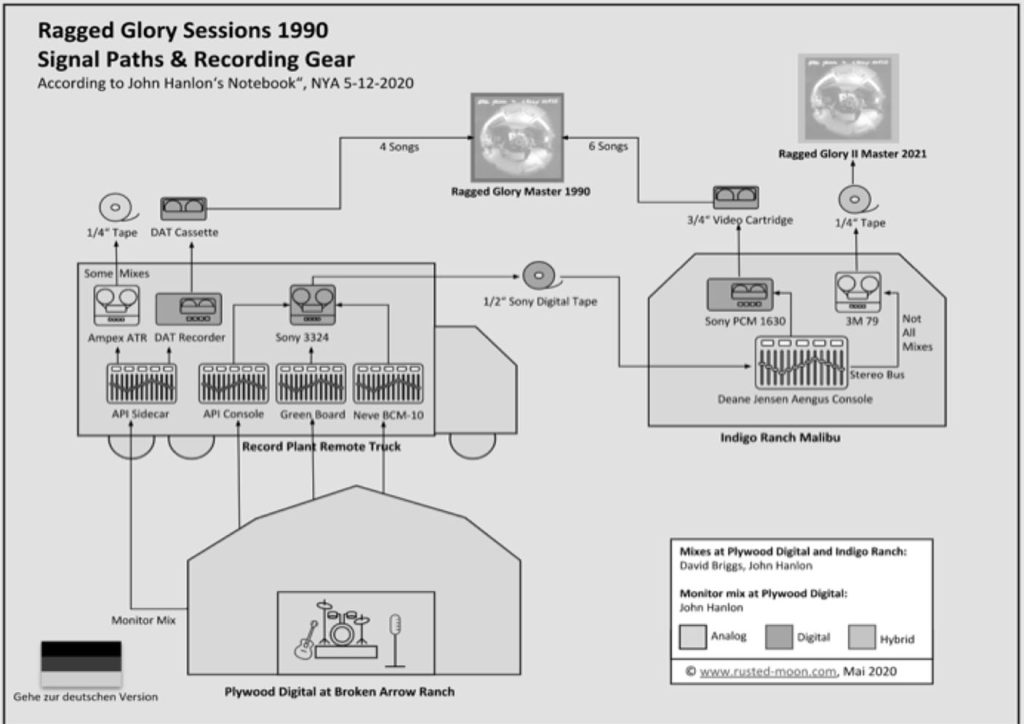
When David Briggs, Neil and I mixed this album at Indigo Ranch in July of 1990 we employed a hybrid situation for mixing. That being, we captured the analog console stereo buss to two separate places. One, an Apogee first generation two channel A/D converter that then sent the newly encoded digital 44.1k sample rate/16 bit mix to a Sony BVU helical head recorder, and most importantly for this project – also to a 1/4″Ampex ATR analog two track tape machine.
We spot checked the analog mixes off of the 1/4″ every now and then but the 1990 mastered album came from the 44.1k/16b digital for both the CD and later that year or the next – the vinyl as well. One has to remember that vinyl was on its way out the door back in 1990 in favor of the CD format. Vinyl then was an afterthought, at least in rock ‘n roll.
Yes, the multi-track Sony 3324 tape machines were feeding their 24 channel audio through their onboard D/A converters via XLR analog snakes to the Indigo Aengus console inputs but the record was in fact mixed in analog via the console stereo buss and only captured to digital (yet again) and to two track tape. The tape gave us a mix safety at that time in case anything happened to the digital two track master mixes.
I always had wanted to hear the tape mixes (same exact mix as the digital) as they would ensure that only the multi-tracks were a digital source. If one counts the path of the CD (or vinyl back then) the album would have been from microphone to CD in the format of A/D/A (mixing) to A/D again to the Apogee converter and CD (including vinyl) mastering.
By utilizing the analog tape mixes instead, the sound only went through one set of A/D converters (the Sony 3324 multi-tracks). Thus it is A/D/A for the new release of this Ragged Glory “Smell The Horse” album on vinyl, and now at a good signal to noise ratio by not fitting all the music on one LP disc but spread across three discs and with the extra songs we recorded then.
In addition, the Ampex tape machine has a slight low frequency head bump that helps the bottom end and sounds better. Also, the old 1990 vinyl was cut from a digital master whereas this edition is cut from the original analog edited to mirror exactly the original album content!
This is why Neil always puts the source guide on every record that is part of the NYA re- releases. One always knows what the mastering source is for the vinyl and CDs. In this case it says, “mastered from original analog tapes” and that is the truth. The source guide always indicates the master source, not the multi-track recording format.
Finally, the songs that were the DAT mixes on the original album had the Record Plant remote truck 1/4″ tapes that also got generated at the same time with the truck DAT mixes. Same mix, and that is what i remember. That’s my story and i’m sticking to it, but the brain memory does fade with time!
John Hanlon
Analog Originals
Neil has embarked on a new concept of re-addressing all of the albums in his body of work to focus on original recordings that were captured on analog multitrack masters initially. Ones that went to digital for speed of editing, that now can stay analog throughout the entire process from mixing to mastering vinyl. ALL ANALOG! Warts and all, to retain the original analog sound quality.
This is something that could yield incredible sonic results as we are going to look at all the records that were first recorded onto analog tape and then, at the time of the dawn of digital with its enhanced editing, because of the desire to edit entire sections of songs and manipulate the sound to our hearts content, we went immediately to digital from that first studio analog multitrack performance.
This was usually done so that the creative process of editing and overdubbing didn’t get bogged down by having musicians have to wait, instead of being creative in the moment when the song and their musical ideas are still fresh. In the past, editing would be done old school with a razor blade and thus musicians were left waiting on engineers and the laborious time consuming process. There’s always a trade off. The magical analog sound quality suffered with digital editing.
THE COLORADO SESSIONS: Part One
The call came in about two weeks before the end of March.
Neil said, “let’s record in Colorado in a couple of weeks to work around the next full moon. Just some overdubs on several songs I did solo acoustic on the road. Just me by myself, I’ll play the added instruments.”
Well, well. That soon changed to be, “We’ll have Billy (Talbot) overdub some bass.” Then additional instruments were ordered and then… “Hey, John… Can we get Jeff Pinn (our tech) to come up and set up the Green Board (UA 12 channel tube console) and the Studer 8 track 2” tape machine and go analog all the way?” And that’s never really a question but more of a request that one wants to fulfill because as usual, Neil is onto to something and I stopped trying to figure out what – a long time ago cuz it’s usually a great ride and you want to be on it when it starts.
So, Jeff was not available and I thought I was off the hook for all the analog gear staging, but then Neil said he’s got the “The Horse” coming in – which is all of the band Crazy Horse, so we were now a “GO” on all things recording full analog including the Neve BCM-10 and Baby Neve consoles as well as the UA “Green” board and 8 track machine and full digital ProTools. Whenever possible, it is always best to record Crazy Horse on eight track or less because their best records were done that way and as the saying goes,”If it works, don’t fix it”. Putting the pressure on the band and me to “Be great, or be gone”… never hurts and makes it a challenge; always more exciting and you are more alive in the process.
It also sounds amazing! And there is one simple reason for that regardless of analog, digital, sample rate, bit depth or anything else, because there is less electronics and less circuitry, less microphones, and more sound, period!
And that makes for better music. Why I got into this craft a long time ago….
In an historical silver mining town in the San Juan Mountains and we were going to do some musical mining of our own on the mesa above the long valley and box canyon the town is located in.
None of us had ever worked before at this studio above Telluride so it would be an experience. Not to mention that we would be at approximately 9,200 feet above sea level. The air is a little thin at that elevation and you have to acclimate. And that takes time. So I drove in from the California coast with my own gear and spent three days getting there, in order to do just that, acclimate, prior to load in and setup.
In a sense I had to build a studio within a studio to accommodate all the additional recording gear along with space to set up all the instruments. And there were a lot of them. If there is an instrument in the studio – it has to be able to be recorded and that gets a little tricky when the mandate is to record the basic track in an eight track format and setup. Some instruments can go to additional overdub tracks on the digital machine but the core eight tracks are important to not deviate from. Without our technician, yours truly would be swapping the 16 track heads for the 8 track headstack to go on the Studer analog machine. I also brought along Neil’s Ampex ATR 2 track tape machine for mixes or for real tape slap effects on the mixes. Aligning analog gear is another entirely different endeavor and luckily for me – everything worked. It didn’t hurt that my previous career was as a studio electronics maintenance technician. It’s like riding a bike, it comes back fast when you get back on, cuz you have to take that ride.
Before Neil had first mentioned recording with his gear, I had Jeff Pinn and John Hausmann prep and check out all the consoles in LA – just in case the equipment would ever end up in Colorado for sessions in the future. That decision paid off big time and was fortuitous. Once we got everything into the Studio In The Clouds above Telluride all the electronics were re-seated and equipment powered up with a fire extinguisher nearby, just in case. The band loaded in and three days after driving up the long snowy rutted and icey access road with our first load we were ready to record.
Steve Drymalski the production manager made all of the load-in smooth and logistics possible and Neil’s longtime guitar and keyboard techs – Kurt Kasinoff and Bob Rice respectively, attended to all things musical instrument setup wise whilst I dealt with the control room with Lynn Peterson the studio manager along with his assistant Greg Naylor. Our digital engineer extraordinaire Dana Nielsen edited his brains out for Neil on the tracks as they were recorded and Philip Broussard manned the eight track tape machine and the PA. Always a fun job….not.
Briggs once offered me the monitor mixing job back during the “Unplugged” album. I looked at him and said, “You must really be pissed off at me”. He just laughed, and said “just kidding – you don’t want that gig with Neil”. A recipe for disaster could be lurking in the kitchen.
My next article will talk about the recordings as the weeks unfolded. No days off until the “Horse” rides out of town.
John “Senior Chief” Hanlon
THE COLORADO SESSIONS: Part Two
Nils Lofgren came to Crazy Horse, returning to the band after 40 years. One never really leaves this band. They are brothers for life. There is also something very special to see a life reunion of sorts. The last time I had worked with Billy and Ralph was in 2012 as we finished up Americana and Psychedelic Pill at Broken Arrow Ranch.
Recording sessions started the second week of April high in the Colorado Rockies. We started gradually by adding Crazy Horse onto existing live performances of a few songs Neil had recorded live during a solo tour just prior to the session. This was a method rarely undertaken as it requires having Neil, Ralph, Billy and Nils perform live to an existing piano/vocal or acoustic guitar/vocal track- not normally a scenario that Crazy Horse would find itself in. But it worked out great. Neil, Billy, Ralph and Nils recorded live, playing along with ‘live Neil’ as he came over the PA in the room and headphones.
This recording process was employed for the first three songs in as many days.
Neil had eleven new songs and that meant the possibility of recording full live band tracks of at least eight new ones beyond these.
Nils had played on and off with Neil since After The Gold Rush, Tonight’s the Night, Trans, and toured with him. Nils is a natural, an original member, replacing Danny Whitten after his untimley death.
This initial recording process, dubbing on solo live tracks, also served well to warm everyone up to the studio and to the thin air at 9,200’ of elevation, which was ready made for a challenge.
Musicians need to hang out and acclimate but they also want to get to playing music and recording sooner than later. No one wants to wait just to get used to the altitude so the Horse was chomping at the bit to record, and record they did. We were cutting live tracks on the fourth day in the studio.
Prior to playing, one of the things Neil worked on was his guitar tone. His sound now is more direct than on previous records with the Horse after 1975. He had by-passed his effects system so it hews more closely in tone to what he recorded on Everybody Knows This Is Nowhere some 50 years ago. Same guitar -same amp.
We had a PA set up for Neil to sing live on the tracks. David Briggs called it “group art” for a reason. Who the hell wants to overdub vocals, staring through the control room glass looking at an engineer? A Pop record can benefit from this vocal recording technique but rarely does a Rock ‘N Roll band. Besides, Sinatra, Elvis and Dylan recorded live vocals with the orchestra and band respectively and it didn’t hurt them, so again, if it works – don’t fix it. We are just louder. There are no rules, just preferences.
Besides, it’s all the risks and pushing oneself as part of the ensemble and the give and take that makes it great or terrible. So, rarely does one find one’s self straddling the middle ground of mediocrity when one records this way. But a method easy to record – it is not. The PA technique is basically to turn it up in the room until it feeds back and then turn it down – slightly. The problem is there are a lot of really good condenser microphones set up and it doesn’t take much to get feedback into everything. You are on the edge.
When we started recording the full band live with Neil, the first song was tracked with him on acoustic guitar and Nils on the piano along with Billy and Ralph, the rhythm section. They nailed the first take. We then got another song cut also with Neil on acoustic guitar and Nils on organ, again the first take. Saturday found more editing and chorus vocals going down. Crazy Horse has usually added vocal choruses after the original cut. That’s a big part of their sound. From that point on out the band instrumentation was classic drums, bass and two electric guitars with Ralph, Billy, Neil and Nils!
By Sunday evening, the band had three more new songs, following their time-honored method. We had now established a rhythm to the recording process. At the end of recording Wednesday we had finished tracking and adding parts to two more. Much editing and mixing was undertaken. Thursday yielded the last two new songs. We would circle back to previous work until the content felt natural in its flow in terms of editing.
Most of these band tracks were first or second takes. If they have to record two more takes it’s often wasted time, but you don’t know it until you come back and listen with fresh ears an hour or so later. One can’t see the mountain without the valley. It is all part of the process of discovery, and you can never know until you listen back. Briggs taught me something a long time ago, “If it’s worth recording, it’s worth listening to”, even when you think you’re right about a previous take, sometimes you just have be patient and make a mental note to re-listen to an earlier or later track and keep it to yourself until the timing is right to have the band re-visit the listening. It’s real important not to interrupt their creative flow if they’re into playing.
By Friday we were circling the wagons and had spent most of the day editing and mixing and recording a lot of chorus vocals for the last song we tracked.. All along we were doing mixes every day in order to capture the moment, because that moment is always the basis for what we end up with down the road.
We had been recording all of eleven days and nights without any time off.
Better to keep the foot on the gas and not lose momentum. To say that everyone was focused would be an understatement.
Saturday after the crew and I packed up the gear, we decamped to Daryl and Neil’s home for a great dinner and playback session lasting well into the evening, finally watching the alpen-glow as ‘Rainbow of Colors’, a new song, resonated amongst us all. Sunday saw us all riding out to different destinations, marking an end to this great chapter together.
The fruits of our labor will be out this fall as the new Neil Young – Crazy Horse album. Listen loud!
Mastering the LP, Songs for Judy
There is something magical about dropping the needle on a record. It draws you into a listening experience that cannot be captured in the playback of any other form or medium of music. Be it CD, an I-Phone, laptop computer, with or without earbuds, even a cassette tape for those old enough to know, it all pales next to playing an LP vinyl record. You actually have to do something and drop a tone-arm and cartridge onto the lead in groove, preferably without screwing yourself and sending it flying across the disc. The quiet thump one hears and feels when having successfully mastered the mating of stylus to grooved plastic is a glory to behold. It never gets old. It signifies the start of a musical experience that engages you in a way that no other can. You actually have to sit and listen. The record demands it.
This is especially rewarding when the music emanating from the near field speakers has something special to convey.
This is exactly the case with Neil’s new album ‘Songs for Judy’ that I am evaluating. I have been listening to the reference lacquers of our mastering work at Bernie Grundman Mastering in Hollywood as captured by Chris Bellman in the cutting room. Tim Mulligan, Neil’s longtime mastering engineer had already mastered this collection of 23 songs that had been recorded during Neil’s solo tour in November of 1976. Most of these songs came originally from Joel Bernstein’s audio cassette recordings in the hall as Neil performed with just an acoustic guitar, piano or banjo. Occasionally a 12-string guitar or Stringman synthesizer would make an appearance.
Tim did all of his work in the digital domain at a sample rate of 176.4K and a word depth of 24 bits after converting the analog cassette tapes to digital for assembly, audience crossfades, level matching etc.
My and Chris’s job was to get it from Tim’s digital files to four sides of vinyl and not get in the way by “fixing” things or smoothing the rawness out of the music recordings as is so oft the case in today’s world of cutting edge digital crap. Don’t get me wrong, digital is great, but for me it’s a tool to be taken advantage of and a means to an end result, not the ends itself, especially with the making of vinyl records. In mastering for the vinyl, we use Lavry DB gold converters that are modified insofar as the power supply circuitry by Beno May the chief engineer and tech at Grundman’s. Nothing, absolutely nothing, is stock. The mastering consoles are all analog. They sound better and it sounds musical, period.
The vinyl we cut in that room has an analog path derived from the output of the Lavry D/A converter through the analog mastering console and on out to the lathe. When my source is an actual analog tape, the vinyl reference lacquer is cut from a purely analog path. It never goes to digital. That said, I usually do a test mastering from the tape through an A/D converter so I can experiment with song gaps, levels, EQ if necessary without playing the master tape needlessly. Once my decisions are final after listening at home or with Neil, then I go back in and cut that EQ, level changes and add or subtract leader from the tapes as needed to accommodate my notes from the hi-res digital playback for mastering evaluation, in order to then cut the reference lacquers only once.
Sibilance from the lead vocal can cause distortion on the record that would not be present on the digital CD or hi-res digital audio on the timeline. On this record there were several places where Chris had to employ a de-esser in the audio chain but it’s only introduced for the areas that need it. Otherwise it is hard bypassed.
The ‘Songs for Judy’ album is a double album, with four sides of audio. I approved the reference lacquers of this knowing that since I listened, Tim Mulligan found two songs with a mic stand hit by Neil during the recordings when he re-proofed the files he had sent me. We will replace Tim’s digitally fixed files into the cutting session source when the Master lacquers are cut to be delivered to the plant. The rest of Chris Bellman’s previous EQ and level changes will carry across seamlessly since Tim was working in digital and files are exactly the same except for the several frame fixes.
After that, the plant will send me test pressings of the album. It is then that I will get to hear how well that LP was manufactured. I will have Chris Bellman’s reference lacquers to compare to in order to troubleshoot the source to be corrected if there is any problem or discrepancy found. The quality should be identical if the vinyl itself is clean. The master lacquers that Grundman’s sends to the plant are the same type that I get when we master onto the lathe in the cutting room initially. Mine will be played, whereas the ones sent to the pressing plant will go right into plating. After I approve the test pressings the record will go into production and you will all get to hear what I experienced as well.
Long live vinyl and good listening!
Senior Chief
Out Of The Fire : Mastering the LP Odeon Budokan
Dear readers,
Apologies for not lending an ear to your queries earlier but there has been a tear in the fabric at ye old homestead. I am reporting post fire from Malibu.
The act of staying with one’s house and home through the apocalyptic fires that raged here three weeks ago tonight was unsettling at the least.
Suffice it to say, I saved my house, or, it was spared by the capricious nature of this beast that roared out of the northern parts of this Los Angeles County that the Native Americans so aptly called “Valley of Many Smokes”. And I don’t think they were referring to personal use. Now to the business at hand.
Progress is being made on mastering the Odeon Budokan album for vinyl from the original ¼” mix tapes. This is one of Mr. Briggs conceptualized records, pulled together in 1976 from the Neil Young & Crazy Horse tour of the Orient and Europe, comprised of concerts at Odeon Hammersmith in London and Budokan Hall in Tokyo Japan from March of that year.
We also have the Tim Mulligan mastered hi-res digital of this album at 176/24 of the project that will possibly be utilized for the NYA website timeline.
We always listen and determine whether the website digital audio sounds better coming straight from Mr. Mulligan’s digital mastering, so it would be D-D whereas the vinyl might or might not sound better coming A-A directly mastered in Analog from the master tapes. Every project is different.
There is no formula as to formats being digital or analog in terms of mix sources. We use the best we have always. We leave no stone unturned unless it weighs several tons, meaning if there is a tremendous amount of editing to be done or there are second and third generation master tape copies that are worn out and suffering sonically, or a given project was never really assembled in a viable analog domain – only then do we decide which to master from in terms of a given release format such as vinyl records, CDs, hi-res digital for streaming etc.
Each different release format, along with the project audio source, can dictate how we choose.
The vinyl can be mastered from digital 192/24, 176.4/24, even 44.1/24 as in the case of Deadman and 44.1/16 for Harvest Moon. That’s obviously because they were the only mix masters that existed for those particular two albums. That is just one example.
There will be many more as all Neil’s catalog gets re-released for vinyl as well as higher resolution digital down the road.
Next up is Tuscaloosa, (under the radar monster) a previously and only partially mined album project from early in the 1973 Time Fades Away tour of the US by Neil & The Stray Gators. . . . .It’s a “good un” as John Lee Hooker would say. “Pots on, gas on high” as he also wrote in one of his songs. ‘Tuscaloosa’ was a particularly potent lineup of great musicians at the zenith of their brotherhood. Ben Keith, Jack Nitzsche, Tim Drummond, Kenny Buttrey and Neil.
More to report here soon, as we undertake mixing from the original master 2” analog 16 track tapes and review in Colorado during the next several weeks.
John Hanlon
LONG MAY YOU RUN
Hi there,
First of all, I wanted to write how amazing the NYA is, and how it is a really great thing for Neil’s music lovers like myself and others.
My question is: Why albums like “4 Way Street” and “Long May You Run”, which were recorded on analog tapes (I assume), only get CD audio quality (16Bit/44kHz) and not higher audio quality, on NYA?
Thanks again for all your effort,
Eran Raz
Hi Eran,
Good catch on your part. I missed this one on the hi-res 192/24 delivery from the mastering house to the record company in December of 2016.
The “Long May You Run” album had been cut for vinyl from the original master analog tapes earlier in the fall of 2016. Neil decided to add this album to his third boxed set of ORS (Original Release Series) albums comprised of American Stars ‘N Bars, Comes A Time, Rust Never Sleeps and Live Rust so that set would in fact be a five album boxed set with Long May You Run leading the pack as they are the next albums in chronological order after the second set ending with Zuma.
The CD masters were cut and delivered next – also mastered directly from the analog tapes. However the hi-res 192/24 on three of the albums and American Stars ‘N Bars in 176.4/24 had been delivered in October 2014 for Pono hi-res releases from Warner Brothers Records to offer the first 12 albums of Neil’s catalog in hi-res digital audio to be available for the Pono Player at that time.
This work had been done by Tim Mulligan at Redwood Digital back in that period. That same audio has since been made available to the NYA website for streaming and downloads.
The hi-res 192/24 audio of Long May You Run had not been formed when the original first 12 Neil Young albums had been delivered as that title hadn’t been remastered or offered in anything but the original CD format of 44.1/16 currently in print at WBR. When I remastered that album I cut a 192/24 digital file at Grundman Mastering in Hollywood and since that was late December of 2016, it fell through the cracks. I must have been thinking about a Christmas turkey dinner instead! I knew we already had hi-res digital audio available on all the other titles from several years prior. Thanks for bringing this to our attention.
Since your letter, I have directed Grundman’s to get the hi-res files to WBR and subsequently to the company that uploads the hi-res audio for Neil’s NYA website. It should be up, and will replace the CD quality 44.1/16 audio, in several days.
SC