
By Joel Gouveia
How skip culture, the 30-second rule, and your 15-second attention span killed the greatest art form in modern music.
The 45-Minute Ritual
I remember the smell of the plastic wrap.
There was a specific, tactile ritual to coming home from the record store. You’d crack the seal, pop the tray, and press play. Then, you’d do something that feels like an extreme sport in 2026: you’d sit still.
I used to have a yellow legal pad where I’d sketch out my favourite track numbers as they played. I was circling the highs, and making a mental blueprint of the “skip-less” runs. It was the first iteration of a playlist, I suppose, but it was anchored to a single, cohesive vision. I’d decide to clean my entire room just because the album was 45 minutes long and I wanted to stay in that world until the final track faded into static.
Back then you didn’t really listen to songs – you listened to the full project. Sometimes there were skits, interludes, minutes of silence or ambient background noise. But it was collectively a part of the listening experience.
Today, that ritual is extinct. The Album – the definitive 45-minute contract between two souls — is being dismantled, piece by piece, dissolved into an Algorithm of the Immediate that has no memory and no mercy. We’ve traded the 45-minute immersion for a 15-second “moment,” and the cost is higher than any monthly premium subscription.
The primary reason albums are ceasing to exist is simple: they are being taught to please the machine. Every industry expert I’ve sat with in the last decade has confirmed the same terrifying calculation. Spotify has rewritten the definition of a musical “Body of Work” by making its financial success entirely conditional on transience and brevity.

The 30-Second Rule
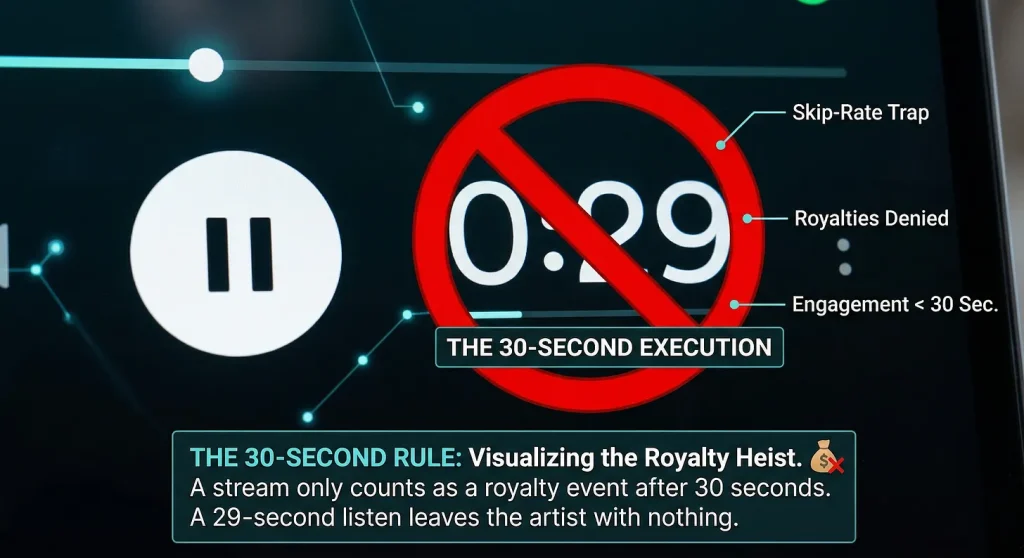
Spotify has weaponized the first thirty seconds of a song to the point of creative strangulation.
In the current “Pro-Rata” payout model, a stream only counts as a royalty event if it passes the 30-second mark. If a listener skips at 29 seconds, the artist gets $0, but Spotify still collects the data. This has created a “Skip-Rate Economy” that is murdering the album’s pacing. Skip rates on the platform average 24% within the first five seconds and nearly 50% before the song even ends.
The result is a culture of front-loading. The “slow-burn” intro is dead. The atmospheric track 1 – the one that sets the mood for the LP – is now considered a financial liability. If the listener doesn’t get a hook in the first 10 seconds, the algorithm flags the song as “low engagement” and buries the entire project. We aren’t writing full songs anymore; we’re writing for the 31st second. We’ve replaced the narrative arc with a desperate grab for attention.
The Dopamine Deficit
If you asked a pre-teen today to sit through a 45-minute concept album, they’d look at you like you were asking them to read the dictionary in a single sitting. It’s not even a lack of curiosity; it’s more of a neurological heist. Our youth are the new high-velocity junkies, twitching for a micro-hit of instant gratification because the alternative is a silence they’ve never been taught to inhabit.
Social media is the new smoking, except the pack is glued to their palms and the smoke is their own identity. We’ve raised a generation that doesn’t just use these platforms; they belong to them. They are crackheads for the flicker of the scroll, and music has had to mutate just to keep up with the shakes.
We’ve traded the story for the stimulus.
In a measurable race to the bottom, the data confirms an accelerating, technical collapse of song length.
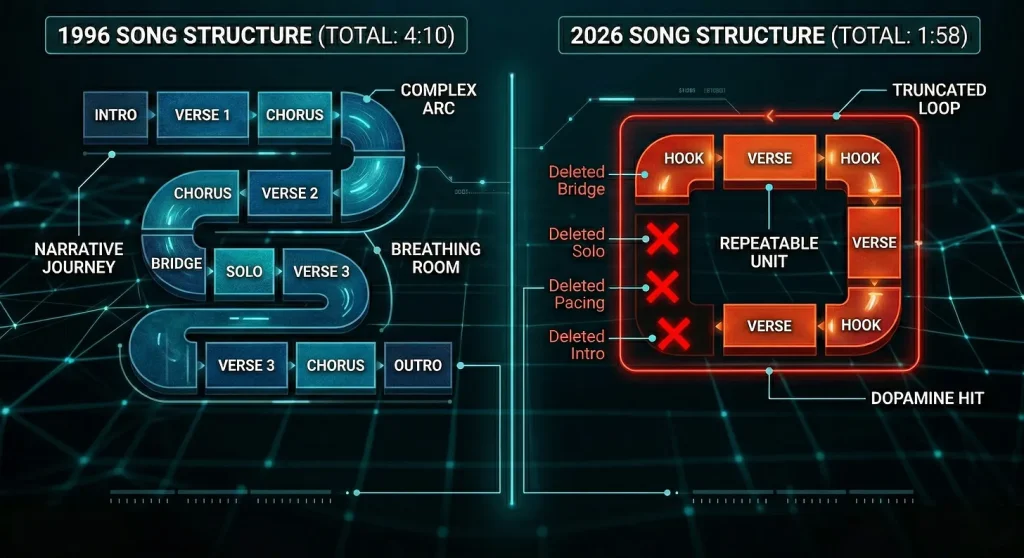
A study by researchers at the University of East Anglia analyzed Billboard Hot 100 hits from 1990 to 2019. They found that the average song length had plummeted by nearly 50 seconds, from 4:10 to 3:20. The numbers in 2026 are getting grim, pushing hard toward the two-minute ceiling. Hits are now clocking in at 1:58. Stripped of bridges, stripped of solos, and stripped of any musical breathing room.
The math is cynical, but makes total sense: if a song is under two-and-a-half minutes, a kid is three times more likely to loop it. It’s a hack. Artists aren’t being told to write songs to tell a story; they’re being told to write “Repeatable Units” to game the stream count. We’ve optimized for the replay button, and in the process, we have deleted the bridge – the very part of the song designed to provide a new perspective – and replaced it with a hallway that leads back to the beginning. We just stay in the same room until the algorithm decides it’s time to move on.
The Waterfall Release
Artists aren’t building trying to build legacies through recorded music anymore. They’re maintaining a streak like a teenager on Snapchat.
The album drop with no singles used to be a cultural event. Today, music execs and A&Rs look at it as an inefficient waste of money. The modern LP has ceased to be a cohesive project; it is now a content graveyard where labels bury tracks that failed to go viral.
Labels have moved to the “Waterfall Release” model – dropping a single every four to six weeks like a slow-drip IV. If you drop a full 12-song album all at once in 2026, the Spotify algorithm treats it like a one-night stand. It looks at the project as a singular moment in time.
But if you feed it a single every month? It recognizes you as a consistent contributor and rewards you for feeding the machine.
By releasing 12 songs over 12 months, the artist has 12 distinct chances to land on “New Music Friday” or “Release Radar.” They maximize the algorithm’s “Fresh Upload” signal rather than its narrative signal.
The tech is literally holding the art hostage. “If you feed me, I’ll be nice to you.”
Why spend two years crafting a narrative arc when the algorithm is hungry for a fresh upload every 14 days? We’ve optimized for the loop, and in the process, we’ve deleted the soul of the LP.
The Great Compression

The concept of the album is dying because convenience has murdered complexity. We have replaced Love with Association.
Back in the CD days, you still had to commit. You had to physically walk to the record store. You had to physically change the disc. You had to navigate the “boring” parts, the weird transitions, and the experimental B-sides to get to the payoff. That friction is exactly what created the bond. It’s what created obsession. You didn’t just like the song; you respected the journey because you were required to take it. Today, we blindly add a catchy hook to a playlist and follow a sexy thumbnail.
The irony of 2026 is that while Vinyl sales have hit their highest peak since 1991, the vast majority of us are still consuming the “Fast Food” version of the file. Spotify’s audio quality is a technological failure. Even with every quality setting maxed out, you are capped at 320kbps—a messy format that strips the “air” and the gravity out of a recording. It is a shadow of the 1,411kbps lossless streams offered by Tidal or Apple Music. Yet we accept the blur just because it’s easier.
You Can’t Fall in Love with a Micro-Dose
Here is the heartbreak at the centre of the scroll: I see a world where it is becoming biologically impossible to fall in love with an artist.
We are drowning in a sea of perpetual noise, where decision fatigue has replaced discovery. The average person is now exposed to anywhere from 4,000 to 10,000 digital brand impressions every single day. In that blizzard, how do you find a soulmate? You used to have three or five favourite bands that were your identity, housed in a beat-up binder of ripped CDs. That wasn’t just a collection; that was you. Now, we have a revolving door of temporary fascinations.
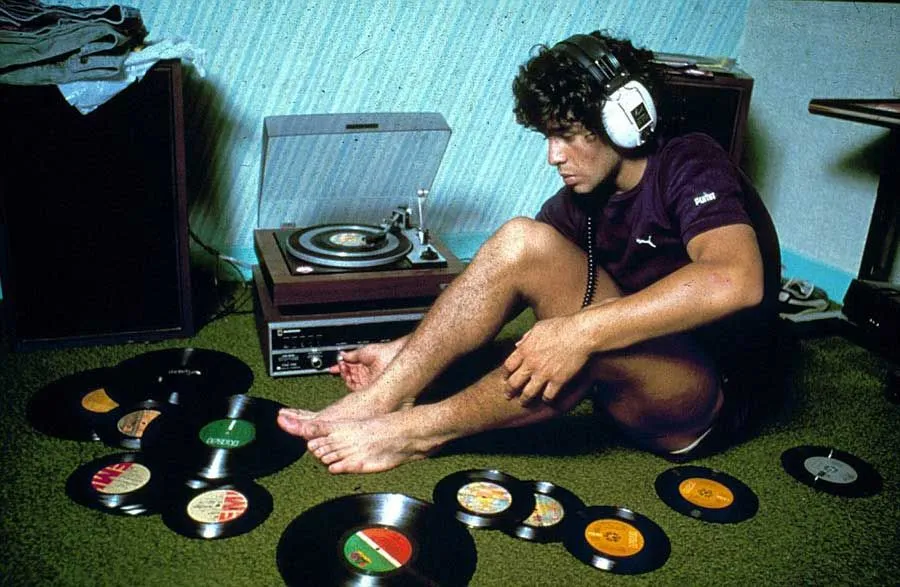
Love requires a High-Fidelity Commitment, and commitment requires Duration. You cannot fall in love with a piece of work that only lasts 1:58. An album used to be an invitation to occupy someone else’s headspace for forty-five minutes. You stayed in the room until you understood the furniture.
But when you strip a song of its bridge and cut it down to a “Repeatable Unit,” you aren’t making art anymore. You’re making a Sonic Snack. You consume it, you get your hit, and you throw the wrapper away. You don’t build a legacy on a snack.
We’ve traded the friction of the needle for the addiction of the scroll. And I’m not sure we’re ever getting that 45-minute ritual back.
The Biological Rebellion
The platforms aren’t going to save us. They are in the business of attention harvesting, not nourishment. Expecting Spotify to protect depth is like asking a slot machine for a conversation.
The correction is coming from a biological rebellion. It’s why we’ve seen the massive migration to Substack and the rise of the three-hour podcast. We are gravitating toward long-form spaces because authenticity cannot be faked in the deep-dive. You can manufacture a fifteen-second “vibe” in an afternoon, but you can’t manufacture a forty-minute truth. Substance only reveals itself when the clock is running.
It is a quiet, violent craving for a meal in a world of digital appetizers.
The industry tried to turn music into a background frequency. But most of us aren’t looking for a soundtrack to our scroll. We’re looking for a world to live in.
NYA Thanks The Artist Economy!