Because he fears he can’t prevail any other way
BY DAN RATHER AND TEAM STEADY
At his ill-conceived midterm convention in Dallas, Trump told the assembled sycophants to “cheat like hell” in the coming election.
With that in mind, we remind ourselves that we are now five weeks out from what is arguably this country’s most important midterm election since 1866 at the end of the Civil War. The level of engagement and enthusiasm being shown by American voters for this current election is heartening. But with engagement comes a tidal wave of information and propaganda — so much so that it’s increasingly difficult to tell the difference between the two.
A lot of what is sold as news regarding this election is disinformation with a capital D. And this “news” is reaching the president, who then amplifies the lies and legitimizes nonsense.
Donald Trump has made no secret of his distrust of American elections. To clarify, he distrusts American elections when he or his party lose. He is fine with the ones they win.
The president has discovered that sowing concern about election integrity is a great way to scare the electorate. The best and only way to combat his deceptions is to vote.
It is worth saying again, for emphasis: American elections are safe. No one, not the president, not his lawyers, not his posse of MAGA election deniers, has ever produced evidence of anything close to significant fraud. This country’s elections have consistently proven to be among the most dependable in the world for honest results.
Also, for clarity’s sake, the election clause of the U.S. Constitution unambiguously gives the power to run elections to the states. As in: “The Times, Places and Manner of holding Elections for Senators and Representatives, shall be prescribed in each State by the Legislature thereof; […].”
Marc Elias, one of the country’s foremost election attorneys, explained the president’s scheme to win the midterms in one succinct sentence: “Donald Trump’s plan is to make it harder for you to vote and easier for him to cheat.”
That might explain why he has barely lifted a finger to help Republicans in Congress running for election — because he may think he doesn’t need to.
The president is not subverting democracy alone; many of the loudest voices egging him along are coming from outside the White House. Earlier this month, a group of anti-voting activists and election deniers met for a three-day conference in Las Vegas dubbed the “Storm Summit.” Notable speakers included three people who have the president’s ear but no official government role and are widely accused of spreading lies and conspiracies.
Peter Ticktin is a private attorney who went to high school with Trump. According to The Atlantic, he believes Democrats cheated in the primaries and that Trump will take action prior to the election to prevent more cheating or declare martial law on or before November 3. He also says that he believes Iran, China, and Venezuela were involved in the 2020 election.
Tina Peters is a former Colorado county clerk who was found guilty on state charges related to tampering with voting machines during the 2020 election. She was sentenced to nine years in prison. Trump, with Ticktin’s help, pushed for a pardon from the Colorado governor. She was released on June 1. At the convention, she made an appeal directly to the president: “Listen to the people outside of the administration.”
Wayne Allyn Root is a far-right radio host and author. He emails his weekly opinion columns directly to Trump, who often posts them on social media. According to The Atlantic, Root received a standing ovation at the conference when he said the election could be turned if Trump declares a national emergency.
Is the president plotting something around Election Day? Unknown, but he’s certainly not disavowing the idea.
There has been much talk and hand-wringing about whether Trump will declare a national emergency or martial law. Can he do it? Many political and legal scholars say probably not. Even if he attempted either declaration, it is not clear that it would be effective.
A president can declare a national emergency, but it only gives him certain limited powers. None would give Trump control of elections, but declaring one could create considerable chaos, especially if he ordered the military to enforce it.
“There seems to be a wild misperception on the part of some Trump allies that an emergency declaration allows the president to do anything he wants. It is not a blank check,” Elizabeth Goitein, a senior director of the Brennan Center for Justice’s Liberty and National Security Program, told The Atlantic.
Martial law is different from a national emergency. Martial law is the displacement of civilian authorities by the military. It has been enacted 68 times in American history, perhaps most famously in Hawaii after the attack on Pearl Harbor. There is no mention of it in the Constitution. Congress has passed no laws to define it, and the Supreme Court’s few rulings on it have been vague.
While martial law may be a nebulous legal concept, it is clear that the president lacks the authority to declare it. And even if he could, it is illegal to deploy federal troops to the polls. It is considered a form of voter intimidation.
Acts such as a national emergency and/or martial law might be, at other times, considered too far-fetched and too nightmarish to seriously consider. But these are not ordinary times, as we have been reminded by Trump in recent years. So it is not unreasonable to discuss and be alert to the dangers such acts represent.
While Homeland Security Secretary Markwayne Mullin and Dan Caine, Chairman of the Joint Chiefs, both said there are no plans to forcibly take over the elections from the states, Trump is notorious for acting without consulting his cabinet or advisers.
Since Day One of his second term, Trump has expended much energy subverting trust in our elections, either by official acts or by the spreading of disinformation. And if eroding public trust doesn’t work, he is experimenting with other ways to rig the system.
- One of his first official acts was to pardon the January 6 insurrectionists, who tried to disrupt the certification of a free and fair election.
- He has demanded that every state hand over its voter rolls to the federal government. Eleven have complied. The other 39 have not, many going to court to prevent it. The Trump administration has lost every case, 21 times and counting.
- At every opportunity, Trump claims he won the 2020 elections, perpetuating a blatant, unsupported lie.
- He threatened to prosecute every election official who had a hand in running the 2020 elections.
- He pressured states to redraw their congressional maps in favor of Republicans, thinking it would net them between 12 and 14 seats. With political winds shifting, that number is now likely down to four or five.
- He has repeatedly tried to get the SAVE America Act through Congress. The voter suppression bill would make it hard for many Americans to register to vote and cast a ballot. It would also restrict mail-in voting. So far, Congress has failed to pass it.
Many states have passed laws to thwart Trump’s attempts. Earlier this month, California Governor Gavin Newsom signed new laws to prevent the president from exerting “dictatorial control” over elections.
In a press release, Newsom said, “We have no bigger task than fighting to protect the right to vote from interference and meddling — the future of democracy is on the line.”
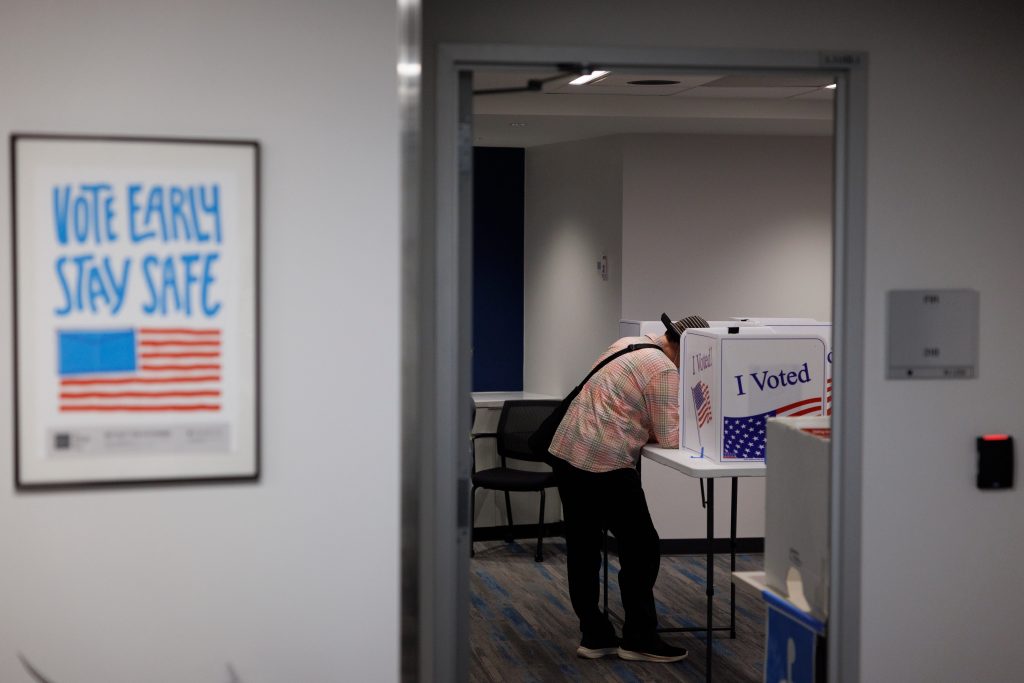
It is imperative that every American of voting age understands the rules for registering to vote and casting a ballot in their state. To that end, here again is a voter checklist. Vote early if your state allows it. Vote in person if you are able.
Make a plan to vote and do it now. The nonpartisan, nonprofit Vote411 offers all the tools to make planning easy.
- Register to vote. Click here to register in your state.
- If you are registered, check your registration so that, if there is an issue, you have time to fix it.
- Find out what voting options are available in your state.
- Can you vote early?
- Can you vote by mail? (Vote by mail if you must, but voting in person is preferred – especially this year when Trump is trying to create chaos with mail-in ballots)
- When do polls open and close?
- Where is your polling place?
- Once you have decided how you will vote in person, figure out how to get to the polls. There are many organizations that provide free rides, like RideShare2Vote.
- If you encounter a problem when voting, you can reach out to the Election Protection Coalition or call their hotline at 866-OUR-VOTE or 866-687-8683.
- If you want to do even more, consider becoming a poll worker to help safeguard our elections.
It cannot be said often enough: Every vote counts and vote like your democracy depends on it, because it does.
This month we are donating $10 to the Committee to Protect Journalists for every new annual subscription to Steady. As of today, we will be sending more than $11,300 to CPJ. This is your last chance to support both Steady and CPJ with your subscription. If you are unable to become a paid subscriber, we understand and are committed to providing our content free of charge.
No matter how you subscribe, I thank you for reading.
Stay Steady,
Dan
NYA Thanks Dan Rather and Team Steady!