
 The GOP’s Epic Fail
The master plan for Republican domination is in danger of being Trumped
BY DAN RATHER AND TEAM STEADY
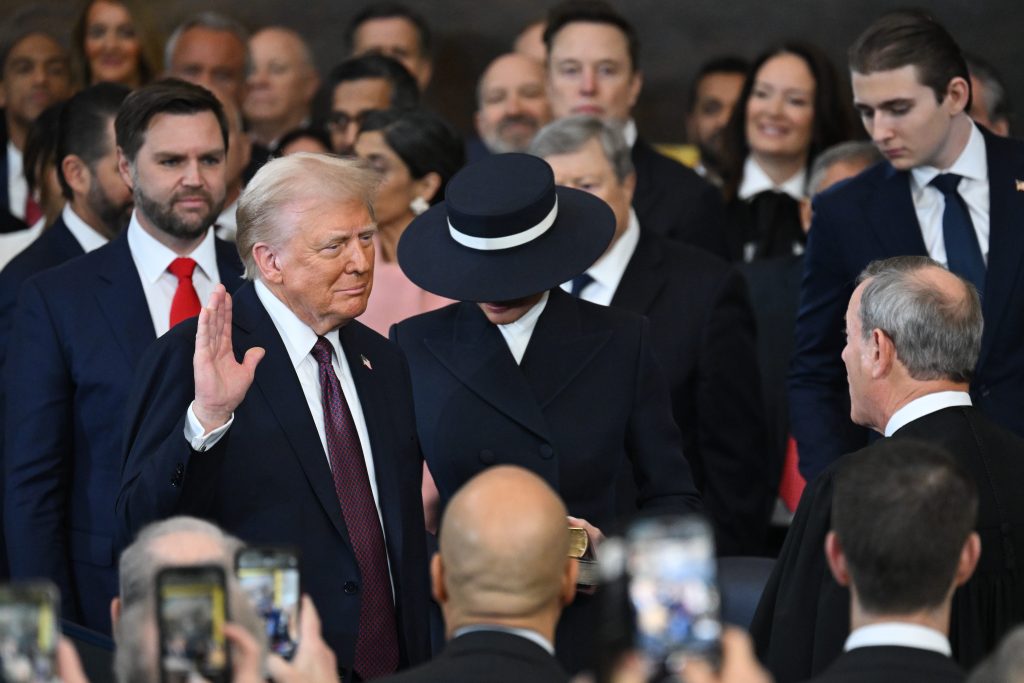
When Donald Trump was inaugurated in January 2025, he didn’t take the oath of office with his hand on a Bible. No matter. The Republican Party was rejoicing. They controlled the White House and Congress. While this confluence has occurred a few times in recent history, 2025 was different.
Along with control of the House and Senate, a Trump-stacked majority was sitting on the Supreme Court. In addition — though they would all have you believe otherwise — President Joe Biden had given them a surging economy, having successfully navigated the recovery from the Covid pandemic.
Trump has not only squandered this political bounty, but he has severely damaged much of American democracy and the Republican Party in the process.
This reporter vividly remembers when the Republican game plan for dominating American government was first hatched 60-odd years ago. It touched on power, money, and race. Trump’s ascension was the unanticipated culmination of decades of work by a party that, during his terms, has reached new lows, including embracing a corrupt insurrection.
On January 20, 2025, Republican glee could not be contained. Twenty-one months later, the Grand Old Party is whistling a different tune. Before we get to the Republicans’ buyers’ remorse, let’s recall how the party pulled off its political trifecta.
Barry Goldwater’s decisive loss to President Lyndon Johnson in the 1964 election galvanized the Republican Party’s concerted and multifaceted effort to rebrand and rehabilitate, with the goal of dominating American politics within a few decades.
The Republicans’ long game started with the “Southern Strategy,” on the heels of the passage of the Civil Rights Act and Goldwater’s loss. The GOP understood it needed to broaden its appeal beyond their traditional base, which stretched from the East to the Midwest and on to California. The South had been solidly Democratic since the Civil War.
Many conservative white Southerners, who had historically voted for Democrats, were enraged about the new Civil Rights legislation and scared that it would upend their way of life. Republicans were able to successfully exploit racism, ushering in a historic political realignment.
Nothing illustrates this more clearly than George Wallace’s third-party run for president in 1968. Wallace was the governor of Alabama, an avowed segregationist and a Democrat who famously said, “segregation now, segregation tomorrow, and segregation forever.” He carried five states in the presidential election, all in the South.
In the decades that followed, the Republican Party extended their coded racist playbook to the Rust Belt, the Sun Belt, and many “white flight” suburbs, capitalizing on white anxiety about the changing country. Republicans touted “states’ rights,” which was code for allowing Southern states to continue their racist policies.
Another prong of the GOP approach was to build new coalitions, which included libertarians, religious conservatives, and gun owners. Not exactly political bedfellows. But when Richard Nixon came to the presidency in 1969, he commanded new efforts to use race to appeal to those groups, as well as others. He often used his vice president, Spiro Agnew, as the frontman for his version of a new Republican “Southern Strategy.” It was clever and it worked.
The Republicans also built new infrastructure to support their goals with lobbying groups and think tanks like the Heritage Foundation, founded in 1973, and the Cato Institute, founded in 1977. It was Heritage that later became known for authoring Project 2025.
Conservatives dominated the burgeoning talk radio industry and eventually started Fox “News” in 1996. The GOP was the first to fundraise using direct-mail and use data to drive get-out-the-vote efforts.
They also recognized this couldn’t be a top-down effort, so they started recruiting, supporting, and funding Republicans in local and state races. This not only got their message out at the grassroots level, it gave them a pool of experienced candidates to eventually tap for higher offices.
Next on the list was to reshape the nation’s judiciary. Republicans did this by appointing strict constructionists to lower courts, thus ensuring an ideological shift in rulings and conservative judges available to become higher court jurists. This long-range strategy began with the Nixon presidency and ran through the presidencies of Ronald Reagan, both Bushes, and Trump.
All of these plans played out against the backdrop of national politics happening in real time. While Nixon set the party back when he was forced to resign in 1974, Reagan emerged soon after to lead the GOP back into political power. His celebrity and charisma, a precursor to Trump, helped win over many who were dejected by Nixon’s Watergate scandal. Reagan came across to many as a decent man with lots of common sense. But all of this and his affable demeanor didn’t preclude his use of racial dog whistles to get elected.
By challenging President Gerald Ford for the 1976 Republican nomination, Reagan laid the groundwork for his successful presidential run four years later. He beat President Jimmy Carter handily by, among other things, appealing to white, working class men. Many had high school diplomas, union cards, and jobs that didn’t cover the bills. These frustrated voters, who had long felt let down by the Democratic Party flocked to Reagan, in much the same way they flocked to Trump.
For the next two decades, while the presidency was flipping back and forth between the parties, the GOP set its sights on Congress. In 1994, they broke the 40-year Democratic stranglehold on the House, by spotlighting their party’s religious and socially conservative bona fides.
Republicans continued to win races by striking a balance between racial resentments and social issues in the guise of culture wars.
In 2004, more than half of America’s governors were Republicans and more state legislatures were in Republican hands than at any time in American history. While more people identified as Democrat than Republican, the GOP’s long game strategy was working.
Then came 2015 and the unforeseen rise and surprising success of Trump. With Trump the Republican establishment was forced to overlook decades of bad behavior, because a year later a majority of American people were willing to do so.
Trump’s populism appealed once again to working class white men, who felt left behind and left out. They were looking for a champion and believed they had found one in Trump. His racist and divisive rants, sprinkled with lie after lie, replaced the more subtle style used by his predecessors.
“Trump is the manifestation of people’s anger. People all around the country want to send Washington the bird, and they see him as the gigantic middle finger,” Haley Barbour, a former Republican National Committee chairman, told NBC News.
By 2016, Trump’s Make America Great Again movement had morphed into a seemingly unstoppable train, and the party believed it had no choice but to hitch a ride. But Trump’s first term as president was no joyride, marked by his dismal response to the pandemic, two impeachments, and his incitement of an insurrection.
It is hard to believe now that we have the full picture of his first term, but Trump was surrounded by enough people who could and would stand up to him, who would and could keep his worst tendencies in check.
He hated those obstacles. So, when he assumed the presidency a second time, he made sure those spoilsports were nowhere near the Oval Office. Only the most die-hard MAGA loyalists, who would always tell him “yes,” made it past the West Wing gates.
In his second term, Trump has destroyed norms, bucked long-held Republican convictions, and dismantled conservative tenets. Any independence the party might have had during Trump 1.0 was gone, replaced by loyalty tests and presidential retribution.
So here we are, more than five decades on from the “Southern Strategy,” and what was a winning plan for Republicans, if not America at large. The great irony of this midterm election is the disaffected white voters, whom Republicans have so long relied on, and who guaranteed Trump’s wins, are suddenly heading for the exits.
According to The New York Times, there has been an extraordinary shift of white working class voters away from Trump, mostly over his botched handling of the economy and his war with Iran.
You know what they say about the best-laid plans of mice and men… they often go awry. Because the Republican Party chose to back rather than repudiate Trump, not once but twice, it badly damaged 60 years of meticulous planning and the possibility of political domination for years to come.
Please consider supporting my team’s efforts to protect our democracy through the power of independent journalism by becoming a paid subscriber. It’s one of the best deals on Substack. I thank you for your support.
No matter how you subscribe, I thank you for reading.
Stay Steady,
Dan
NYA Thanks Dan Rather and Team Steady!