
By David Clarke
In Part 1 – Here We Are In The Years, David Clarke looked at how the Neil Young Appreciation Society was originally founded together with Paul Makos, and the very first issue of the society magazine Broken Arrow published in August 1981.
By the time the second issue of Broken Arrow Magazine was in preparation in late summer 1981, a team had been assembled. Andy Cox was now fully on board, Grahame Reed had also joined, and consequently the second issue looked a lot more polished. Other exciting things were also happening. The ‘Rust Never Sleeps’ film was due to be released in the UK. Paul, Andy and myself attended a preview screening at Blue Dolphin Film Productions in London and we then all went to see the premiere at The Screen On The Green in Islington. We had now also made the acquaintance of Angus MacSwan, a freelance journalist. He did the society a valuable service by having a small article printed in the national newspaper the Daily Mirror under a headline which said something like ‘At last a Neil Young film you can actually see’! Significantly it also included the Neil Young Appreciation Society’s phone number and this resulted in a significant number of enquiries and new members.
Grahame Reed had responded to the very first ad that appeared in the music paper New Musical Express but he agonised for 2 or 3 weeks before deciding to join. This delay meant that he ended up with membership #134.
We were luckily given permission to set up a stall at cinema venues showing the ‘Rust Never Sleeps’ film in order to hand out NYAS membership information. Paul and I did a couple of promotional stints at the Dominion Theatre in London’s Tottenham Court Road. As this was winter, however, it was not the most pleasant of tasks and did not, I believe, bring in many more new members. Andy Cox fared even worse, becoming snow- and fogbound on his journey to one of the venues. The hardships we put up with!
Angus MacSwan took over the magazine’s information page, Grahame contributed an excellent review of the film, and the second issue was published. However, in order to consolidate the new enterprise a team was set up and meetings held. The first of these was in the board room of the company division I worked for, and in these auspicious surroundings sat Paul, myself, Andy and Angus – at least as far as I remember! Further meetings were subsequently held and Alan Jenkins also attended these. Andy Cox takes the credit for introducing Alan to NYAS – a good job he did so, as will be seen later. So we were now a gang of six, comprising Paul, myself, Andy, Grahame, Alan and also Richard Hoare. Angus had now left to work in the Far East. Under this constellation, the issues of Broken Arrow up to at least number 6 were produced. Presentation and content were getting better with each issue, reflected in the increase in the number of pages as well as the quality of the articles submitted, and the greater range of editorial expertise now involved.
Around this time, Neil’s managers at Lookout Management contributed two complete sets of his albums and these were used as incentive prizes for members. Finances were still an issue, however, since it became apparent that the success of our merchandising had only temporarily shored up the general financial situation. To alleviate things as far as we thought practicable, the annual membership fee was increased from £3.50 to £4.50 – still optimistic as far as we were concerned and certainly good value for members with six issues of the magazine each year. Unfortunately, the merchandise ran into one or two supply problems, mainly with the photos and posters, and delivery had been slow on these. This eventually led to my first ‘confrontation’ with member number 90, Bry Carter – the first of many I am glad to say. It was Bry who gave Paul the soubriquet ‘kamikaze’ – due, it is alleged, to the latter’s erratic driving behaviour. I cannot endorse such a scurrilous accusation, but Paul did seem to revel in this notoriety.
Are You Ready For The Country?
With issue number 6 of Broken Arrow we would be completing our first year of operations, managing to keep to our promise of a bi-monthly format. We held a pre-production meeting in our ‘boardroom’, and the most animated discussion concerned the relative merits of photos which had recently been provided from the States. Which of them should be the front and back covers? Andy and I felt that the one which was eventually used for the front cover was a better portrait, and our view prevailed.
The next issue, number 7, broke the very exciting news of Neil’s major tour to Europe with the Trans Band, his first tour of any kind since the Rust Never Sleeps tour in 1978. During preparations for the issue, Paul and I travelled to West London to interview Elliot Roberts, Neil’s manager, who confirmed the tour arrangements. At the time Elliot was planning five nights at the Wembley Arena but in the end it became only two. Elliot was most courteous to us and, despite our lack of interview technique, did most of the talking. He gave us what we felt was a very good interview. He even cancelled his pre-booked taxi and travelled back to Central London in our car even though we were not sure of the exact location of the WEA offices. He looked a little concerned when we pulled out our A-Z street guide halfway down Wardour Street in Soho. In these security-conscious days, this scenario would not in all probability be an option.
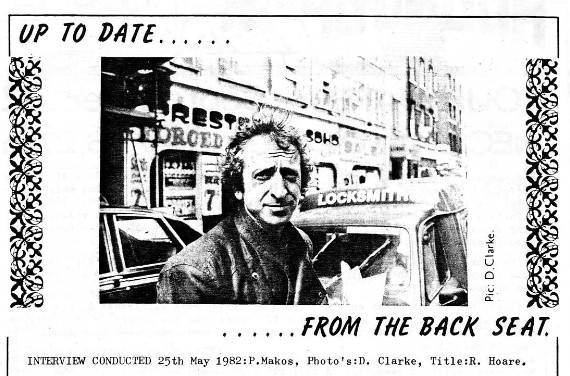
We then visited the offices of the official tour promoters to secure preferential tickets. We tried to obtain merchandise/promotion space for NYAS at the tour venues, but the interests of big business prevailed and this door was firmly shut in our faces. We were however promised a special consignment of tickets and pre-sold these to members without charging any extra booking fees (although these were only 30p in those days!). As the editorial in issue number 7 explains, a great deal of time and effort was put into promoting NYAS and obtaining the tickets. The tickets duly arrived and were distributed to members immediately. We found to our delight that they were for the front rows, and I had a seat in row 3. Paul, however, subsequently received a telegram from the agency ITB (his telephone was undergoing one of its euphemistically-titled periodic malfunctions) to say that we had been sent the wrong tickets! We had in effect been given VIP tickets and not those intended for ‘mere’ fan club members. As they had by then already been posted off to our members, we were of course unable to return them as requested – so I guess a kind of justice was served. That is if the ringing in my ears that lasted for three days after the show as a result of sitting in row 3 was a benefit…
Around the time Neil’s 1982 tour began, membership of NYAS had reached 600. With the strength of the production team, and annual membership renewals already coming in, the future, while not looking exactly secure, was at least more assured than it had been. Our initial target had been 400 members. We had exceeded this figure by around 50 per cent within just twelve months,
After The Goldrush
Around this time Paul Makos moved back to Scotland with his family to help run his mother’s business in Glasgow. Magazine production initially went with him. Paul had been a magnetic personality that kept us all together. He was always an optimistic doer, remarkable for someone who as a child watched his father die from a heart attack on a beach on a family holiday. It soon became clear, however, that Paul could not run his business and handle the magazine at the same time. Although I discussed the possibility of taking it on myself, I soon realised I wouldn’t be able to manage it. From my personal perspective it was evident that with the departure of Paul to Scotland and control of the association moving away from London, I would no longer be able to devote the time and commitment that it now needed. I had a demanding job and a young family, so in a way it was a relief to see things in someone else’s good hands.
So it was that Andy Cox took over the editorship from issue 11 in early 1983, and production became based in Nottingham. Andy would be the first to confirm that the editorship of the magazine was an onerous task. However he stuck at it until issue 15. By then the original team had begun to fragment. From issue 16 onwards the enterprise was thus very fortunately taken over by Alan Jenkins.
Although other members continued to assist with articles and information, the entire running of the society, the handling of the finances, and not least the editorship of the magazine, and all that went with it, became Alan’s sole responsibility. In hindsight I can only endorse the view that Alan Jenkins did a superb job and without him Broken Arrow would almost certainly have been consigned to history. We all owe him a great debt of thanks for handling this immense task for so long.
Fortunately, Scott Sandie valiantly stepped into the breach in 2001 and took over the reins for a further thirteen years until Broken Arrow’s final issue number 134 in June 2014. But that story is for him to tell.
I am proud of what was achieved by NYAS and by everyone involved in it. I am certainly personally heartened by the response I received from members that I have met over the years. I particularly remember the Rusties from America that I met at the NYAS convention which was held in Brixton in London over 3 days in November 2005 to celebrate both the 100th Anniversary issue of the magazine as well as Neil’s 60th birthday. NYAS had clearly become an international institution.
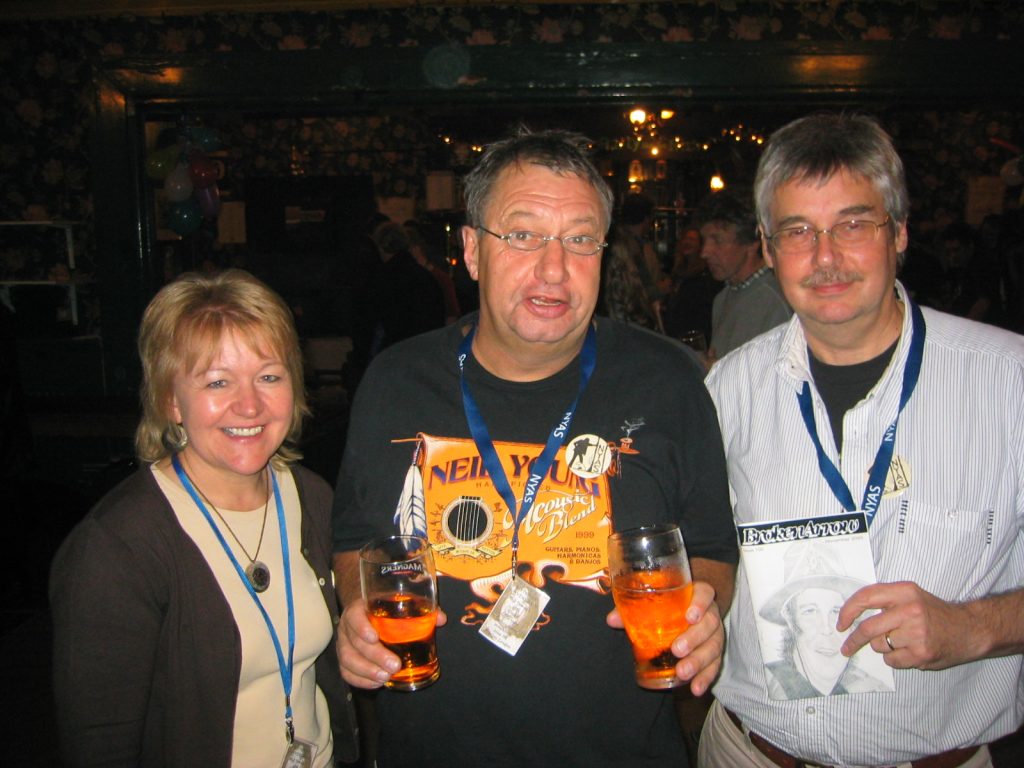 David Clarke (NYAS #3, right) with his wife Margaret (NYAS #4) and Bry Carter (NYAS #90, centre) at the NYAS Convention in 2005.
Another outstanding memory for me was from the day prior to Neil’s appearance with the Electric Band at the Hop Farm Festival in Kent on 6 July 2008. NYAS members convened (as usual) at a pub near the venue on the evening before, and an impromptu concert was held with members playing many of Neil’s songs with great skill and aplomb. This was the last time that I met Scott Sandie and his associate Paul Docker. I am happy that from our tentative beginnings in 1981, a worthwhile project with a large international following had emerged that would keep going for more than 30 years.
Originally published in its original version under the title ‘Hold Back The Years’ in the Neil Young Appreciation Society’s Broken Arrow Magazine issue no. 100. Revised here by the original author David Clarke. Published with permission. Images from Broken Arrow Magazine © Neil Young Appreciation Society.
In the next episode of story, Scott Sandie will look back at the Alan Jenkins-era through to the end of 2001, and to his own guardianship of NYAS and Broken Arrow until 2014.
All back issues of Broken Arrow have been archived on the Sugar Mountain website as PDFs and can be read at https://www.sugarmtn.org/ba/. There is also a search function on the index page which allows you to search for specific articles, and you can also order back copies of some issues.
RB