

by Jonathan Foley, Ph.D. and James Gerber, Ph.D.
Greenhouse gases come in many kinds, from many sources – so our efforts to reduce them should, too.
Many people are trying to help halt climate change, but their efforts are sometimes too narrowly focused, making them less effective than they could be.
The four simple charts below can help you expand your field of vision so you can see the full spectrum of solutions and pursue those that offer the greatest impact.
1. It’s Not Just Carbon Dioxide
Carbon dioxide (CO₂ ) is a problem, and a big one. But it’s not the only one. There are several other greenhouse gases to consider, too — methane, nitrous oxide, and so-called f-gases (mainly hydrofluorocarbons, chlorofluorocarbons, and other fluorinated gases).
Take a look at this chart of the global warming potential of humanity’s greenhouse gas emissions.
 Figure 1. Global warming potential of greenhouse gas emissions in 2024. Here, we compare the global warming potentials of four main categories of greenhouse gases – carbon dioxide (CO2), methane (CH4), nitrous oxide (N2O), and F-gases – by averaging their global warming potentials over a 100-year period. Data from the IPCC, EDGAR, and the Global Carbon Project, synthesized by James Gerber.
Some gases trap heat much more effectively than others, and some remain in the atmosphere longer than others. So to compare them in a consistent “apples to apples” way, we often convert them into equivalent units by calculating their “global warming potential” over 100 years. This is a standard tool for comparing different greenhouse gases and their impacts on climate change — but it does bury a few important points. For example, methane is far more powerful at trapping heat than CO₂, but it doesn’t last in the atmosphere very long. So, in the short term — say 10–30 years — methane is extremely important to climate change. But in the longer term, like a century or two, it’s less so.
CO₂ gets most of the attention, and for good reason: It represents about 75% of the global warming potential of our greenhouse gas emissions (on a 100-year basis) each year. And the lion’s share of that — about 61% of total emissions — comes from producing and burning fossil fuels, including oil, coal, and natural gas. That’s why many climate change solutions focus on reducing the use of fossil fuels — they cause about 61% of the problem.
But a lot of CO₂ and other greenhouse gases don’t come from fossil fuels, and we need to look at those too.
About 8% of greenhouse gas emissions stem from CO2 emitted by land use, especially deforestation. (Burning trees — which are largely made up of carbon — is like burning coal. They both release CO₂. ) And some CO₂ is emitted from industrial processes — including cement production.
Then we have methane. The largest source of methane is agriculture, especially cattle and rice fields. Fossil fuel production also releases methane, mainly from leaks, flaring, pipelines, and wells. Industry also releases methane, especially from landfills and wastewater facilities.
Nitrous oxide, another key greenhouse gas, mainly comes from excessive fertilizer use in agricultural soils.
Finally, we have fluorinated gases (f-gases), such as hydrofluorocarbons (HFCs), chlorofluorocarbons (CFCs), and sulfur hexafluoride (SF6). These chemicals are typically used as refrigerants or in industrial processes.
Humans emit other minor greenhouse gases — and another kind of warming pollution called black carbon – into the atmosphere as well. But for simplicity’s sake, this is a good starting point.
The greenhouse gases that warm our planet include more than CO₂, and come from more than just burning fossil fuels.
The bottom line is this: The greenhouse gases that warm our planet include more than CO₂, and come from more than just burning fossil fuels. We need to widen our perspective to better understand and more effectively address climate change.
2. It’s Not Just Fossil Fuels
The chart below summarizes the three major ways we produce greenhouse gases: by producing and burning fossil fuels; through industrial processes, products, and waste; and by producing food and using land. Fossil fuels are the biggest culprit, for sure, but industry and the food system are clearly important, too.
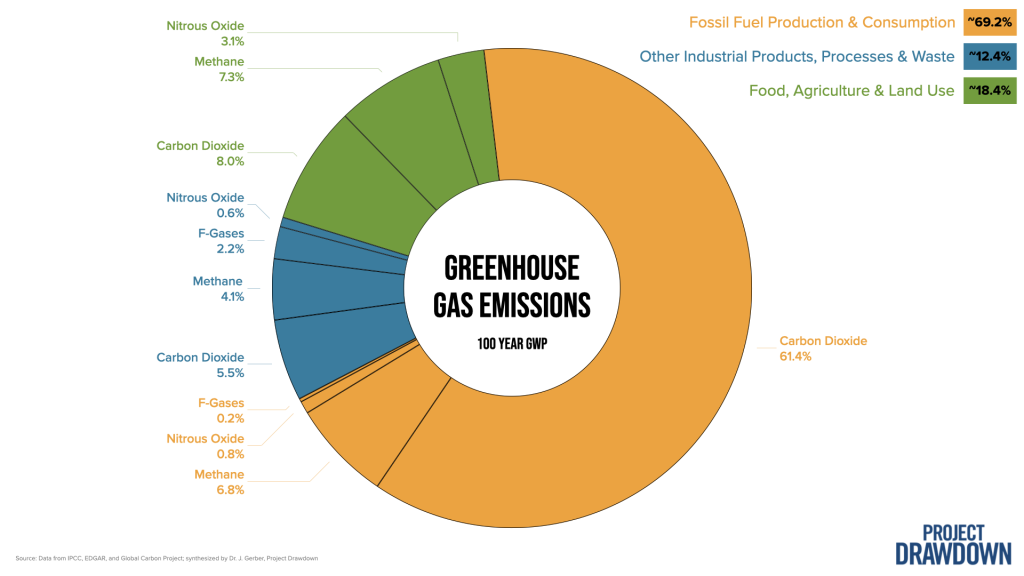 Figure 2. Greenhouse gas emissions by mode of production. We can take the emissions data from Figure 1 and reorganize them into three categories: emissions from producing and burning fossil fuels; emissions from industrial processes, products, and waste; and emissions linked to food, agriculture, and land use. This shows that we must focus on reducing emissions from industry and the global food system, in addition to those from fossil fuel use. Data from the IPCC, EDGAR, and the Global Carbon Project, synthesized by James Gerber.
3. Every Sector Matters
We can also break down greenhouse gas emissions by major economic categories. Globally, the three largest sectors with the largest emissions impact are electricity, industry, and food, agriculture, and land use.
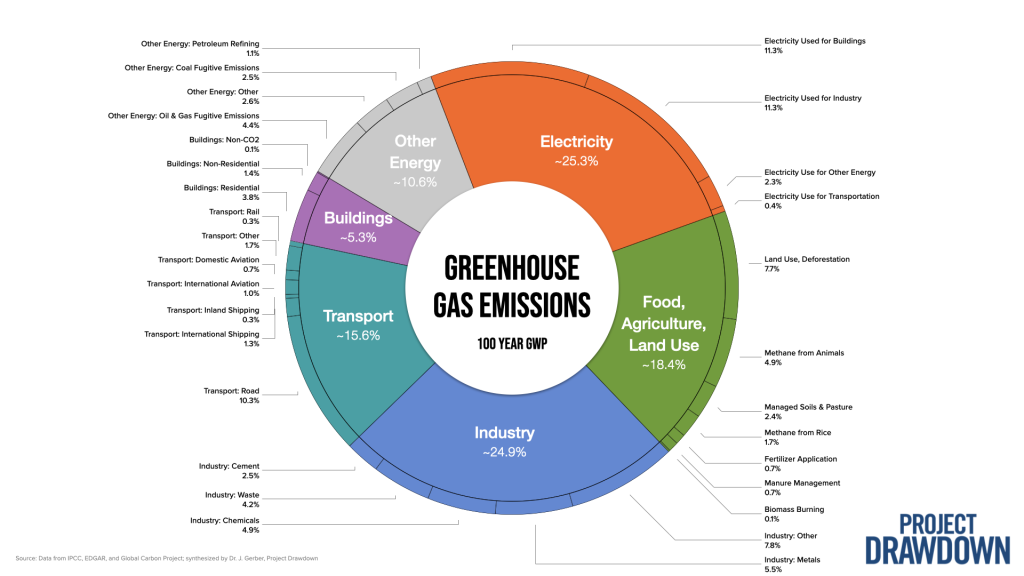 Figure 3. Greenhouse gas emissions by economic sector. Organizing emissions by sector shows the wide range of opportunities for reducing them. Note, however, that these data are for the world as a whole, and proportions, and so the biggest opportunities for reducing emissions) vary substantially from country to country. In the United States, for example, food and land use account for a smaller share of emissions, while transport accounts for a larger share. Data from the IPCC, EDGAR, and the Global Carbon Project, synthesized by James Gerber.
You may be surprised by the large contribution of food, agriculture, and land use. Clearing land for food production is the biggest culprit here. Methane production by cattle and rice fields is second, and nitrous oxide emissions from overuse of fertilizers on agricultural soils are third.
The bottom line is that all six major sectors – electricity; industry; food, agriculture, and land use; transportation; buildings; and other energy emissions – contribute to the problem. The good news? That means that the solutions can come from all six sectors, too.
4. Removal Matters, Too
Reducing the release of greenhouse gases into the atmosphere across different gases, production modes, and economic sectors is important. But removing greenhouse gases from the atmosphere can help, too.
Nature already does a great deal of this. According to the Global Carbon Project, only ~50% of anthropogenic CO₂ emissions remain in the atmosphere; the rest is absorbed by the oceans (~29%) and land-based ecosystems (~21%). If we look at the 100-year global warming potential of the full mix of greenhouse gases, ~22% of this is absorbed by the oceans, and ~16% by land-based ecosystems.
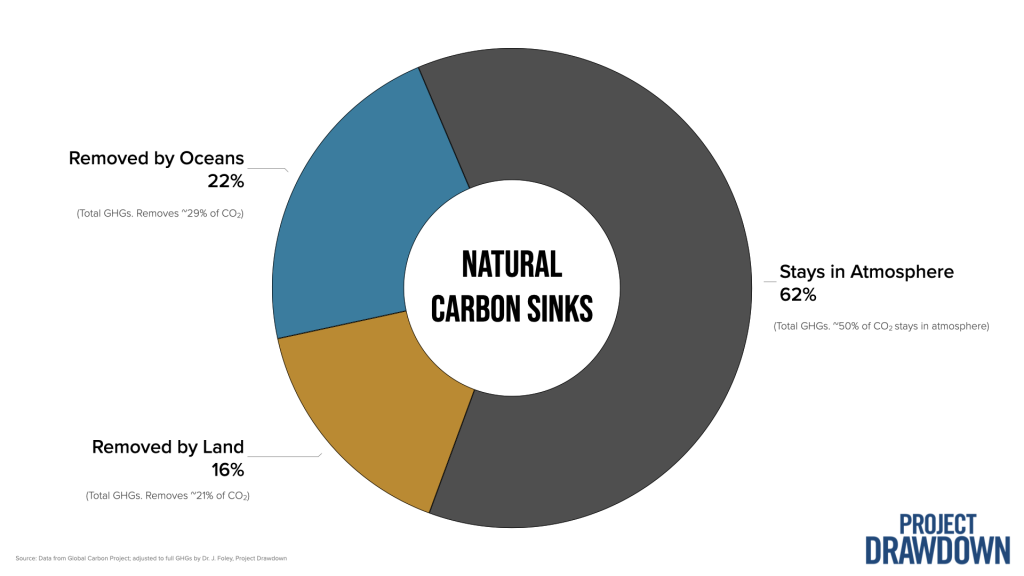 Figure 4. The fate of annual greenhouse gas emissions. About 62% of anthropogenic emissions, as measured by their global warming potential over 100 years, remain in the atmosphere. But the remaining 38% are absorbed by the oceans and land-based ecosystems. Enhancing these natural sinks and augmenting them with engineered devices can help mitigate climate change. Data from the Global Carbon Project, adjusted for all greenhouse gases.
An important point here is that it might be possible to get these natural greenhouse gas “sinks” to absorb even more CO₂. Planting large areas of new forest, restoring carbon-rich soils under agricultural and degraded lands, restoring coastal ecosystems, and protecting threatened natural ecosystems are all ways to do this right now. And there are many others.
We also can develop technologies that remove greenhouse gases from the atmosphere. So far, however, machines that can remove greenhouse gases at scale are still far away, and it’s best to be skeptical of them for now.
The Bottom Line
The bottom line is this: Climate change is not just a CO2 or a fossil fuel problem. It cuts across greenhouse gas types, modes of production, sectors, and reduction strategies. In the end, we need to look at the whole picture of greenhouse gas emissions. We need a portfolio approach.
And we need to set priorities within the portfolio. We need to start with the “big wins,” including enhancing energy conservation, scaling up renewable electricity generation, reducing food waste, shifting diets, improving agricultural systems, electrifying transport where possible, constructing and retrofitting buildings for energy efficiency, and electrifying heating and cooling systems. And we should also target methane and so-called super-pollutants — as soon as possible — to help us buy time to do the rest.
Beyond cutting emissions, we should look for ways to remove greenhouse gases (especially those that will take time to eliminate at the source) through the development of safe carbon sinks. Enhancing natural carbon sink solutions — replanting forests, increasing “carbon farming” on agricultural lands, restoring coastal ecosystems, and the like — is an excellent “no regrets” strategy to start.
Addressing climate change is one of the greatest challenges we face in the 21st century. Making sure we fully understand the problem – and all the opportunities we have to lower greenhouse gases – is an important place to begin.