
Ethical Consumer Nov/Dec 2025
Tech companies – and make no mistake, the bulk of the companies in this new ‘Alternatives to Amazon’ guide are tech companies, not music companies – have dramatically changed the way that most of us consume music.
We’ve been running a boycott of Amazon since 2012 over tax avoidance, and Spotify is currently facing a well-deserved public reckoning over a whole host of ill-doings, but it can be hard to tell if there are more ethical alternatives waiting in the wings.
This guide assesses Amazon and Spotify alongside their direct competitors (other streaming services), plus a range of digital music sales platforms and more radical alternatives. It is not an exhaustive list, but we have included the most popular sites alongside a selection of alternatives that appear to be trying something different. This was one of the top guides voted for in a readers’ survey we did earlier this year.
An introduction to Spotify
You have to admire Spotify’s determination to push the “no such thing as bad publicity” notion to its limits over the past couple of years. The company has faced unrelenting criticism over its meagre payments to artists since its 2009 launch, but Spotify’s repertoire of bad press has expanded in the post-pandemic years to include – non-exhaustively – the sponsorship and platforming of Trump adjacent conspiracies via the Joe Rogan Experience, the alleged promotion of “fake” artists to lower its artist royalty spend, and founder and Executive Chairman Daniel Ek’s repeated forays into computerised weaponry development.
Is music streaming broken?
It’s important to note that while Spotify receives extensive criticism regarding artist compensation, it does not use a significantly less equitable payout model than most of its competitors. The norm in the sector is called a “pro rata” or “market share” payment basis. This is used by Spotify alongside TIDAL, YouTube, Apple Music, Amazon, and more.
The streaming platform aggregates all revenue from subscriptions and advertising, and this pot (minus a cut taken by the company, often around 30%) is split between rights holders on a market share basis. For example, if an artist’s tracks accounted for 1% of all streams, then that artist’s rights holder (generally their label) receives 1% of the available payout. Contrary to popular conceptions, artists are not paid a set perstream rate.
While it may make intuitive sense, the pro rata model favours superstars. The top 1% of creators receive 90% of streams, so get the lion’s share of the available revenue, meaning that niche and
independent artists effectively subsidise the biggest artists. Algorithmic playlists and recommendation engines amplify this effect, creating a rich-get-richer cycle of streaming revenue and visibility.
It’s also important to note that these rates are payments to rights holders, not to artists. Record labels typically take the largest share of this revenue, especially for artists under traditional deals, leaving musicians with a miniscule fraction of total revenue, as low as 2% of the payout in some cases.
What’s wrong with Spotify?
Some of the most pertinent critiques concern the company’s links to AI weaponry, its alleged use of fake or “ghost” artists to improve profitability, and the effects of its hyper-individualised,algorithmically mediated playlisting model on music culture more broadly.
AI militarism
Daniel Ek, Spotify’s co-founder and Executive Chairman, has a well documented history of investing in AI weaponry through his backing of Helsing, a European AI defence company. Since 2021, Ek has directed hundreds of millions of euros into Helsing via his private investment firm, Prima Materia, and has also taken up a leadership role on the company’s board, currently serving as chairman.
This investment is not directly coming from Spotify itself, but Ek has reportedly cashed out $724m of company equity since 2023. It seems reasonable to assume that at least some of this money has been directed towards his killer robot passion project, and that there is therefore some likely causal relationship between a Spotify subscription fee and funding AI militarism.
Ghosts in the playlist
Liz Pelly’s 2025 book ‘Mood Machine’ (pictured) provides a fascinating investigation into Spotify allegedly cramming its popular playlists with lowcost stock music or ghost artists, alongside the rise of new payola practices in streaming. Payola is the term for the much maligned practice of financial bribes in return for media promotion, which has persisted between record labels, radio stations, and other industry players despite an official ban since 1960.
Spotify’s alleged “ghost artist” strategy involves commissioning cheaply produced tracks, often designed to blend seamlessly into mood playlists like “Deep Focus”, “Coffee Shop Jazz”, or “Peaceful Piano”. This music is designed to sound similar to other artist’s music, and is allegedly given undue prominence in Spotify’s playlists at the expense of the artists whose sounds it aims to replicate.
If, as widely alleged, Spotify owns much of this music outright, then it doesn’t have to pay any royalties when it is listened to. These tracks are not promoted as creative works in their own
right, existing instead as a form of sonic wallpaper to keep users streaming on the platform.
One doesn’t need a PHD in cynicism to spot the insidious financial incentives here. Spotify has effectively persuaded its users that its algorithm knows their tastes and interests perfectly – surely it wouldn’t exploit that trust in order to instead feed them music that matches the
interests of the company’s profit margins and shareholders?
Algorithmic payola
Those remaining independent artists are also being asked to surrender a cut of their royalties in exchange for consideration on Spotify’s vaunted editorial playlists, a practice the company euphemistically branded in 2020 as “Discovery Mode”. Spotify insists these tools are voluntary promotional services, but this appears to be algorithmic payola in all but name. Major labels, meanwhile, wield their power (all were major early Spotify investors) to secure playlist placements for their own rosters.
Algorithmic playlists rip songs out of their cultural contexts: the places and times that birthed them, the political forces and history that drove them, and the actual human beings who
worked on them.
Music as disposable content
The controversy is not only about the financial hit to musicians who miss out on playlist placements but also reflects the erosion of cultural value. Spotify’s Daniel Ek has infamously stated that the cost of creating music or “content”, is “close to zero” in the modern world, and his platform certainly appears to treat it accordingly, as a disposable commodity.
This is important because Spotify provides more than just “on demand” streaming. It is ostensibly designed as a music discovery and recommendation tool – a one stop shop for all your musical needs. Yet while features like Spotify’s AI DJ and “radio” playlists drip feed users with an infinite scroll of content, this is presented without the context that gives music its cultural weight and meaning. Algorithmic playlists rip songs out of their cultural contexts: the places and times that birthed them, the political forces and history that drove them, and the actual human beings who worked on them; and repackage them into a user-personalised experience to be consumed passively.
Compare this to the experience of community and grassroots radio shows, which often dive into a particular movement, sound, place, or time, in order to place music within a broader cultural history. Like most forms of neoliberal “culture”, the tech platform approach is instead hyper individualised: it doesn’t matter where and when these songs come from, it only matters that they fit a data-driven model of an individual’s taste preference, which – if we are to dial up the cynicism further – can then be mined to generate more data to target users with more personalised ads.
ALTERNATIVES TO AMAZON
Music Streaming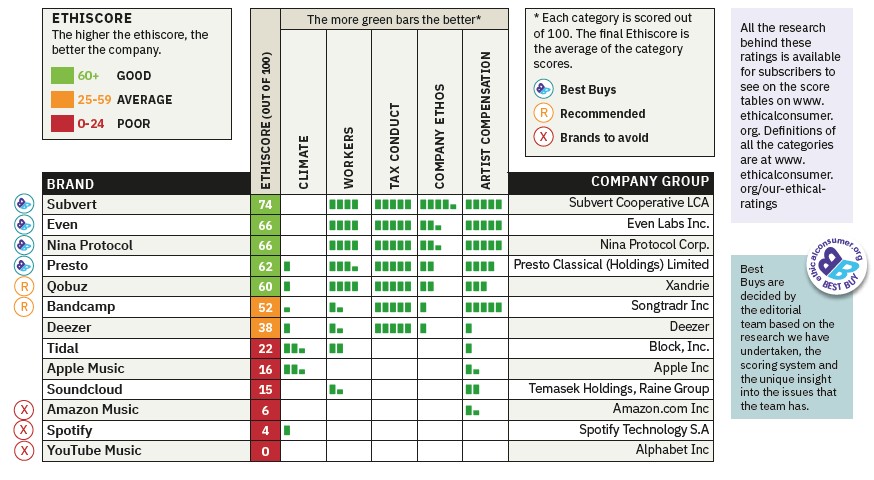
WHAT TO BUY
Choose a company that pays artists fairly.
Purchasing a song earns artists far more than the fractions of pennies made by streaming it. Our brand new Artist Compensation rating assesses a range of payout models, and rewards innovative action in the sector.
Choose a company with an editorial focus.
The corporate embrace of AI and algorithmic slop is resulting in mass layoffs and is changing how we consume music. Look for platforms that prioritise human curation.
WHAT NOT TO BUY
Is the company linked to the arms sector?
Spotify’s CEO’s role in an AI weapons firm has sparked an exodus from the platform, but Amazon and Google (which owns YouTube) have their fair share of dubious links.
Is the company exploiting the artists that keep it afloat?
Major platforms heap fortunes onto their executives, but 80% of UK musicians make under £200 per year from streaming.
Score table highlights
Company Ethos
The major streaming services generally came out worst under Company Ethos. For
a sector that’s infamously stingy when compensating its artists, streamers appear
happy to heap abundance upon their own executives.
Spotify’s co-president took home $18.7m in 2024, but, according to the Musicians’
Union, 80% of UK musicians receive less than £200 annually from streaming.
TIDAL’s owner, Block Inc., only paid its CEO Jack Dorsey $2.75 in 2024. A sign of a radical wealth redistributive ethos at the company? No, its highest paid director came home with $16.5m in the same year.
Amazon’s Andrew Jassy received $40.1m, and Apple’s Tim Cook took home a staggering $63.2m.
Spotify was not the only company with links to the arms sector. Both Google, which owns YouTube, and Amazon lost marks under Company Ethos for their involvement in Project Nimbus – a $1.2bn deal with Israel’s government and defence establishment.
Both are targets of the BDS boycott movement.
Artist Compensation
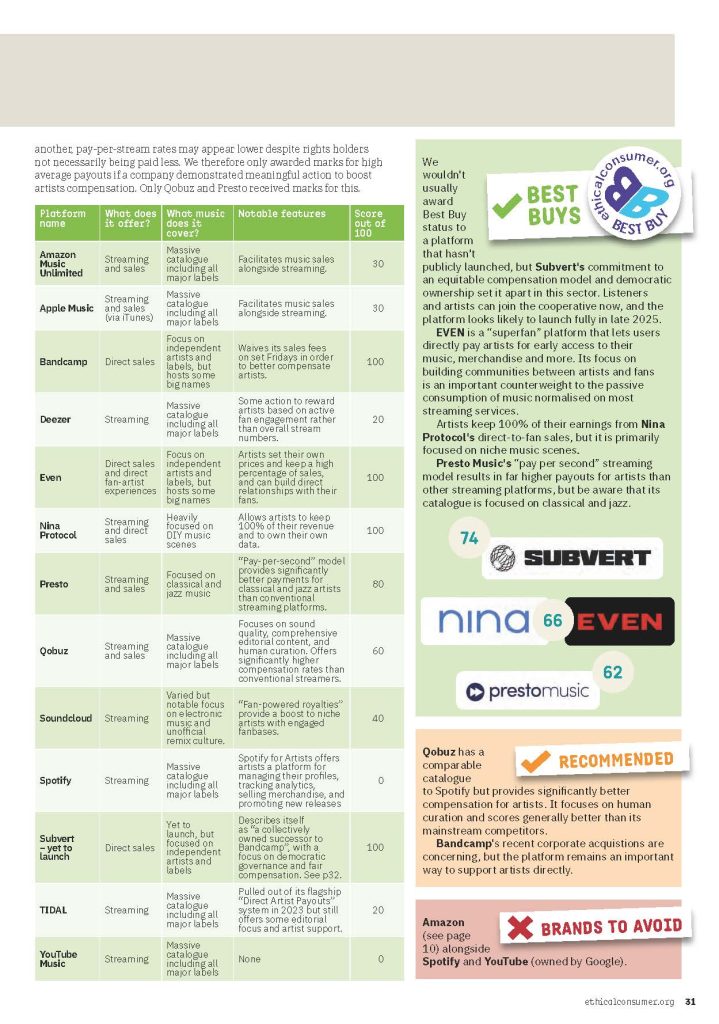
Our new bespoke rating on Artist Compensation condensed much of the information in this guide into a score out of 100. It primarily awarded companies which offered direct sales, as buying a song for £1 is far better for artists than the fractions of pennies earned by streaming it.
Marks were also available to streaming companies that were meaningfully acting to combat the passive, algorithmically mediated consumption of music normalised by conventional streaming services. This might be through a focus on editorialised articles and deep dives, a focus on human curation, and payout models that reward active engagement between artists and fans.
We’ve put the scores into the table on the page opposite, which also has some detail on the models used and musical specialisms of each platform.
Note that we did not base this rating on “pay-per-stream” rates as they are potentially misleading. Platforms do not generally set a “per stream” pay rate, rights holders (and therefore artists) instead receive a share of revenue relative to their slice of the overall number of streams on a platform. If one platform has more overall listeners than another, pay-per-stream rates may appear lower despite rights holders not necessarily being paid less. We therefore only awarded marks for high average payouts if a company demonstrated meaningful action to boost artists compensation. Only Qobuz and Presto received marks for this.
Mainstream alternatives to Amazon and Spotify
YouTube Music
Don’t ditch Spotify and Amazon Music for YouTube Music (owned by Google) if you are looking for a more principled alternative. It is the lowest scoring company in this guide and can’t credibly be pushed as a fairer or more artist-friendly choice. It is also involved in Project Nimbus, a $1.2bn contract to provide cloud services for the Israeli military and government.
Apple Music, TIDAL, and Deezer
Apple Music and TIDAL have not faced the same scale of public scrutiny around ghost artists or digital payola as Spotify. There isn’t evidence of systematic “fake artist” playlisting on these platforms on the same industrial scale, but a lack of transparency over playlist curation on all platforms means ghost or algorithm biased content could exist elsewhere.
French platform Deezer offers a similar service to the others, but is notable for its move towards artist-centric payouts, designed to reward artists with engaged listener bases. Under this model, an artist gets paid more per stream when a user actively searches for them than they would if they are recommended algorithmically. This goes some way towards deincentivising the “music for passive consumption” issue found on Spotify. It’s also got more protections around using non-music – such as an album of white noise for sleeping – to fraudulently game the system.
More niche: Qobuz, Presto, Soundcloud, and Bandcamp
For listeners who want a service that broadly replicates Spotify’s catalogue without replicating its most harmful features, Qobuz offers a strong case. The French platform carries the full slate of major label releases, but eschews a free subscription tier – a model that has consistently driven artist revenues down. It also integrates options to purchase music and places particular emphasis on editorial content and human curation.
According to the company, an independent audit confirmed that Qobuz generates on average five times more revenue per user than the market average. The trade-off is price: Qobuz costs more than Spotify, but that premium supports a less exploitative model.
Presto Music demonstrates an even higher rate of compensation, due to its unique “pay per second” model. The service is focused on classical and jazz repertoires, which tend to have long track lengths that are disadvantaged by conventional stream accounting – on most services, a play of a 2 minute song will generate the same revenue as a 30 minute one. Presto reports that it often pays out up to 10x more than other major streaming services. Choose this if you are happy with a classical- and jazz-focused catalogue.
SoundCloud has long been an essential hub for underground scenes, a place where careers are launched outside of the major label machine. It has not been free of controversy, particularly around licensing disputes, but its adoption of a “fan-powered royalties” model in 2021 set it apart from the pack. Under this system, a listener’s subscription fee is distributed directly to the artists they listen to, rather than being pooled into the wider market share.
Bandcamp has long been treasured by independent musicians for its focus on buying music and its direct-to-creator sales model. The company’s decision to waive its sales fees on selective Bandcamp Fridays provided a lifeline to many artists throughout the pandemic, and Bandcamp has earned a reputation for prioritising editorial curation over algorithmic slop. Yet successive acquisitions by Epic Games and then Songtradr have spread spinal shivers throughout the Bandcamp community. Since Songtradr took the reins, half of Bandcamp’s workforce has been shown the door and, according to Bandcamp union, “the company’s Black and trans/non-binary/gender nonconforming employees were reduced by 82% and 84% overnight”.
More radical alternatives to conventional platforms
Subvert
Mercifully, there are other options on the horizon. Subvert is a cooperative which pitches itself as a “collectively owned successor to Bandcamp”. The platform has not yet launched publicly, but listeners, artists, and labels are already able to join the cooperative as founding members. There will be a phased launch throughout 2025 and 2026.
We would usually be hesitant to recommend an untested company, but Subvert has released a transparent and comprehensive manifesto-style plan called the “Plan for the artist-owned internet”. This can be accessed by signing up for free on its website – https://subvert.fm.
Subvert doesn’t appear to be reinventing the wheel in terms of its usability – it instead looks likely to be functionally similar to Bandcamp – but couples this interface with cooperative principles like transparent accounting, democratic decision-making, and a payout structure that can be adjusted by members rather than dictated by opaque contracts with shady industry players.
We’re hopeful that a cooperative model might help alleviate the issues currently faced by Bandcamp, and it’s promising to see a project with such an explicit aim to challenge corporate power enter the anti-Spotify fray. Other more radical alternatives, such as the Resonate cooperative and Sonstream, have dwindled towards inactivity in recent years so were not included in the guide.
EVEN and Nina Protocol
These two both scored highly but, like other alternatives, they do not provide a directly comparable experience to conventional streamers. EVEN is a direct-to-fan platform for artists to sell their music alongside fan “experiences”, offering early access to music, merchandise, behind the scenes exclusives, events, and more in exchange for direct support. Nina Protocol is a more radical, techy affair: a decentralised music platform and marketplace that allows artists and labels to directly sell their music to fans, keeping 100% of the revenue while also pushing fan engagement and discovery. The technology-heavy, blockchain focus might imply a lack of human touch, but Nina Protocol stands out for its daily editorial write ups about new and interesting music. It is a great option for those wanting to explore niche and DIY music cultures.
Companies behind the brands
uperfan platform EVEN launched in late 2022, and is the brainchild of US entrepreneur Mag Rodriguez. It attracted some big name early adopters in the hip hop and R&B worlds, including J Cole and Chance the Rapper, but the platform includes a wide range of genres with a focus on independent artists.
Its “early access” model is not designed to replace conventional streaming, but instead works alongside it. Most fans may do the bulk of listening on streaming services, but dedicated fanbases can go to EVEN to hear new music first, exclusive tracks, alternative mixes and so on, and in doing so they provide a direct income stream to artists.
Presto Music’s streaming service is just one feather to the Leamington Spa-based company’s bow. Founded in 1986 as a small high-street shop, the company has grown into a major online store for classical and jazz recordings, sheet music, music literature, and instruments. It was held to a higher standard than some other companies in the guide due it having a significant physical supply chain – many
of the other platforms are more or less digital-only spaces with few suppliers or employees.
Presto’s certification by the Good Business Charter and Living Wage Foundation also demonstrates good company practice across the board.
THE CARBON IMPACTS OF STREAMING MUSIC
Streaming isn’t as kind to the natural environment as it first appears. Each play kicks data centres and networks into gear, producing a stream of emissions that balloons with our collectively compulsive listening habits. A 2025 study estimated Spotify’s carbon emissions to be 12 times the carbon footprint of Vatican City, reaching approximately 187,040 tonnes of CO2e.
Downloading music on a streaming service, or buying it on Bandcamp, doesn’t demand the same constant energy draw as streaming it online. Once a file sits on your hard drive, it doesn’t need to awaken a server farm halfway across the world every time you fancy a listen.
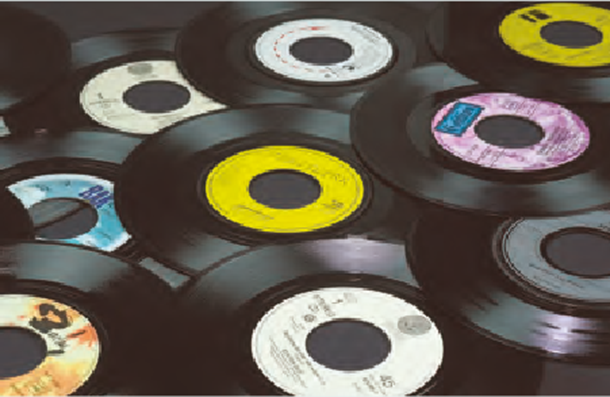 Photo by Eric Krull on Unsplash
Buying physical media looks worse at first glance: pressing plants, plastic cases, and global shipping are hardly hallmarks of environmentalism.
A typical PVC vinyl record creates 1.15Kg of CO2 emissions, putting it in a similar region to a pint of cow’s milk (around 1.1Kg). There are also a host of toxicity issues associated with PVC.
Buying your records or CDs secondhand mitigates some of this impact, and loving that record to death rather than playing it on Spotify a thousand times could even tilt the carbon accounting back in your favour.
SUPPORT THE MUSICIANS’ UNION – #FIXSTREAMING
The Fix Streaming campaign, led by The Musicians’ Union (MU), aims to secure a more equitable revenue share for musicians and creators by changing UK copyright law and promoting fairer negotiation terms with the music industry and government.
The campaign offers a few ways for the public to support it. There is a petition for legal reform, which you can sign and share from this website: www.megaphone.org.uk/petitions/change-the-law-to-fix-music-streaming
It also has a wealth of resources, including videos, articles, and letters, which it encourages readers to share widely. The more people talk about how streaming is broken, the more the union can show that musicians and public support are on their side.
There is also some fascinating work happening across the Atlantic, spearheaded by United Musicians and Allied Workers and progressive congresswoman Rashida Tlaib. At the time of writing, Tlaib is poised to reintroduce the Living Wage for Musicians Act – a bill to regulate streaming services like Spotify and ensure fair streaming payouts to artists. The act would create a new streaming royalty paid directly to artists, ensuring that musicians can build sustainable careers in the digital age. We’ll be watching it keenly from our side of the pond.
No music for genocide
As we went to press, it was announced that over 400 musicians and labels have pledged to remove their music from streaming platforms in Israel as part of a new boycott initiative.
No Music For Genocide is calling on artists to edit their release territories or send geo-blocking requests to their labels as part of a deepening cultural boycott.
Hundreds of independent and major label artists have pledged their support, including longtime Palestine campaigners Massive Attack and Kneecap.