
faroutmagazine
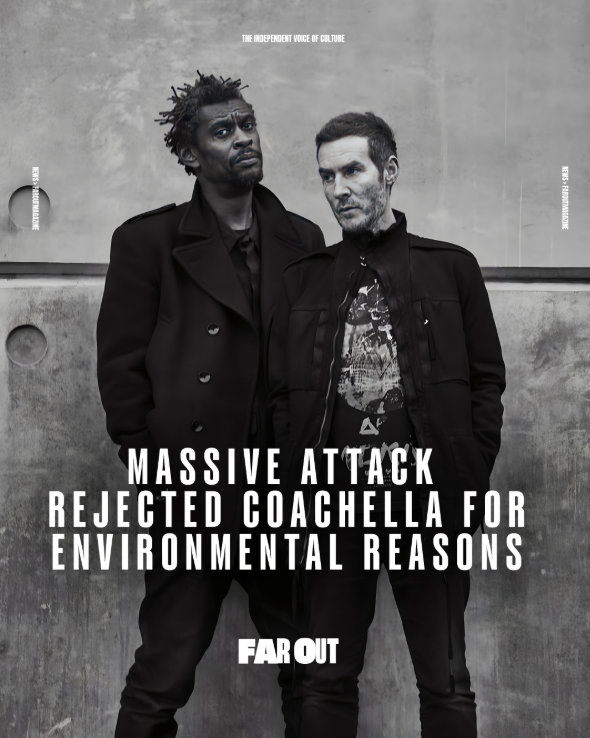
Trip-hop pioneers Massive Attack have revealed that they rejected an offer to play Coachella 2025 on environmental grounds.
The band, comprised of Robert ‘3D’ Del Naja and Grant ‘Daddy G’ Marshall, are one of the most prominent adherents of the environmentalist cause in music. In 2021, they published the report they had commissioned from the renowned Tyndall Centre for Climate Change Research two years prior, mapping the carbon footprint of touring and the CO2 emissions the sector creates. It also provided recommendations for the industry to meet the targets of the Paris Agreements.
Accordingly, the Bristol group became the first band to commit their touring companies to the UN’s Race to Zero emissions reduction schedule.
On August 24th, Massive Attack played the Act 1.5 show in Bristol, which was a “large-scale climate action accelerator” blazing a “trail for new standards of decarbonisation of live music.” It implemented 25 measures to minimise carbon, including giving extra benefits to local attendees and those travelling by train, powering the venue solely on renewable energy, and serving only plant-based foods.
Following that, in November, Massive Attack headlined the Act 1.5 event in Liverpool, which had been anointed the world’s first Accelerator City for Climate Action by the UN. This event also used groundbreaking approaches to reducing the carbon footprint of live music.
Del Naja explained: “We said no to Coachella for next year because again, we’ve been there once, and once was enough. It’s in Palm Springs. It’s a golf resort built on a desert, run on a sprinkler system, using public water supplies. Mental. If you want to see something that’s the most ludicrous bit of human behaviour — it’s right there.”
The musician also criticised artists doing residencies in Las Vegas, which he described as an “aviation destination” in the desert. When asked about the futuristic MSG Sphere, where the likes of U2 have undertaken residencies, the ‘Inertia Creeps’ artist said it’s “a brilliant bit of infrastructure in the worst possible place it could be — in the worst setting in the world.”