

By Ian Livingston
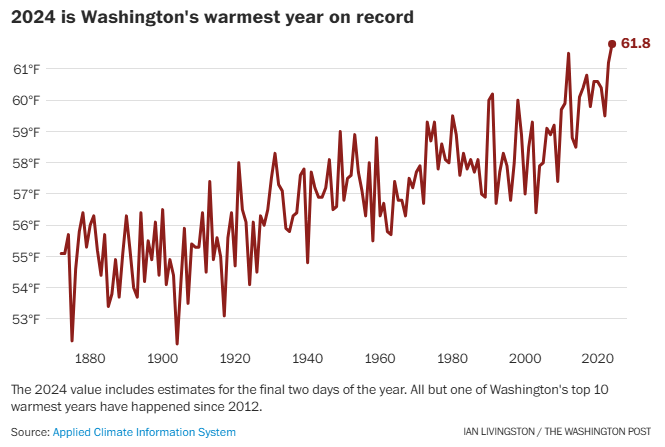
With 2024 mostly in the rearview, another year enters the weather books — one that will be remembered for persistent and record-breaking warmth, recurrent drought, and several significant weather events including a tornado outbreak on June 5 in Maryland. And it’s now official: Cooler December weather couldn’t keep the year from becoming the city’s warmest on record.
This year’s annual average temperature of 61.8 degrees will end up 0.3 degrees ahead of the previous record high of 61.5 degrees in 2012.
Nine of the District’s 10 hottest years have occurred since 2012, according to weather data dating from 1872. While some warmth can be attributed to increased heating caused by urbanization, the rising frequency of record-warm days is a hallmark of human-caused climate change.
A year marked by warm streaks
Contributing to 2024’s record run was the city’s warmest November, with an average temperature more than 5 degrees above normal. A sweltering summer stretch also boosted temperatures.
While the 48 days at or above 90 degrees was not wildly above the average of 40, the temperature hit 100 degrees or higher on six occasions in June, July and August after no highs that hot since 2016.
The year’s coldest week was Jan. 15 to 21, with an average high of 32.9 degrees. A pair of July weeks were the hottest. Both July 5 to 11 and 13 to 19 had average highs of 97.4 degrees; the temperature topped 100 every day from July 14 to 17.
Instances of record warmth spanned January to December; in all, there were 11 record daytime highs and 14 record-warm lows. No cold weather records were set during the year.
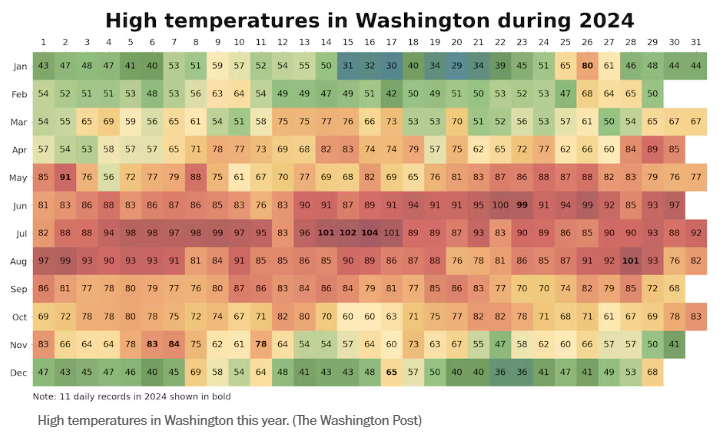
Among the record-warm lows, eight were at or above 80 degrees during the year, the most on record, beating seven in 2016 and 2011.
The city also set records for its warmest high temperature so early in the year when it hit 80 on Jan. 26 and so late in the year when it hit 84 on Nov. 7.
Drawn-out dryness
Other than warmth, the biggest weather story of the year was a persistent lack of precipitation. There were wetter times, especially to start the year, but dry conditions were much more common. Washington had its longest streak without rain on record at 38 days.
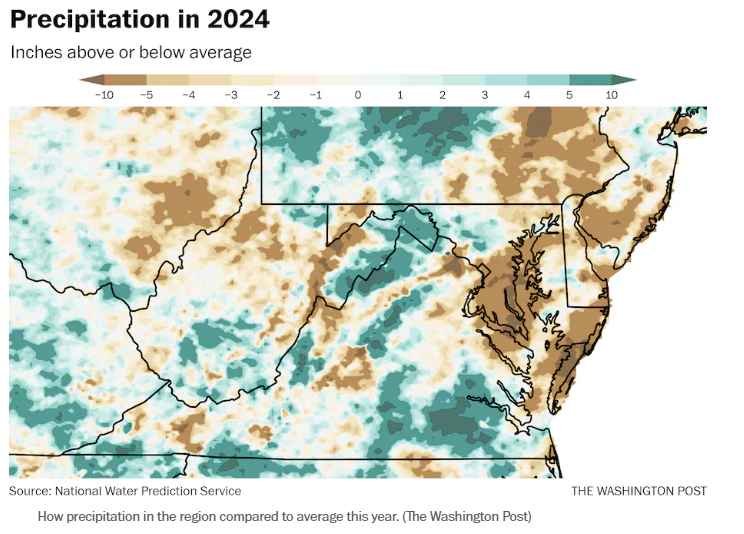
That notable dry run came immediately after an 11-day streak of measurable precipitation, which was the second-longest of that type on record. Washington’s wettest week of 2024 offered up only 3.59 inches, in January.
Drought invaded the city on two occasions, and abnormal dryness was prevalent in the region throughout most of the year, despite occasional retreats following a few bigger rain events.
A series of storms
There were also memorably stormy times:
Back-to-back snows on Jan. 15-16 and Jan. 19 delivered a recently rare stretch of legitimate winter conditions. The 7.8 inches combined for D.C. — with up to 12-plus inches in some locations — pushed the month to above average in a winter that was less snowy and warmer than usual.
One of the most prolific tornado events on record scoured part of the area on June 5. The Weather Service confirmed 13 tornadoes, including several with relatively long tracks through D.C.’s northern suburbs.
Tropical tornadoes also impacted the area on several occasions thanks to an active hurricane season and storm remnants of Debby and Helene passing to the west of the region. Helene produced significant flooding as close as Culpeper and surrounding spots, in addition to historic flooding in the southern Appalachians.
Days with the nicest conditions — highs 65 to 85 and no rain — were most concentrated in fall and spring, as is typical in the area. But a mainly dry October made for particularly nice weather most of the month. More than three full weeks — 23 days — reached the criteria in October alone, compared to the average of 13.
After a warm and peculiarly pleasant fall, December was an anomaly, featuring 17 days below the average temperature for those dates.
And as we look to next year, it seems 2025 may open with an extended period of cold — perhaps marking the start of the coming year’s weather story.
Jason Samenow contributed to this report.
NYA Thanks the Washington Post!