Story and art by Victoria Cavaleri
What Was Going On in the ’60s and ’70s?
The 1960s and 70s were decades of deep upheaval and transformation in America. The assassination of President John F. Kennedy, the escalating war in Vietnam, and the forward momentum of the Civil Rights Movement profoundly shaped the nation’s consciousness. Music, as always, became the mirror of the moment—raw, rebellious, and real.
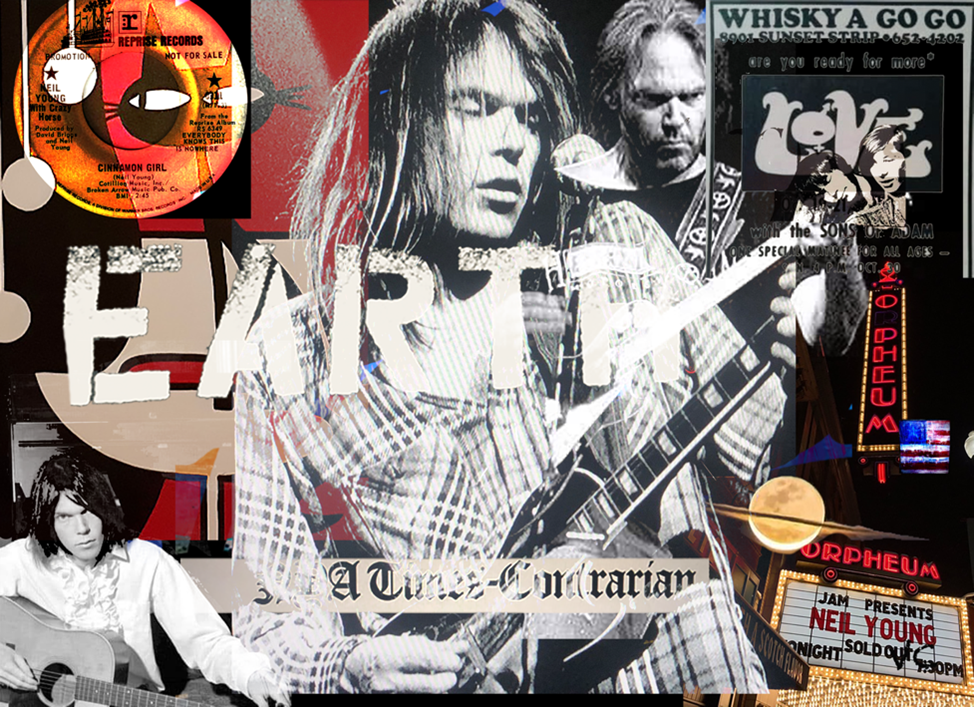
The Whisky a Go Go, often called America’s first true discothèque, stood at the heart of this cultural storm. Located on Sunset Boulevard, it opened on January 11, 1964, in a former bank that had briefly operated as a club called The Party. Elmer Valentine, a former Chicago cop, transformed it into a rock ’n’ roll landmark.
By May 3rd, 1966, Buffalo Springfield auditioned at another club in the Whisky’s orbit—The Trip, a large Sunset Strip venue. These were the early days, and everything felt urgent, electric, and a little bit dangerous.
Donna and I were living at the Commodore Gardens; a 1930s Art Deco apartment building tucked behind Grauman’s Chinese Theater off Hollywood Boulevard. Rent was eighteen dollars a week for our one-bedroom. That night, Neil walked the three miles home with me. It was the start of a friendship that felt both accidental and inevitable.
The Commodore’s courtyard was a collage of Hollywood fringe life—hookers, junkies, drifters, and even a resident Hells Angel named Cowboy, who sat on the stoop and nodded as people passed. Neil, Donna, and I clicked immediately. He told us he was just 20 years old, Canadian, broke, and living on a dollar a day—without a green card.
When we got to the band’s motel that night, the room was a tangle of sleeping bags, guitars, and clothes. Five guys, no beds, just floor space and dreams. Donna and I insisted Neil stay with us. He slept on the couch, the floor, or in one of the twin beds when Donna didn’t come home.
Dinner at the Whisky was often our first real meal of the day. Mario, the manager, told us to bring Neil and the band by—soon they’d be playing there.
Our rhythm was pure Sunset Strip: after work breakfast at Canter’s or the Pancake House, long nights at clubs, and all night movies on Hollywood Boulevard. One theater showed double features after midnight for just a dollar. The four of us—Stephen Stills, Neil, Donna, and I—would pile in with popcorn, soda, and ice cream, all for under $10. The theater was nearly empty, just a few old men sleeping in the dark, while we propped our feet up and let the flickering light wash over us.
And then came 1970.
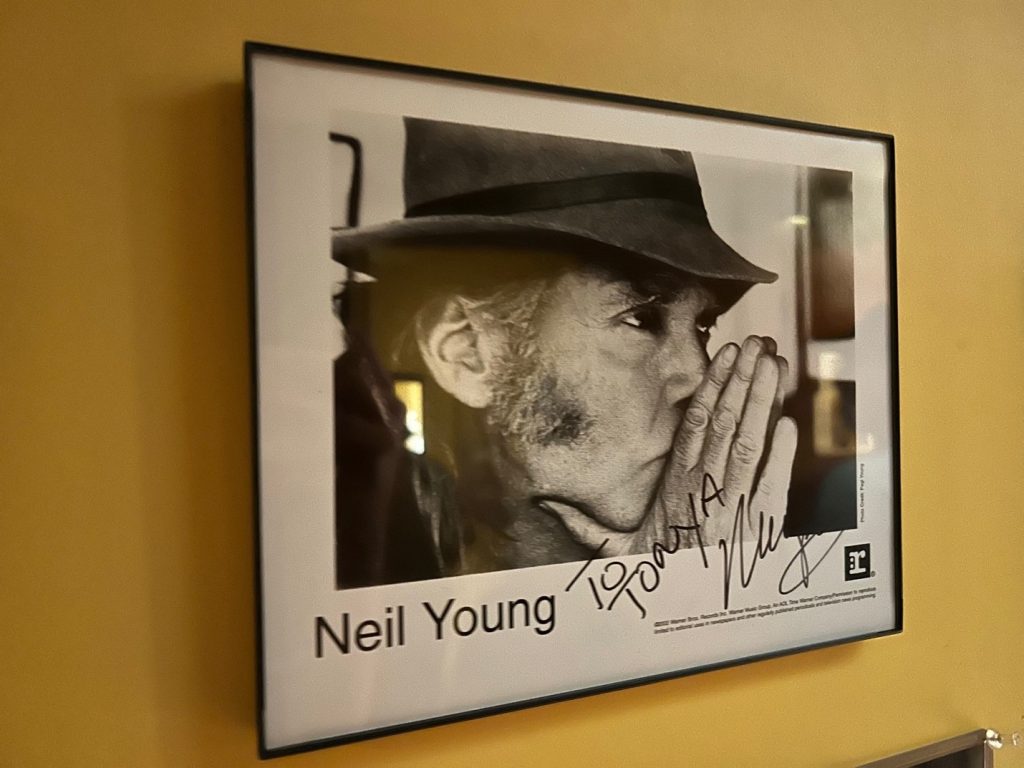
On May 4th, four unarmed students were shot and killed by the National Guard at Kent State University. It was a seismic jolt to the American soul. Neil took his guitar into the woods and wrote Ohio. Just days later, Crosby, Stills, Nash & Young recorded it in a single session.
“Tin soldiers and Nixon coming…”
That one song, raw and unfiltered, captured the anguish of a generation. It turned Neil into more than a rock poet—he became the voice of protest, of reckoning. Before Ohio, he had already written unforgettable songs like Down by the River, Cinnamon Girl, and Cowgirl in the Sand—moody, electric meditations on love and alienation. But Ohio changed everything.
It told the truth in real time, refusing to let the moment fade. As David Karen, sociology professor at Bryn Mawr College, said: “Neil Young underlined just how corrupt and awful the government was—not only about Vietnam.” Ohio became more than a song; it became a stand.
And today, walking the streets of Los Angeles, it’s easy to feel echoes of that same unrest. The homelessness crisis has reached staggering levels. Sirens still split the night. Tents line the sidewalks just blocks from where the Whisky still stands, now a relic of a wilder era surrounded by new towers and old ghosts. The dreams that once brought artists and runaways to Hollywood haven’t vanished—but they’ve hardened. They’re less about stardom now, more about survival.
Back then, we believed music could change the world—and sometimes, it did. Now, in a city straining under economic
And now, the echoes return.
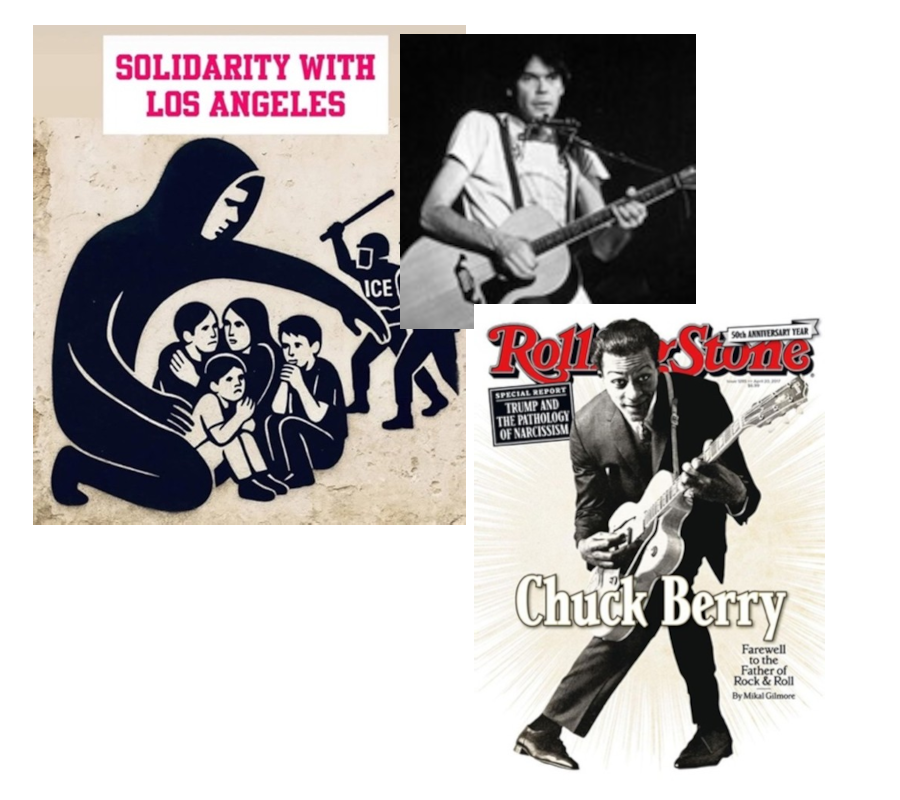
Just as the music we lived with in the late ’60s and early ’70s became an instrument of protest, Los Angeles today is once again a stage for resistance. A wave of demonstrations has erupted in response to aggressive ICE raids—federal immigration enforcement targeting undocumented workers across the city. On June 6, 2025, arrests began in garment districts, parking lots, and workplaces, igniting outrage in immigrant communities.
By June 7, President Trump escalated the response—deploying 2,000 National Guard troops, bypassing California Governor Gavin Newsom’s authority Sirens, tear gas, flash-bangs—echoes of Civil Rights confrontations reverberate through streets once written into songs like Ohio.
On June 8 and 9, the federal presence in L.A. peaked: 300 National Guardsmen, backed by 700 Marines, were stationed downtown—without the governor’s request—sparking accusations of unconstitutional overreach The deployment marks the first presidential activation of a state’s Guard since 1965
Even deeper, an incendiary moment arrived: Trump publicly stated he believed California Governor Newsom should be arrested—calling dissent “insurrectionist” and raising specters of authoritarian control Newsom responded, “This is a day I hoped I would never see in America… an unmistakable step toward authoritarianism”
______________________________________
So what’s the connection?__
1. Music as a mirror and a weapon. In 1970, Ohio channeled collective outrage, exposing truths raw and immediate. Today’s artists, songwriters, poets, and everyday Angelenos once again find themselves using their voices—on the streets, on social media, behind microphones—to speak out, to preserve dignity, to defend human rights.
2. Federal-state collision. Just like the government-student clash at Kent State, there’s now a stark rupture between Californian leadership and federal authority. The deployment of troops without gubernatorial consent echoes a long-standing constitutional conflict.
3. A generation’s reprise. The kids who walked in the footsteps of hippies now walk through tent camps and checkpoints, holding signs, chanting across freeways, invoking communal memory to frame this moment: that injustice demands attention, that “law and order” is hollow without equity.
4. A choice before us all. Back then, we each had to decide: stay quiet or stand. Today, the stakes feel just as high. Will we let history repeat—or learn from it? Will music fade into backdrop—or rise again as our call to action?
So when I walk tonight past the old Whisky a Go Go—its neon a ghostly shadow against a skyline more crowded, more divided than ever—I hear that same spirit. The songs echo, the streets pulse, and the question remains the same:
Which side of history will we be on?