
By Joshua Chong – Arts Critic & Reporter
His notable projects include a new extension to the Art Gallery of Ontario and the Guggenheim Museum Bilbao.
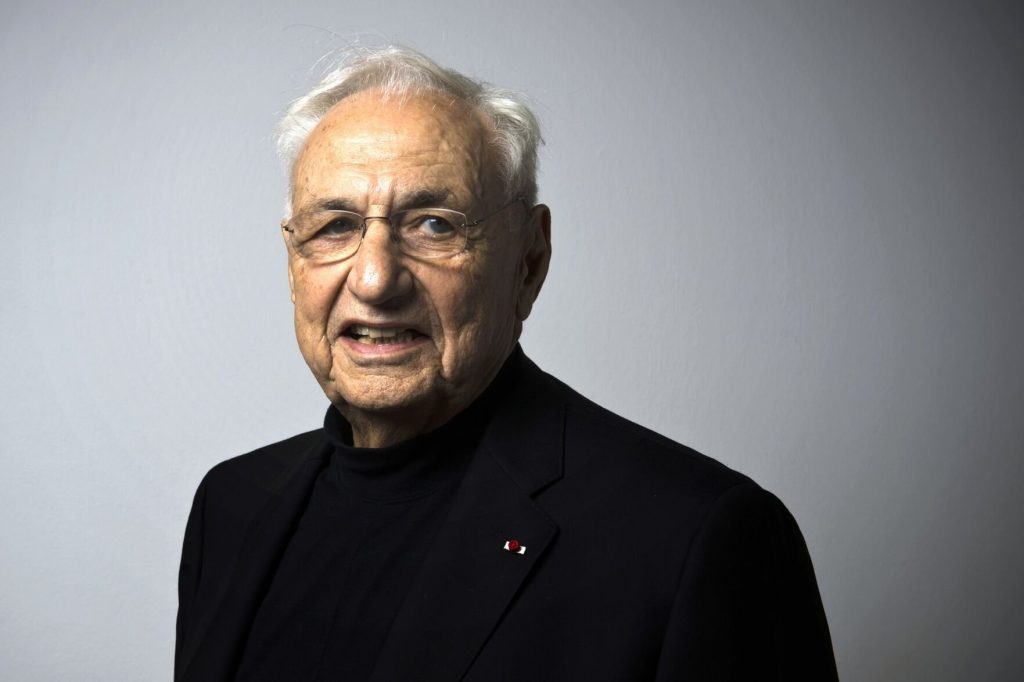
Frank Gehry, the Canadian-American architect whose dynamic buildings defied convention, cementing him as one of the most important and influential designers of his generation, died on Friday at his home in Santa Monica, Calif. He was 96.
Meaghan Lloyd, his chief of staff, confirmed the death to the Star. His death followed a brief respiratory illness.
Known for his deconstructivist and playful style, Gehry’s projects often employed complex geometries and unique materials. His structures were inherently expressive, featuring curvilinear forms and bold, swooping edges.
Over a career that stretched more than half a century, Gehry completed and executed more than 150 projects around the world, including the Walt Disney Concert Hall in his hometown of Los Angeles and the Jay Pritzker Pavilion in Chicago’s Millennium Park.
In Toronto, however, where Gehry was born and raised, he’s perhaps most associated with leading the $276-million renovation of the Art Gallery of Ontario, which began in 2004 and was completed in 2008. His design included a new facade for the museum, composed of glass and wooden beams, overlooking Dundas Street West and the iconic spiral staircase in the museum’s Walker Court.
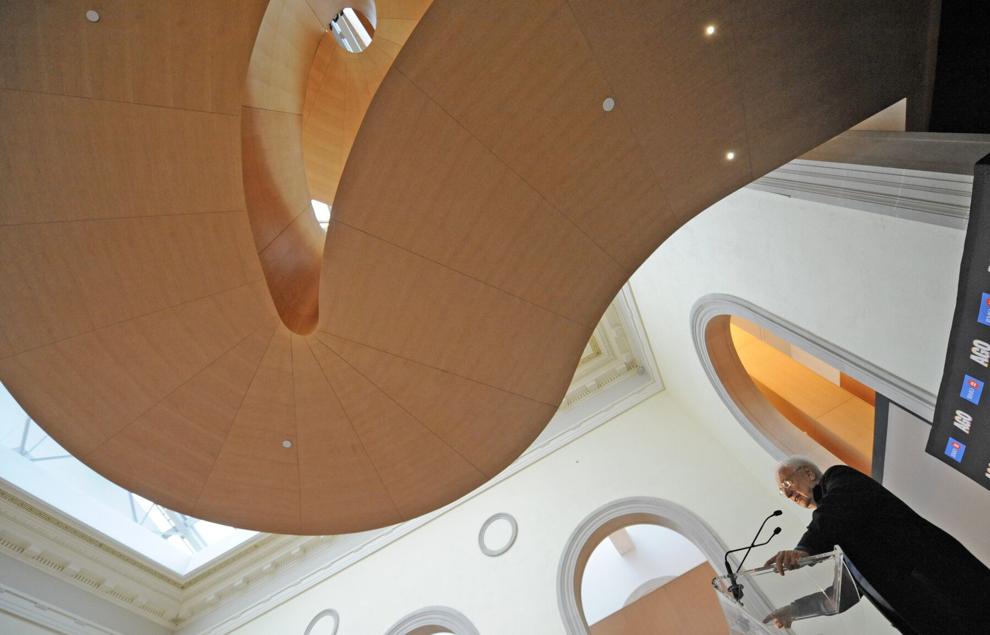 Frank Gehry speaks under the the Allan Slaight & Emmanuelle Gattuso Staircase during a press conference at the AGO in November 2008. Aaron Harris/Toronto Star
Though the project was more modest than most of Gehry’s other commissions, it was praised for its elegance. Christopher Hume, the Star’s former architecture critic, hailed the structure as “the easiest, most effortless and relaxed architectural masterpiece this city has seen.”
In an interview with the Star in 2008, Gehry said his work on the galleries was “the best I’ve ever done.”
“We did the best thing we could do on our budget; a very complicated way of interweaving things within a structure that had been remade many times,” he said. “There are a few details I’d like to modify and maybe some parts aren’t exactly right, but on the whole I think it works surprisingly well.”
Stephan Jost, the CEO of the AGO, said in a statement to the Star, “Frank Gehry was not only the most important architect of the last half century, he was also a great Canadian icon and literally transformed the AGO into the architectural masterpiece it is today.”
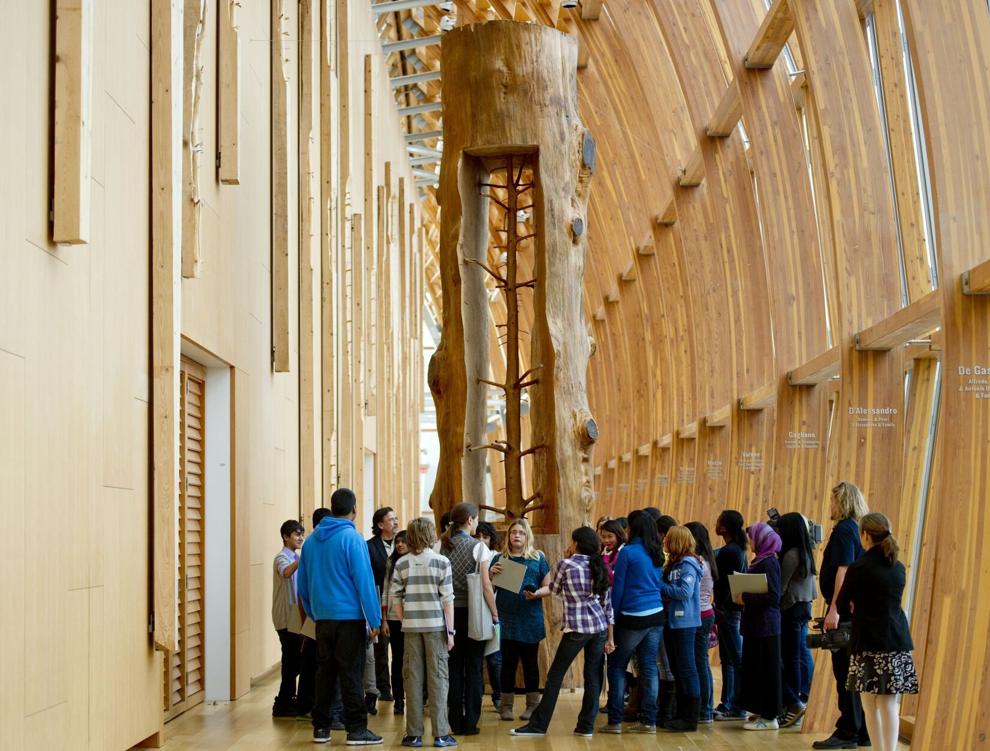 Students gather in the AGO’s Galleria Italia, designed by Frank Gehry, in this 2011 photo. CARLOS OSORIO TORONTO STAR
Prior to his death, Gehry also designed Forma, a mixed-use, two-tower megaproject that is currently under construction on King Street West. When complete, the complex will tower 73- and 84-stories above the Toronto skyline.
“Frank Gehry was much more than my honourable friend. He made architecture that fits his clients’ needs,” said David Mirvish, who partnered with Gehry on Forma and has known the architect for more than five decades. “Frank was willing to take on and looked for interesting and ambitious projects.”
But Gehry’s name would be most associated with the Guggenheim Museum Bilbao in Spain, considered by most critics as his masterpiece, and one of the best structures of the 20th century.
Completed in 1997, the building was made of titanium, limestone and glass. It’s almost sculptural in its form, with swirling surfaces evoking a sense of movement and organicity.
Arriving at a time when public interest in architecture was declining, the Guggenheim Museum Bilbao thrust Gehry’s practice back into the spotlight. The project was such a success that it helped to revitalize Bilbao’s economy and culture, a phenomenon that was later termed the “Bilbao effect.” Meanwhile, Gehry himself became such a celebrity following the museum’s opening that he was often referred to as a “starchitect” — a portmanteau to distinguish architects who had achieved mainstream star status.
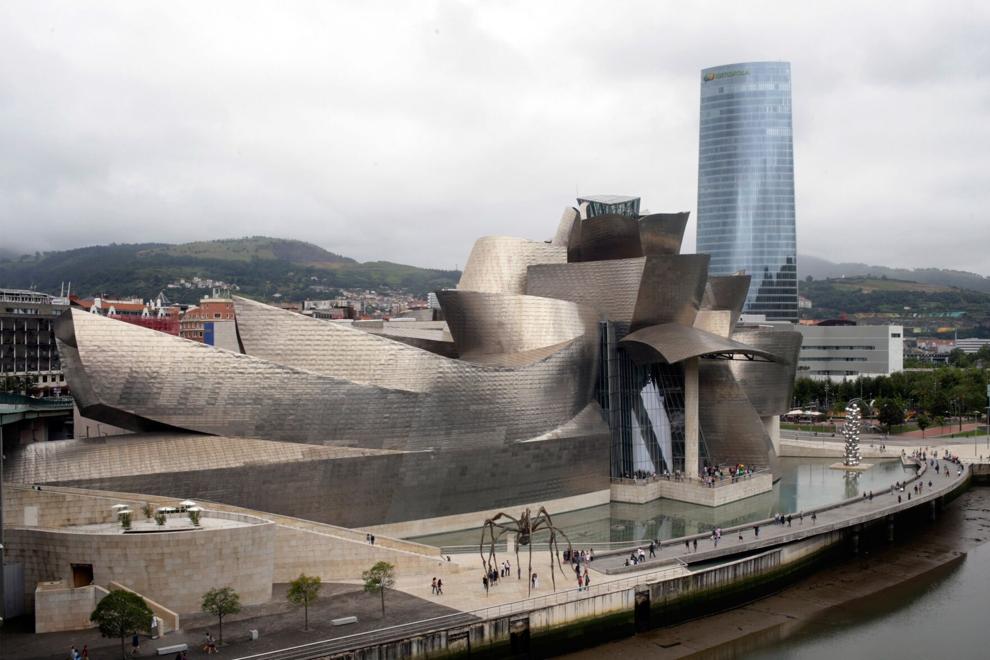 The Guggenheim Museum Bilbao, which was completed in 1997, is considered Gehry’s masterpiece. Bloomberg via Getty Images
Gehry’s projects were largely concentrated in Southern California and Los Angeles, so much so that the city’s architecture became synonymous with his style.
Gehry’s pace of work never slowed. He continued his practice well into his 80s and 90s. But by that point in his career, Gehry could be selective in the commissions he accepted. And he often chose to dedicate his time on projects that promoted social justice. In Los Angeles, he helped to build housing for homeless veterans, and also designed a home for the Los Angeles Philharmonic’s youth orchestra.
Later in life, Gehry toyed with the idea of moving back to Toronto. “It’s because of the politics here,” Gehry, a left-leaning liberal, told the Star in 2016, in reference to the U.S.
For his architectural contributions, Gehry was awarded the Order of Canada in 2002. He was also bestowed in 2016 the Presidential Medal of Freedom, the highest civilian honour in the U.S., by former U.S. president Barack Obama.
 Frank Gehry as a child in Toronto.
Frank Owen Goldberg was born at Toronto General Hospital on Feb. 28, 1929. His mother, Sadie Thelma Caplanski, was a Jewish immigrant from Poland whose family immigrated to Canada when she was a child to escape the rising tide of antisemitism in Eastern Europe. Gehry’s father, Irving Goldberg, was originally from New York City. He ran a business leasing and servicing slot machines, pinball machines and jukeboxes.
Gehry was introduced to the arts at a young age. He attended classical music concerts with his mother as a child, and also frequented the Art Gallery of Toronto, later renamed the Art Gallery of Ontario, the museum which he would later redesign some seven decades later.
After spending much of his childhood in Toronto, Gehry and his family immigrated to the U.S., settling in Los Angeles in 1947. He studied architecture at the University of Southern California, then enrolled at the Harvard University Graduate School of Design, but did not finish his postgraduate degree.
As a young architect, Gehry thrived in Los Angeles. In an open letter he later penned for a special exhibition at the Los Angeles County Museum of Art, he thanked the city for giving him those opportunities. “Anywhere else in the world I would have had difficulty taking the route that you afforded me,” he wrote.
Gehry was married twice, first to Anita Snyder, then to Berta Isabel Aguilera. Between his two marriages, he has four children.
Throughout his career, Gehry remained true to his artistic roots. Though he learned to embrace new technology, including computers that could help him execute more complex designs, he always began each project with a free-handed sketch, using nothing more than pen and paper.
“People ask me if I’m an artist or an architect,” he once said in a 1987 interview. “But I think they’re the same.”