
By Susan Delacourt National Columnist
Opinion
If the theme of 2025 in Canadian politics was to expect the unexpected, the ways in which the political world turned upside down will reverberate into 2026. Everyone will have their own surprise developments of this truly tumultuous year, but here are my top five picks for the big country-shaking shifts of 2025.
The Liberal revival and the Conservative rupture
This time last year, Justin Trudeau was still prime minister, his deputy, Chrystia Freeland, had just quit and almost all Liberal MPs were wondering whether they could keep their seats in the next election.
But along came Mark Carney to fill Trudeau’s shoes and incredibly, the Liberals came close to winning another majority in April. This was significant not just for the Liberals, but for the larger shape of politics in this country.
The Liberals have generally represented the mass-market middle of the political spectrum. Their fortunes have faltered when Canada moves to a polarized fight between right and left, as it seemed in 2015, when it looked like the major fight was between the Conservatives and the New Democratic opposition.
The 2025 election was not going to be that fight, but it did look like Canada was facing a choice between the surging Conservatives under Pierre Poilievre, and a Liberal party that had tacked heavily left under Trudeau.
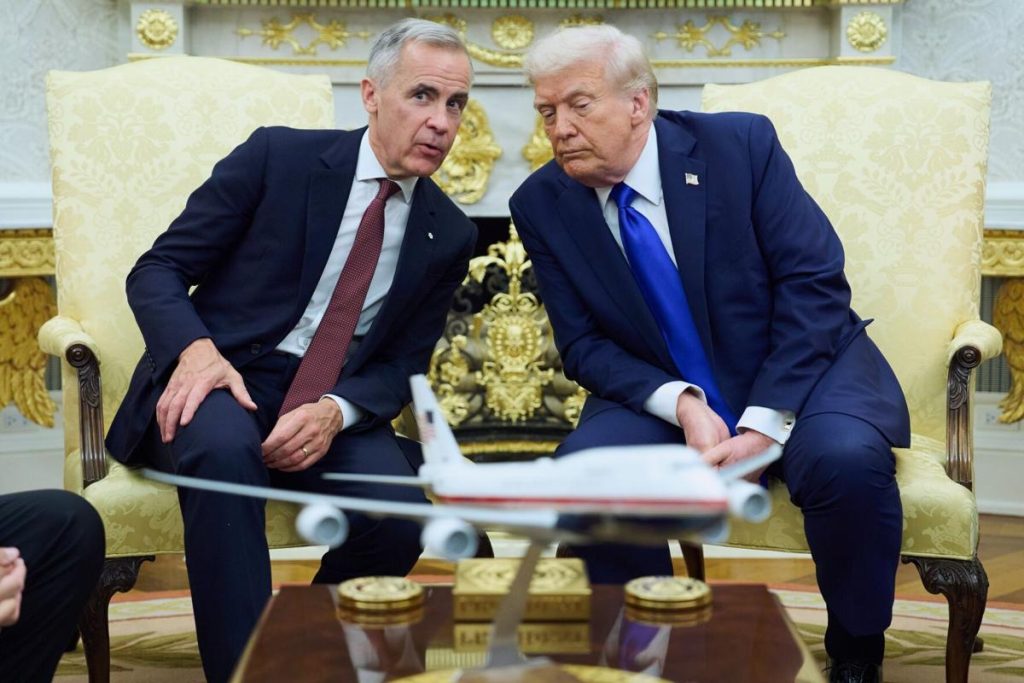
Carney, however, redefined the middle, by borrowing (some would say stealing) some Conservative ideas and putting a more business-friendly face on the Liberals. It didn’t hurt either that many voters saw him as the best leader to negotiate with Donald Trump; someone whose banking and corporate experience would earn some respect from the president. Where Trump was the agent of chaos, Carney presented himself as the force of calm.
The lingering question is whether there is a clearly, progressive left party in Canada and if not, where do those voters go? The New Democrats remain leaderless, and Liberals who are more red than blue are still wondering where they fit in what Carney likes to call his “new government.”
And you can’t talk about Liberal revival, without looking at what it’s done to the Conservative party and Poilievre. The election and subsequent events have exposed fissures among the country’s conservatives — between progressive conservatives in Ontario and the Atlantic, and the Western populists. The divisions are even rumbling through the Conservative caucus, with two floor-crossers and more possibly to come, according to Liberal ministers. Poilievre faces a leadership review early in 2026.
What Carney and Poilievre have in common going into 2026 is a struggle to maintain big-tent politics in a climate polarized by Trump, affordability challenges and stirrings of separatist sentiment in the West and Quebec.
Alberta memo of understanding
Only in Canada would a “memo of understanding” be a watershed development. It sounds as exciting as that old winner of the boring-headline contest: “worthwhile Canadian initiative.”
But this was and will be a big deal. The deal signed late this year between Carney and the government of Alberta Premier Danielle Smith shook the natural order of things in a country where hostility between Ottawa and Alberta has been so constant it might be part of the Constitution.
Let’s never let politicians say again that they don’t deal in hypotheticals. The energy-and-environment deal signed between Ottawa and Alberta is entirely about a hypothetical pipeline and what governments on either side are willing to compromise should one emerge on the horizon.
As we head into 2026, all this is going to become a lot less hypothetical. With each move along the way, the country’s politicians are going to be challenged about their commitments to crucial matters on climate change, Canada’s energy future, Indigenous reconciliation and unity of the federation itself.
How will Carney manage to keep Alberta happy and looking forward to a pipeline, without colliding into opposition from British Columbia, Indigenous communities and environmentalists all over the country? Can Smith or Carney even buy peace in Alberta? Does anyone want to build a new pipeline? These are hypothetical questions right now, but not for long. There’s high potential here for a memo of understanding to turn into a long-running saga of misunderstanding. There’s a long way to go before this becomes a worthwhile Canadian initiative.
Ontario government’s Reagan ad
My first glimpse of this ad came, along with many others, at the big Canada-U.S. summit, hosted in Toronto in early October by the Eurasia Group and the Bank of Montreal. It showed former U.S. president Ronald Reagan, warning against tariffs. I won’t speak for others in the audience, but I found it clever — amusing, even. So did Trump for a while. The president said he might have even been tempted to do an ad like that.
That shrug soon turned into a backlash. Days later, Trump pronounced himself so peeved with the ad that trade talks were suspended and Canada would be hit with a 10 per cent increase in tariffs. Carney eventually apologized to Trump for the ad.
I choose this as a pivotal moment for the country because it crystallizes what you can call the Trump effect. Every country is wrestling with how to deal with this president. For a while, it looked like Carney and Ford were doing the good-cop/bad-cop thing, with the prime minister choosing diplomacy and Ford talking tough to the bully. What’s exasperating is that neither approach works — at least not for long,
Defence spending up
It is no small thing that Canada is in the midst of a massive increase in defence spending. The fall budget pumped around $9 billion in additional cash to defence, to bring Canada’s spending to the current NATO target of two per cent of gross domestic product. The longer-term goal, reflecting the new NATO target, is to get Canada’s spending to five per cent of GDP in the next 10 years.
Leaving numbers aside, this is a huge cultural shift for this country, which long kept defence on the back burner, compared to what were seen as more urgent spending needs, such as health, for instance, or other social programs.
Canada has had many reasons over the past few years to see the world as a more precarious, dangerous place. Wars in Ukraine and the Middle East have been destabilizing to the world’s economy and to the shape of major-power relationships. But the increase in defence spending shows that Canada has to come to grips with its own role in protecting security that we long have taken for granted.
Carney also said there would be “sacrifices” necessary to do this spending boost. The next year may make more clear what those sacrifices are.
Immigration down
Pollsters have been flagging for a while now that something is breaking in what we used to call the Canadian consensus on immigration. Politicians of all stripes clamoured to cast immigration as an economically and socially binding force in this country.
But immigration is now a fraught political topic. In a poll this fall by the Environics Institute, the cultural shift was vividly captured. More than half of Canadians, it reported, now believe there is too much immigration to Canada. The surge in that sentiment, Environics reported, comes from a rapid increase in that sentiment among Conservative voters. In 2020, 41 per cent of Conservative voters said there was too much immigration. In 2025, that had doubled to a whopping 82 per cent.
Conservatives and Liberals, predictably, have been trading blame on who broke the consensus in Canada. Poilievre and his team say the Liberals created the anti-immigrant sentiment by letting in too many newcomers to a country not equipped to handle their housing, employment and health-care needs. Liberals accuse Conservatives of playing to the xenophobia on display with the hard right and in Trump’s America.
Whatever has broken in Canada when it comes to immigration, it carries huge implications for political culture. Where politics once rewarded openness to other cultures and a larger, more generous world view, this speaks to a hardening of borders, if not attitudes.
It is impossible to divorce any of these five big developments in Canada from the influence of Trump, and all he has done to disrupt order in the world in just one year. Rather than pick his re-entry to the White House as one of the big things that changed in Canada in 2025, I thought it was more useful to delve into the breadth of what this president has done to turn Canadian political culture on its head this past year.
Thanks to Trump, Carney, not Poilievre, won the election. Carney knows that a permanently discontented Alberta is fuel for Trump’s disruption, and all the province’s resources the president covets. Trump has revved up the need for more defence spending and broadened the worldwide conversation about closing borders on immigration. And Trump leaves countries in a constant state of wondering whether to pander or resist, even on something as simple as a TV ad.