
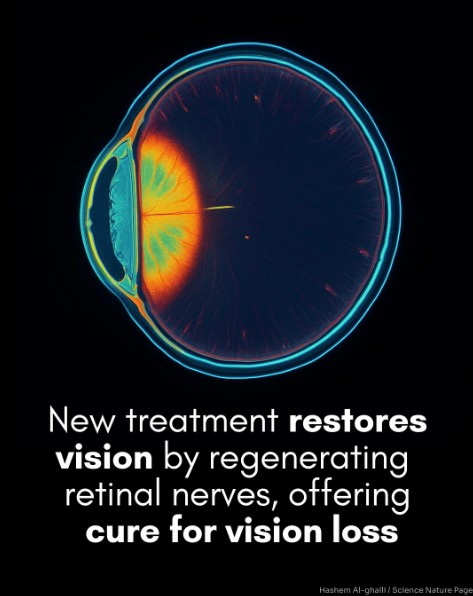
In a groundbreaking breakthrough, researchers at South Korea’s KAIST have developed a drug that regenerates retinal nerves and restores vision — something previously thought impossible in mammals.
By targeting the protein PROX1, which blocks retinal cell regeneration, the treatment reversed vision loss in disease-model mice and maintained the effect for over six months.
This marks the first time scientists have successfully achieved long-term nerve regeneration in the mammalian retina, potentially transforming treatment options for millions suffering from degenerative retinal diseases like retinitis pigmentosa.
The therapy uses an antibody to intercept and eliminate PROX1 before it inhibits Müller glia, the retinal support cells critical for neuron regeneration in fish but largely dormant in mammals.
Developed by biotech startup Celliaz Inc., the antibody effectively reactivates these cells’ regenerative capabilities.
With plans for clinical trials by 2028, this discovery signals a hopeful future for those with currently untreatable vision loss and highlights the power of translating biological insights from nature into medical innovation.
Learn more here!
NYA Thanks @hashem.alghaili!