

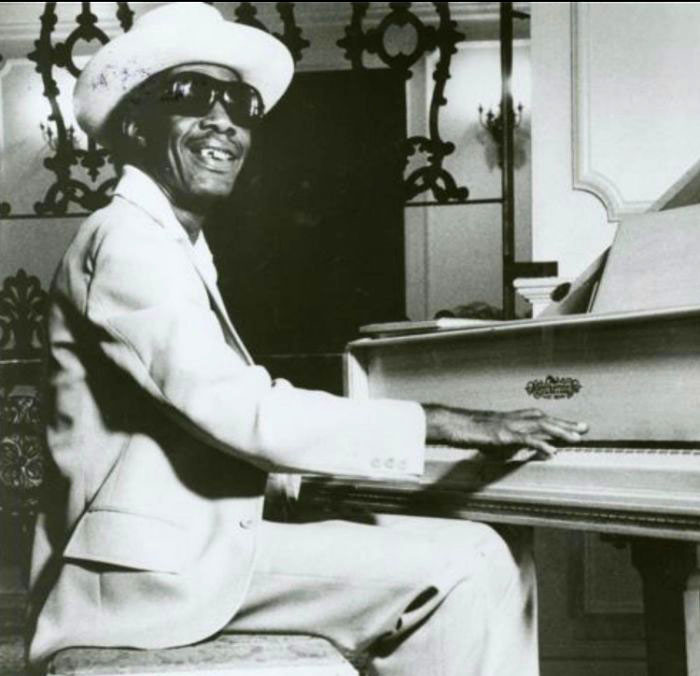
Professor Longhair
When it’s near the end of April, my New Orleans spirit starts to show up strong. There is something about that city, and especially the music that comes from there, that makes the blood feel warmer, and brings back an endless smile for all the years the good times rolled in my many visits way down yonder. This is the time when the New Orleans Jazz & Heritage Festival hosts the first of two weekends of such power-packed music that it sometimes feels impossible it all actually happened.
Those late April days at the Fairgrounds racetrack now seem like a fevered dream of endless excitement, and then the unending nights of shows at the city’s nightclubs and even on the S.S. President riverboat is beyond belief. There is something about New Orleans itself that often took on aspects of a hallucination of happiness, almost like it couldn’t be true. To go from a Professor Longhair bash at Tipitina’s nightclub at the corner of Napoleon and Tchoupitoulas to seeing one of the very first Neville Brothers funkathons at Jed’s uptown, then on to a Johnny Adams’ all-nighter at Dorothy’s Medallion Lounge that would end when the sun came up is to enter a musical sweet-spot that will never come again. Doing that year after year, and having the presence of mind to know that something completely extraordinary was happening, is to win the musical lottery of a lifetime. I have no idea why I fell into this magical zone, but can recall the very first time it happened: April 23-24, 1977. That was the seventh year of Jazz Fest, and by then the word had spread around the world about the irreplaceable grandness of the live music to be heard there.
My first visit to the New Orleans Jazz Festival 1977 was almost an accident, but like so many hallelujah moments in life, looking back it’s obvious it was meant to happen. Some of my friends in Austin had been the year before, and told me they would never let me live it down if I didn’t go the next year. They knew exactly where my musical proclivities were, and how much I flipped for anything with a strong backbeat and celestial singers, which is exactly what was happening all over the Fairgrounds those golden weekends in late April and early May. So with high hopes and deep faith my buddy Dr. M and I drove from Austin to Houston the morning of April 22 in 1977 to catch a plane to New Orleans. Not sure why the drive, but probably to save a few dollars on airfare. First I had to get a permission-to-travel permit (which would come in mighty handy in a few days) signed by my probation officer in Austin, thanks to a slight legal entanglement I had there. No problem. Austin was probably glad to see me go for a while.
Once the good Doctor and I landed at the airport in the City that Care Forgot, as New Orleans is so aptly nicknamed, our brainwaves were blasting. When we heard Huey “Piano” Smith’s “Little Chickie Wah Wah” on the airport Muzak it felt like a big red carpet had been rolled out just for us. There is something so physically freeing about Charles “Hungry” Williams’ drumbeat on that song that it almost lifts the feet right off the ground. TIME magazine critic Jay Cocks once wrote about Smith’s music, dubbing it “endless antics of absolute insignificance.” At first I thought Cocks was dissing the musician, but soon realized it was actually high Zen praise of what rock & roll could accomplish. At least that’s how the fog of time has framed the memory, and I’m sticking with it.
I instantly thought about writing a song called “I Can’t Walk (‘Cause I’m Dancin’).” It wouldn’t be the last song I would think of writing about that wonderful weekend. New Orleans does that to you: replaces reason and responsibility with fantastical dreams and Looney-Tunes logic. The reward is that some kind of invisible hand of fate reaches down and makes sure everything works out, even when it shouldn’t. Maybe that’s because New Orleans is such an old city that it can’t be held to the modern responsibilities of other metropolitan burgs. Whatever is supposed to be will be. And everything else can take a slow stroll into the Mississippi River that rolls right through the city.
Once Dr. M and I got to the French Quarter and found the De La Poste hotel, the streets had turned into a non-stop parade of crazed humans and atomic sounds. There is no place like New Orleans when its fuse is lit. A dozen different strains of music collide into each other through the thick air and enter into an invisible dance of delight. Smiles are mandatory for all involved, and it starts to feel like the clocks have been shot and time doesn’t really exist. Not in any real fashion. Bars are open 24 hours, and many don’t even bother to have locks on the front door. Gaiety is de rigueur, like a holy right for everyone. The New Orleans sky had turned the deepest shade of blue on the planet, and as darkness started to descend on the Quarter it appeared to jack up the bloodstreams of the wandering pedestrians all doing the sidewalk boogie on Royal, Bourbon, Decatur and avenues beyond. Things were about to happen.
For us it was a march on Royal Street to Canal and the ancient street cars that cruise up St. Charles before hanging a right on Carrollton. We jumped on one to get to Napoleon, and then walked on the neutral zone, as the esplanades are called there, and went looking for a new club called Tipitina’s. None other than Roy Byrd, aka Professor Longhair, would be commandeering the stage at midnight, and it was something not to miss. Longhair was as legendary as New Orleans music gets, and for the most part had been MIA for many years of his life since his early popularity in the late-1940s and ’50s. But the Professor was back, and once he got jumping that night in ’77, it was bliss-city throughout the club. Maybe that’s because there is no one, repeat no one, who ever played the piano and sang like this man. He put such a boatload of gris-gris on all his syncopated songs they twisted the ears of those nearby into a pretzel. And he then proceeded to sing and whistle along like the Pied Piper of an unnamed planet. As his set progressed so did the level of hypnosis Longhair placed on the frenzied crowd, until by the end of the evening when there was such an air of undeniable delirium among the faithful that Tipitina’s seemed to capsize back and forth, like it was a boat rocking in the Gulf of Mexico. Screams, whistles, stomps and various uncivilized behaviors commenced in the club so wildly that the good Professor could not leave the stage without sparking mayhem. So he came back out and geared up the most knocked-out version of “Big Chief” ever done, and telepathically transported the crowd straight down to Rampart and Dumaine and then Congo Square. I was so taken up in the cosmic nirvana that I walked up onstage and got Professor Longhair to sign my B.C. headache powder packet I carried for emergencies. When my wallet was lost five years later, it hurt more losing that autograph than my driver’s license. I’m still praying it gets returned someday.
It was three o’clock in the morning before Dr. M and I got back to our hotel, and since tomorrow would be spent at Jazz Fest spread out over the entire Fairgrounds racetrack, we decided to turn in early. By New Orleans standards. The next morning, after a beignet and cup of liquid speed (aka chicory coffee) at Cafe du Monde, we grabbed a city bus down Esplanade to see exactly what was in store for the inaugural day. Among every musical event I’ve ever been to–rock festivals, Mississippi blues barbecues, Madison Square Garden concerts, a private Velvet Underground event in Paris, The Texas Playboys in dance halls, wherever–there has never been anything as exciting as walking into the New Orleans Jazz Festival those first dozen years. Spread all over the infield of the racetrack, with a dozen stages large and small, it looked like someone had drawn a schematic of heaven and then filled it with everyone from Albert King to the Neville Brothers to Irma Thomas to the Dixie Hummingbirds to the Dixie Cups to Ironing Board Sam to Lee Dorsey and beyond. There were colorful homemade flags flying, people body-painted within an inch of their lives, culinary jackpots like boudin and crawfish, Peterbilts full of ice cold Dixie beer and true music dignitaries like Count Basie sauntering around the stage areas. Even Bongo Joe was pounding out his extraterrestrial rhythms on a 55-gallon oil barrel he tuned with a hatchet and crowbar. It was like a mad hatter had redrawn reality and let the good times roll. I don’t think I’ve ever been as exhilarated for any one moment in my entire life. After an hour of copping as many visuals as possible just sweeping it all in, my skin felt like a dozen lizards had crawled inside me and were running up and down the length of my body at full speed. I had to remember to breathe I was so enthralled.
After six hours of floating from one stage or tent to another in a state of perpetual perfection and melting into a flow of divine glory that such wonderful music evokes, Dr. M and I found ourselves in front of Stage 2 just as Bonnie Raitt and band kicked into their screaming smash hit at the time: a funkified redo of Del Shannon’s forever-great signature song “Runaway.” The huge swell of people in front of Raitt gelled into one undulating sea of groovers, bopping and dipping and screaming and shouting along to the unforgettable chorus: “And I wonder I wa wa wa wa wonder / Why a why why why why she ran away / And I wonder where she will stay / my little runaway my run run run run runaway…” By now 90% of the crowd felt like they were levitating, and the other 10% were passed out in the back of the crowd holding on to the ground to stay steady. Directly above all this someone jumped out of a low-flying prop plane and quickly pulled open their parachute. The person deftly guided themselves down to the edge of the crowd just as Bonnie Raitt glided into the song “What Do You Want the Boy to Do.” It was an easeful transition from “Runaway” into softly bringing the audience back to earth, and just as Raitt got to the second verse, to the side of the band the song’s writer and all-time New Orleans absolute hero Allen Toussaint slid onto the piano bench to perform it alongside the band. For those music lusters in the know, seeing Toussaint suddenly appear unannounced was like having the Pope come onboard silently at a Sunday mass in Jackson Square’s St. Louis cathedral, and brought Saturday’s music full-circle. There was no way to top it, nor was there a need to. Sometimes life feels so full it’s best to put a pin in it and hope tomorrow comes soon.
And that’s exactly what happened on Sunday. There was local hero at the time Aaron Neville singing in the gospel tent while grown men and women cried at the beauty of his voice, Snooks Eaglin with the Meters’ drummer Zigaboo Modeliste and bassist George Porter Jr. running circles around the funk on one of the smaller stages, Ernie K-Doe cutting up and getting down on his hits “Mother-in Law,” “A Certain Girl” and “T’ain’t it the Truth” and Walter “Wolfman” Washington playing a kind of voodoo blues that must have had Marie Laveau smiling somewhere. The Wolfman could actually howl. All this and so much more all over the massive grounds, sending out gargantuan waves of irresistible righteousness on the Sabbath. God was not only in the house, he was at the Fairgrounds. And at exactly the right moment, Antoine “Fats” Domino and his 10-piece band kicked off their soulacious set with “I’m Ready.” Straight off the opening downbeat, you could hear that the Fat Man, as he called himself, had the cream of the crawfish crop for band members. The five-piece horn section was playing the music of the spheres, with people like Herb Hardesty, Lee Allen and Red Tyler shining like diamonds, at the same time guitarist Justin Adams and drummer Smokey Johnson pulled magic tricks from their repertoire-heavy hats on a set list straight out of blue heaven. After an hour of musically-induced ecstasy, the clipped guitar notes of “Walkin’ to New Orleans” spread over the 10,000 people in front of the stage like they were being covered with a blanket of audio spirituality. Fats Domino is the crowning jewel of New Orleans music, a man who started out playing for tips between sets by better-known locals, but quickly grabbed the winning ticket to permanent royalty. He still lived in New Orleans’ Ninth Ward, and when he moved next door he put the letters FD on the front of his new house with big black plastic letters so people would know he was still in the neighborhood. Fats Domino was permanently home–in New Orleans. When Jazz Fest ended that Sunday night, it had to be with Domino. There is no other end possible to such a fantastical Jazz & Heritage Festival. As we motored to the airport to fly back to Houston, Dr. M and I swore an oath that the only way we would ever miss a future Jazz Fest would be if we were in jail or dead. And I kept that bond for the next twenty-five years, except in 1989 when our first child was born during festival week, and the year that the whole event got canceled because of torrential rainstorms. Then, after Hurricane Katrina devastated so much of southern Louisiana in 2005, it felt like it was time to say goodbye to what had been a 25-year run. Never overstay your welcome my mother used to tell me. And that time had come.
Still, getting back to Austin from that first festival in 1977 proved to be a little trickier than Dr. M and I had imagined. When we got to the New Orleans airport after our Fats Domino epiphany, we’d forgotten it was the start of Daylight Savings Time that day so it was an hour later than we thought. We had missed our connecting plane to Houston. Which meant we had to sit in the New Orleans airport overnight waiting for the next departure at 7 a.m. When we finally did disembark in Houston on Monday at 8 a.m., there were several uniformed Houston policemen, two tall men in gray suits and even a German shepherd waiting at the end of the arrival ramp. Neither of us is sure why, but we both instantly snapped they were waiting for us. That was definitely the overriding vibe. The law enforcement officers quickly stepped forward, separated me and Dr. M, arrested both of us on federal bank robbery charges, then marched us handcuffed through the airport directly to the basement where the jail cells were. By then, I was so confused I didn’t even try thinking. I’d grown up in Houston and knew the best thing to do in the presence of their police force was to be quiet and stay respectful. The officers did not like two-way discussions about anything. A few hours later one of the men in a gray suit came into my cell and said a small error had been made. Dr. M resembled someone on a Wanted for Bank Robbery poster the airport personnel in New Orleans had, so they had alerted the authorities about the match-up. Then the FBI requested we be allowed to fly from Louisiana to Texas, because crossing state lines jacked-up the penalties for bank robbery, and they would be waiting for us in Houston when we departed the plane. Which they were. The only problem was that while Dr. M did resemble the face on the wanted poster, that person was described as being 160 pounds, and Dr. M was over 250. Not to mention being 7-inches taller than the bank robbery suspect. And the suspect’s accomplice was described as African-American. Which I am not. Then, back to the beginning, I luckily had my permission-to-travel permit from the probation department in Austin, so no problem for me there when the FBI ran my name through their system. Without that permit I would have been breaking the law and arrested. When the FBI official apologized and asked if they could do anything for me, I politely requested they call my boss, Precinct 5 Constable John Milloy in Travis County which included Austin, and tell him why I would be late for work that day. I was a dispatcher in the Constable’s office, which the FBI found extremely hard to believe, but in good spirit they did as I requested. Constable Milloy, bless his heart, and I laughed about that the rest of his life.
When Dr M and I got back to Austin and for the next few weeks, when our friends would ask us how Jazz Fest was, all we could do was break out in huge smiles, shake our heads and laugh. There are still no words to describe the power and the glory of that weekend in late April 1977, and all the others that followed in New Orleans over the years. It really was the greatest show on earth. The days and nights and all the music seen and heard there changed me forever. Even now, with almost every New Orleans artist I saw at Jazz Fest and different New Orleans nightclubs like Tipitina’s, Jimmy’s, Dorothy’s Medallion Lounge, Maple Leaf, Lion’s Den, Jed’s, Glass House and so many more, now gone on to the other side, I still feel and hear them right next to me. Such wondrous and vivid memories don’t disappear. They live inside me, telling me what an incredibly lucky life I have had, and reminding me that as long as the music plays somewhere everything is possible. As they say in New Orleans: “Yeah you right.”
Bill Bentley