

There are musicians who take on the characteristics of ghosts. They begin their musical life with all the hope and promise of those with an aura of invincibility. It is like they have inherited a way to connect with a force that promises them infinity, that their songs and performances move from ordinary strengths into that place which cannot be described. It doesn’t really happen that often, especially in our modern times when everything is easily known and knowledge is instantly shared. The times of mystery are no longer there. Knowledge is at our fingertips and there is almost nothing that can’t be discovered.
In so many ways this ability to learn anything seems like an amazing ability, but in other ways it takes away the dedication to devote passion to those things that require hard work and inventive pursuits. Having everything at our fingertips can end with a near sense of frozen overabundance. Too much can be too much. It has always seemed that becoming a private detective in the search for timeless music is part of the real thrill of finding something that is life-changing. If everything is at the click of a keyboard key, then what does that do to our attention span? Here today, and gone in a few seconds? The search is often the most thrilling aspect of true discovery. That’s where the kicks come in.
Karen Dalton, for most of her musical life, was not well known, and sometimes it seemed like that was her choice. Before the age of reissues really became king, it was like the woman was like an apparition, except for those who just happened to be in a certain nightclub in Colorado or Greenwich Village or someplace where Dalton was actually performing. Betting on and winning the trifecta might have been a stronger possibility. But the sound of her voice, like a cross between an angel and a streetcleaner, was one for the ages. It came out of nowhere but contained all the truth inside it.
Born in Bonham, Texas and raised in Oklahoma, Dalton discovered a voice that called to her to sing and play music not normally taken up by a young woman like her. She zeroed in on country blues and the most moving styles of folk music in a way that felt like it was a spiritual calling. Like there was no other way for Dalton to find a place in life that would let her exist.
The woman’s voice had an otherworldly quality that sounded like she had found a way to become another person. The depth and tone of how Karen Dalton sang went far beyond expectation, and allowed her while still a teenager to enter that zone of eternal expression. When she left the south and headed for New York City in the early 1960s, it seemed like this was a preordained calling from someone beyond herself. There are musicians who tap into the spirit world to find a new presence for who they are and what they want to do. It’s often easy to spot them, and become a follower of their sound. And once that happens, there is little chance that the inspirational wonder will ever disappear. What’s the phrase: “In for a penny, in for a pound?” For me, the dozen or so singers who captured my soul in my teenage years are still the ones who guide me through the vagaries of life: Roky Erickson, Otis Redding, Lou Reed, Van Morrison, Bobby “Blue” Bland, Townes Van Zandt, Irma Thomas, O.V. Wright, Neil Young, Etta James, Aaron Neville, Skip Spence. They are like a foundation that never shifts. After discovering Karen Dalton’s reissues in the past decade, she has become another beacon of what the human voice and its songs can capture when the heart is most open to a new sound. Once the psychic jukebox is filled it can be hard to find space for other artists, but the hunt continues because there is always hope for a new obsession.
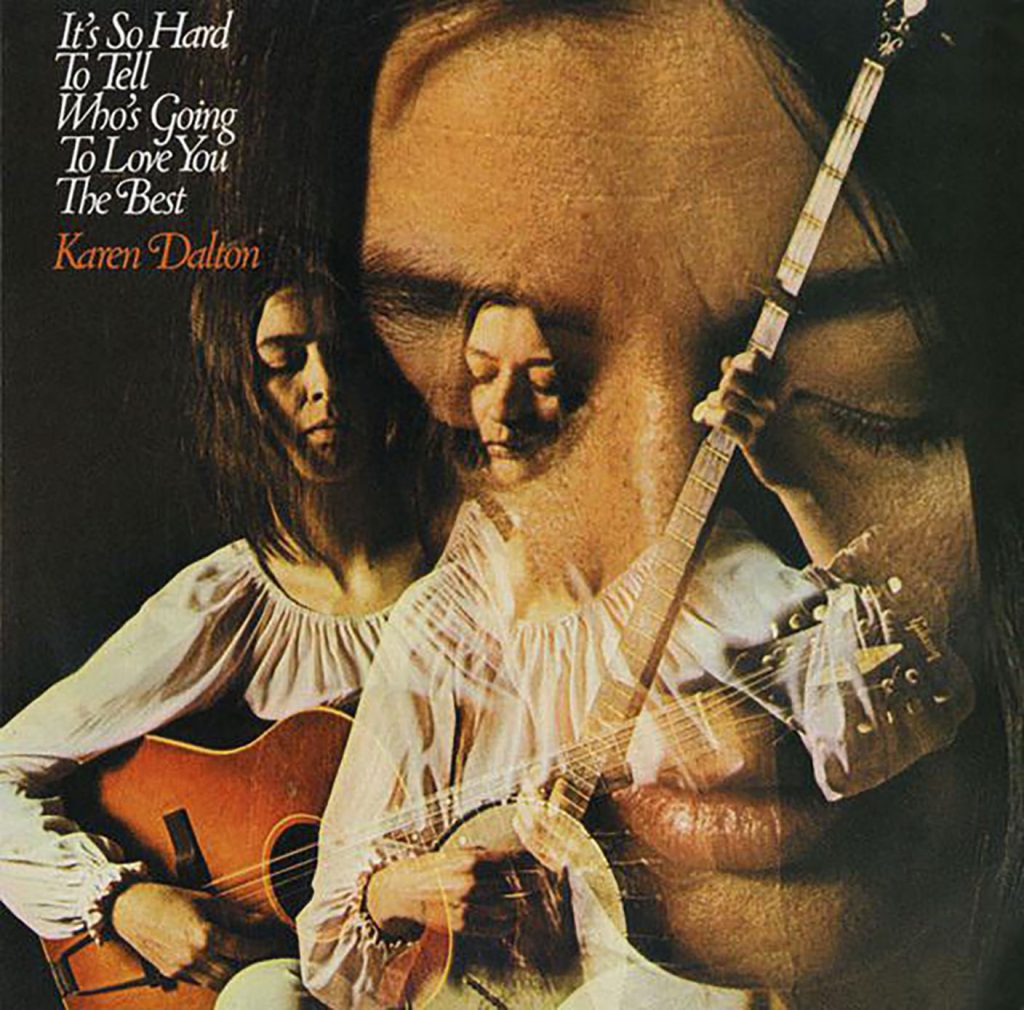
For Karen Dalton, she relied on her twelve-string acoustic guitar and long-neck banjo when she ventured over to the East Coast. Those were her tools of the trade. She also took one of her two children with her, jumping into a lifestyle that would always be challenging and full of unorthodox lifestyle surprises. At the heart of it all though, was a dedication for music that lit a fire inside her. There was no changing that, or rearranging her priorities for life. This was someone who had found a rock-bottom reason for living, and no matter how upside-down her experiences became it would always be music that called the shots. The cost could be high, but it was something she never tried to negotiate her way out of. Dalton’s first album, IT’S SO HARD TO TELL WHO’S GOING TO LOVE YOU, was released on Capitol Records in 1969. Recorded under somewhat strange circumstances, which included the engineers not telling her when the recording tape machines were rolling, it’s an honest insight into the sound of someone who really felt untethered to the world. Karen Dalton had an ethereal presence even though her songs were grounded into the hardscrabble world of the blues and the most insightful shades of American folk music. Dalton’s label, Capitol Records, was also home to folk king Fred Neil and since the two artists were already friends they were able to add musical touches to the woman’s debut release. And while it helped generate some public excitement, it really didn’t have the kind of impact the singer needed to gain enough attention to bring her a large audience.
Two years later, Karen Dalton moved to Just Sunshine Records, run by Woodstock Festival producer Michael Lang with producer Harvey Brooks, a Bob Dylan studio associate and recent member of the super-band Electric Flag featuring Michael Bloomfield, Barry Goldberg, Buddy Miles, Nick Gravenites and others. 1971’s IN MY OWN TIME felt like the kind of album Dalton needed to make to establish a breakthrough with the public, but it didn’t happen. There might have been lifestyle challenges which held her back, or maybe business obstacles with the label which became roadblocks, but whatever it was the woman lost her place in the spotlight and vanished from a national presence. And that seemed to be the last large attempt to help the woman find a place in America’s national music scene.
It wasn’t until 1997, over 25 years later, that the various reissues and live collections by Karen Dalton started to appear. But it was too late for the woman with the magical voice and unforgettable sound to be there to try again. Dalton had died in 1993, never really able to share all her musical gifts with the world. There have been a half-dozen released since then, with all kinds of live tapes being discovered and released, along with her studio highlights. The most recent, SHUCKIN’ SUGAR, is the perfect look and listen to an often-hidden musical force that was able to cast a spell on those willing to go under. Recorded at the Attic Club in Boulder, Colorado in 1963 except for one song, it is an alluring visit to someone’s earliest efforts to play in public, and accompanied by Richard Tucker on guitar and vocals, it shows why Karen Dalton became such an underground legend really before she had a chance to find a public persona. In many ways, it seemed like that’s where the woman liked it best. Never one to become cozy with the press and even the public, really. Instead Dalton seemed to like hiding from any kind of star-making machinery to the point of not recording or touring at all. It was almost like remaining an enigma was her most-valued pursuit, and anything that became a deterrent to that was jettisoned completely.
In the end, as always, all that really matters is the music made and music left behind for generations to hear. Karen Dalton lived in a world of mostly her own making, and never really explained why it fit her so well. She sang when she wanted to, and did the same with touring. And instead of seeming sad, in so many ways it’s best to think of her as someone who didn’t really have to compromise to reach a place she probably did not want to be: famous. Instead the woman from Bonham, Texas shared her musical gifts when she could, and did not have to change to stay true to herself. In the end, that just might be what matters the most to an American treasure that continues to be discovered by those who need her most: the people who find salvation in the sound of a soul being shared.
Bill Bentley