

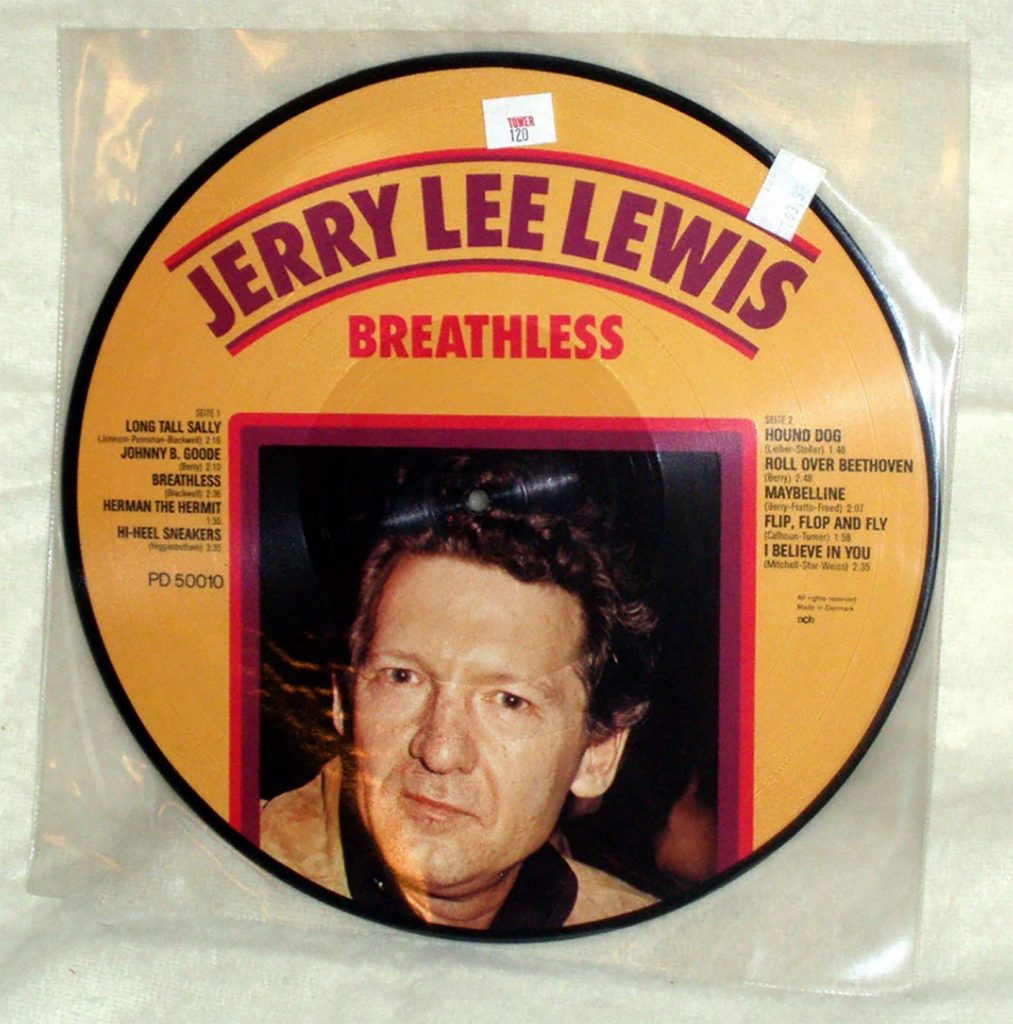
“Well the way is dark the night is long / don’t care if I never get home / I’m waiting at the end of the road…” –Jerry Lee Lewis (First 45/1956)
Seeing Jerry Lee Lewis for the first time is not unlike walking into a hurricane. The man had such a fierceness of spirit it could be frighteningly unforgettable. He would look into the audience like he was staring into the eyes of everyone there–at the same time. Then Lewis would get a slight smirk on his lips, like he knew what was coming, and then roar into a song like “Great Balls of Fire” knowing he was about to drop a bomb into everyone’s brains. Realizing how great he really was, he’d almost laugh at the effect he had on listeners. There was nothing like it then, and there’s nothing like it now. They should have called him the Thriller instead of the Killer, because Jerry Lee Lewis threw out thrills just by walking onstage and sitting down on the piano. Everything after that was pure nirvana.
When my friend and I got my father to drop us at the Sam Houston Coliseum in September 1963 to see a rock & roll show being thrown by KILT radio, we didn’t really know what we were getting into. I’d flipped all the way for Elvis Presley in 1956 when his “Hound Dog” single came out, but once Presley went into the Army in ’58 I felt like his sonic buzzsaw had been silenced. But Lewis, well he was still howling at the moon in ’63, even though he’d had his wings clipped pretty short after marrying his 13-year-old cousin six years earlier. There was an essence to this Louisiana born and Memphis bound musician that he did exactly what he wanted, and never thought twice about the consequences.
That night in Houston in 1963 now seems like a fable. President John Kennedy had been in office close to three years, and turned America into a center of determined excitement. The Cuban missile crisis had come and gone, Russia was losing the Cold War and now Kennedy was talking about sending men to the moon. And the Beatles had started making their rollicking and irresistible music heard in the United States. In so many ways it seemed like the world was starting to rock, and the adults couldn’t stop it no matter how hard they tried. And Jerry Lee Lewis was right there with it, even if had been given the ultimate F in conduct by those in charge. Lewis laughed, and kicked his piano bench clean off the stage. He had come to restake his claim in rock & roll, no matter how hard the media tried to paint him an ogre, and in Houston he wasn’t going to give an inch to the Everly Brothers’ heavenly harmonies and romantic bliss.
The fact that Jerry Lee Lewis outlived almost all his peers makes complete sense, because he had already torn up the rulebook as a teenager and never looked back.There was not a chance he’d be checking out early. He had way too much hard-headedness for that. Being one of the four tentpoles of rock & roll’s early years–along with Elvis Presley, Chuck Berry and Little Richard–gave the young man a license to do whatever he wanted. Which is exactly how he lived his long life until 87. It almost seemed like a game to Lewis, and if you wanted to play it with him you had to do it his way. Or else.
After those incredible successes of the 1950s, things cooled down when he’d been hung out to dry by the establishment, so the singer simply switched genres, moving out of rock & roll and into country music. It took a few years in the ’60s to get that in gear, but eventually the country charts were full of Lewis’ hits and the man never looked back. When someone is built out of steel there is not much to be done to break him. And no one was going to break Jerry Lee Lewis. He had a way of seeing adversity as an asset and would roar into the storm like a man on fire. No matter how much Nashville may have wanted the Louisianan to disappear, he wasn’t going to. Nothing could stop him: the establishment, booze, pills, the law. Nothing. Because when Lewis started singing and playing piano, it was like the cosmos parted to let him in. There was a ruthless propulsion to how hard he played piano, like if boxer Sonny Liston was at thekeys, and his voice was a gift from above. Of course, Lewis knew that better than anyone. That’s why he always bet on himself to persevere.
I found out myself the unflinching core of Jerry Lee Lewis in 1992 when Sire/Warner Bros. Records signed him to the label and he recorded an album to be called YOUNG BLOOD. As Lewis’ new publicist, I was sent to his home in Nesbit, Mississippi–not far from his old stomping grounds in Memphis–to set up interviews and then try to get them accomplished. Easier said than done. For starters, it is not that easy to find a street address in Nesbit, because the town barely exists. Driving to close proximity I stopped in a tiny convenience store and noticed when going inside to ask for directions a small piece of white note paper taped to the front window that said: JERRY LEE LEWIS HOME TOURS–$5. And then there was the address. Not many stars let the public in to roam around their homes, but then not many artists are Jerry Lee Lewis. When I finally found his house his then-wife Kerrie took me into the den to meet the man called The Killer. In reality, he was as kind as he could be. We started talking about musicians, records, history and a dozen other things. He would fan himself with a paper plate if he got revved up, and after the first session with writer Rob Seidenberg from Entertainment Weekly magazine, I asked Lewis when he wanted to start doing other interviews the next day. He advised me to get a room at the Peabody Hotel in Memphis and he’d let me know. That sounded a bit fishy, but I quickly learned discussing alternatives with Lewis was useless. He owned the world, and there would be no discussing Plan B.
The next day at the Peabody ,Lewis had summoned guitarists James Burton and Kenny Lovelace to join me, hopefully to do interviews with Lewis talking about the recording sessions for YOUNG BLOOD. Burton, Lovelace and I sat at the hotel bar waiting for the call to start the day’s interviews. But that call didn’t come. Same thing the next day. I soon started feeling I had stepped into the Twilight Zone, where time didn’t really exist and nothing was quite as it seemed. No problem. I was discovering what Jerry Lee Lewis Saving Time felt like, and knew there was no alternative.
The third day in Memphis Jerry Lee Lewis and his driver picked me up at the Peabody and we started moving around Memphis in his Lincoln. We’d go by Sun Studio where he started, and then Hernando’s Hideaway where he spent a lot of crazy nights performing and getting in trouble. There were dive bars, barbecue joints and even a couple of places where he’d met various future wives and sordid sidekicks. Late that afternoon we ended up going by Graceland on Elvis Presley Boulevard and Lewis said, with an edge of envy in his voice, “To hell with Elvis. I could have been bigger but I didn’t have no Colonel Parker. I was flat-out unmanageable.” I could feel someone who had gotten to the very top of the world and realized so many mistakes that took him down. But there was no real resentment in him because he knew himself well enough to know it was his fault. Jerry Lee Lewis was on intimate terms with reality and wasn’t going to play the blame game. Not today, anyway.
With no interviews done in Memphis he decided to head back home and try again the next day. Making it back to his house then, Lewis first wanted to show me how he fed the many dogs that roamed his property. He’d get a large sack of dock food, cut it open with his switchblade knife and then empty the entire contents all over the driveway. A dozen dogs would run in from around the acreage, eat all the food and then take off again. I’m not sure Lewis knew the dogs that well, but it didn’t really matter. He wanted to make sure they were taken care of. That was the job.
He then asked me if I wanted to see what he lovingly called “the I.R.S. room.,” which was near the front of the house. We walked into a large space that had a beautiful grand piano, several striking pieces of antique furniture and a dozen original gold records engraved to him. Lewis said, “When the I.R.S. gets me on unpaid taxes they come and take all these things. Then when I pay them off, they bring them back.” He laughed at what was clearly a game to him, and gave me as sly a look as I’ve ever seen, like he was letting me in on some cosmic joke he’d worked out with the United States government. A game he always won, which was obviously his favorite kind to play. We both laughed and then moved back into his favorite reclining chair in the den. He soon told me he needed to go to his bedroom and rest. Again, no negotiation possible. When I said that in an hour another interviewer would arrive, he said that wasn’t a big deal. They could join him laying in bed and do the interview there, in a dark room. By now I’d learned that what the Killer said was the rule, and that was that. And it worked just fine, if not quite in an ordinary way. I was learning that this was someone who had always gotten his way, and that was not going to change. So I rolled with it, and actually had fun watching the world turn Jerry Lee Lewis-style. At the end of that day he thanked me with a warm handshake and said, “Killer, I’ll let you know when we’ll do it again.” I can’t say I was surprised that I didn’t hear from the Lewis crowd for the next twenty years. The YOUNG BLOOD album never came out on Sire-Warner Bros., because it was transferred over to Elektra Records and they got to take over the wheel. I laughed, counted myself extremely lucky to have learned how things worked not only at Casa Lewis in Nesbit, but also had gotten a breathtaking eye-level guided tour of Memphis with one of the city’s true musical mavericks.That happens about once in life, and I knew it.
Life being full of surprises, by 2009 I was working at Vanguard Records and one of Jerry Lee Lewis’ prime benefactors was the unique Steve Bing. He loved the music of Lewis as much as anyone ever did. When Bing brought the label an album titled ROCK & ROLL TIME it was an obvious collection to release, full of inspired musical partners performing with Lewis–including Neil Young’s second album appearance, each one a knocked-out take of a Jimmy Reed song. At this stage of Lewis’ life it was something that seemed very special. No one knew then it would be the musician’s last album, but in every way it was a sizzler. It was the Killer. That was everything. Jerry Lee Lewis soon put on a special show at B.B. King’s on 42nd Street in New York, giving the label deluxe treatment as he said: “I played 35 minutes, instead of my normal 30.” Again, it was Jerry Lee Lewis Savings Time and we loved it. He even made an appearance on the David Letterman Show that week, where he was scheduled to play a short performance going into a commercial break instead of a full song. No such luck: once Lewis started playing at the taping he wouldn’t stop. David Letterman Show executives were running around trying to get me to end the song and I just laughed: nobody tells the Killer what to do. That was Lesson Number One I had learned a long time ago, and I loved Lewis dearly for it.
That was the last day I ever saw Jerry Lee Lewis, but flying home on that trip I remember something he’d said when we first met. We were sitting in his beloved den as he was gazing around him and who knows what he was thinking. But then he looked at me wistfully and said, “I’m probably going to hell, but who knows? Maybe I’ll catch a break with the Lord when it’s all over.” I’m putting my money on the man who set fire to the music world all those years ago getting that final break. He had a huge rock & roll heart and there’s no reason to believe it has stopped beating now.
Bill Bentley