
“It’s like deja vu all over again…”
–Yogi Berra
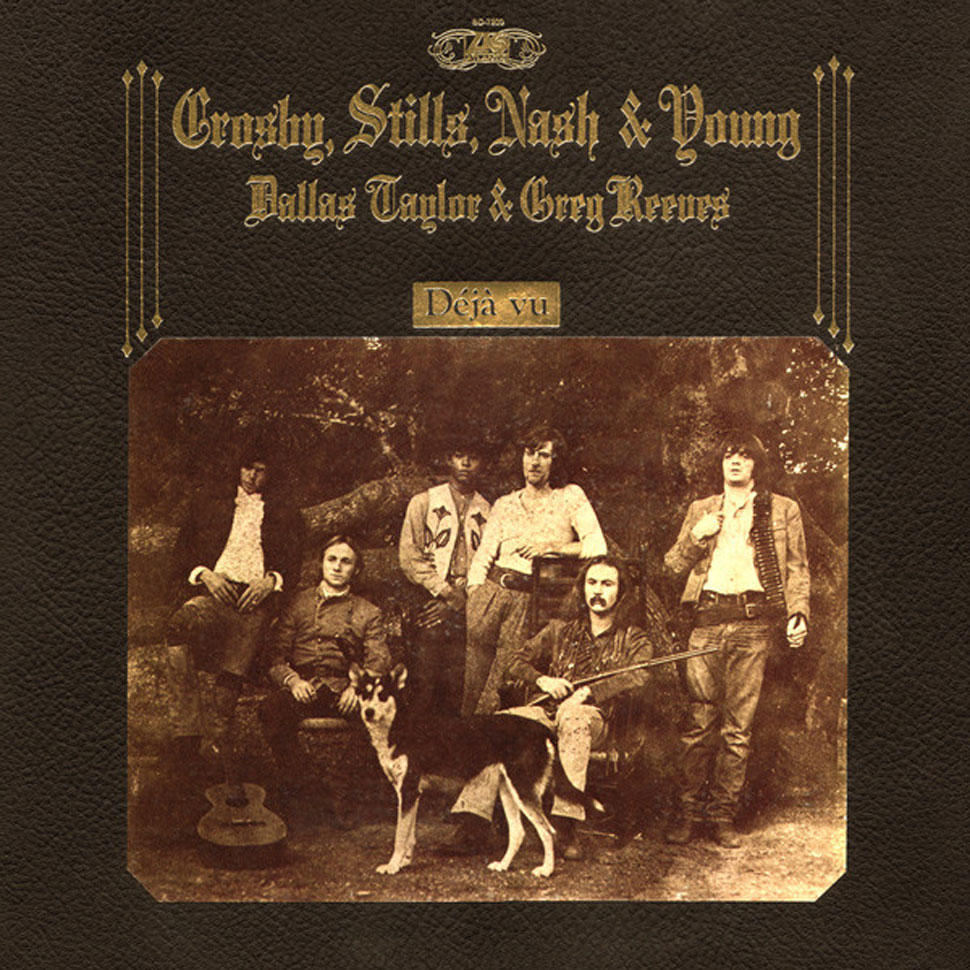
Longtime baseball legend Yogi Berra had a circular way with words, and even when they didn’t make total sense, they still rang true. Just like DEJA VU. The Crosby, Stills, Nash & Young album first released in March 1970, covers a lot of territory on its ten songs, sometimes feeling like four different artists are each on their own run to eternity. But things also come together in magical ways that cannot always be explained by sheer logic. Those were the times, as the 1960s were ending, when all the norms that had so long ruled music, art, politics, even life itself were being tested and reframed in ways that pushed at the limits of everything which came before. It was also a time when the visionary quest that had marked that decade was showing signs of tatter around the seams. Something which looked so true and beautiful and, yes, loving was turning dark at the edges. DEJA VU was able to shine its sonic light in the middle of all that turmoil, and make it understandable in a way which was previously unheard. It was a message to the youthful masses that needed to be shared. David Crosby, Stephen Stills, Graham Nash and Neil Young gathered for a precious moment and did just that. The album might not have been meant to save the world, but it sure wouldn’t have hurt if it did.
DEJA VU has been released again in several new configurations, with all kinds of demos, outtakes and unreleased tracks, as well as newly-mastered vinyl editions and top-of-the-line graphics and essays. There is no stone left unturned this time around. It all helps reinforce what a culture-changer the music became, often for reasons that weren’t that obvious the first time around. One thing is for sure: when DEJA VU was first released on March 11, 1970, it instantly became an album that had to be heard, not unlike The Beatles’ SGT. PEPPER LONELY HEARTS CLUB BAND in the summer of 1967. The counterculture often spread its messages in underground ways, and still managed to communicate what was essential. DEJA VU had that import. The dreaded word supergroup hadn’t been invented yet, so when CSNY got the nod as one the idea was clear: the music on their debut album was indispensable. And while that might have been too much pressure on a band that really didn’t have a history yet, things were moving at warp speed in 1970. Life needed changing, and whatever ammunition could be used to effect that change–and surely rock & roll was the most powerful–then it had to be done. There really wasn’t a choice. The stakes felt too high.
The band’s musical arrow to the heart still hits home 51 years later. These ten songs grab onto an historic time for America. It was a moment when a massive shift of consciousness had happened, and the entire country was starting to deal with the essence of what really was a new way to look at reality. It would be an ongoing evolution that continues to this day. But in the sonic boom that had occurred in the United States in the 1960s, there was a reverberation all across the nation. In San Francisco, Los Angeles, New York and a few other cities, so many of the arts had presented a different way to live. The old scorecard of wealth and material acquisitions had been given a run for its money by inner growth and the ability to see life as more of an experience than a competition. CSNY’s new songs then had zeroed in on that zeitgeist, and helped move it into the fast lane.
In some ways DEJA VU was a high-water mark for the counterculture’s aspirations. It came in the nick of time, because 1969 had been such a whiplash year of highs (Woodstock) and lows (Charles Manson) that it was hard to tell which way society was going. Add the continuing escalation of the Vietnam war, President Nixon’s unsettling first year as President and an unending march to the dark side, hard drugs edging out psychedelics and a growing sense that maybe the promises of a different lifestyle that had ruled the ’60s was in danger of dissolution. When 1970 began it was starting to feel like walls were being built and the currents of enlightenment were being blocked, and maybe even turned backwards. Something wasn’t right in paradise.
DEJA VU’s opening track, “Carry On” by Stephen Stills, cracked things open like a promising battle cry. It set up what would follow it on the album as answers to the question of how the youth explosion would persevere. It was only seven months after Woodstock, but that seemed like a lifetime ago. What the deadly concert at Altamont hadn’t blurred, the march of history was beginning to bring fear to the forefront. Commercial success had become a new religion, and the music itself could sometimes feel like it was part of that process. Still, the foursome of CSNY had appeared almost out of nowhere, and weren’t afraid to put their flag in the ground for what they believed. Graham Nash’s “Teach Your Children,” featuring Jerry Garcia’s mesmerizing pedal steel guitar, was a heartfelt hope for a future where the next generation might have a better chance at realizing the peaceful hopes of their parents. Then David Crosby’s “Almost Cut My Hair,” a searing song of self-examination that is as chilling today as it was five decades ago brought so many questions to the front. The albums first three songs were as different from each other as they could be, but like a rock trifecta they announced that something was definitely happening here.
Those three opening tracks become the perfect set-up for Neil Young’s “Helpless,” which arrives almost like a letter from another planet, one where Young had drifted after leaving Canada when he was 21. While nightmare nostalgia swirls and lingers in the musical background, the idea of returning home becomes a dream that cannot be denied. It’s like the tightrope of life has taken over: where to go, what to do, when to stay, when to leave? In ways that at first might appear to be a young person’s dilemma, it is really a puzzle which is never solved: can you go home again? The final question then becomes where is home, and are the chains really locked and tied across the door, as Young sings, so you can never enter or leave to find it? In the end, it just might be that home really is the place where all your changes were. And then realizing that the changes might never end. That’s when the knees buckle, the heart tears in two, and those blue, blue windows in the sky and the guiding stars become the only way to find the way forward. Wherever that is. After that track, it’s rock & roll to the ultimate rescue with CSNY’s scorching version of Joni Mitchell’s “Woodstock.” Mitchell might not have been at the world’s most famous rock festival, but that’s where the wonder of imagination comes in, because without question her spirit flew there through the magic of songwriting. And the band, who were there playing only their second concert, nail “Woodstock” to the wall forever. Life is funny that way. In the vinyl world, which is the place this album was first made for, the side ends. Time to contemplate and decide what’s next. Side two, or silence? Life is full of choices, and fortunately we have the freedom to decide.
When it does come, the second side of DEJA VU takes off like a carousel of swinging sound on David Crosby’s title track. Part rock, part jazz and all soul, the song clears the deck with the declaration, “I feel like I’ve been here before.” Which, over a half century after first being stated, still flashes with relevancy. Of course, it will never be definitively answered, but that’s beside the point. Experience teaches that it’s not the answers that count, but rather asking the questions. Philosophers have realized for centuries there is no ultimate resolution for this life or the next, but that striving is what keeps humanity pushing forward. Sometimes not knowing is the most important element of all. Which is likely why Graham Nash’s “Our House” arrives just in the nick of time, when the cosmic draft of “Deja Vu” needs to be calmed a bit with domestic bliss. Two cats have never appeared with such welcome relief.
The loving cats don’t stay around for long, as Stephen Stills “4+20” gets right to the point: when does life become too painful to continue. Again, it’s another question with no one answer, but each of us has to look into a possibility of the end, the “many colored beast.” Sometimes youth can paint the world into bright and shiny colors so the dark night isn’t so obvious. But it’s impossible not to believe it’s not there. It can last too long, and Stills’ struggle with love sounds like a grudge match to the end with fear. No holds barred. That the song leads into the album’s opus is likely no accident. Neil Young’s “Country Girl” might be divided into three sections–“Whiskey Boot Hill/Down Down Down/Country Girl (I Think You’re Pretty)”–but it rolls together in one overwhelming wave. While the song wanders into different realms, at its core it mixes confusion and resolution, and puts it all into the unpredictable motion of life itself: “Too late to keep the change / too late to pay / no time to stay the same / too young to leave…” It feels like the best music is often one lyric away from tying a pretty bow around the package, but that would be the easy way out. Guessing is the blessing, and there are never shortcuts to an answer. The questions are the prize.
The great albums know when to exit the stage, and the age of vinyl always provided a time limit that could be a gift in itself. To end DEJA VU, Stephen Stills and Neil Young created the only co-written track, “Everybody I Love You,” perhaps as an offering of upness, that optimistic dance into the future. As an audience, there is always the hope a band exists in a harmonious land of togetherness, but that would probably mean the edge needed to make timeless music has been dulled. There is no dullness here, and the search for love that has run through DEJA VU is still being sought. Which is why “Everybody I Love You” sounds like a positive projection, with the verdict still out: “Though your heart is an answer / I need your love to get me through.”
Sometimes it feels like being alive means being able to live with the uncertainty of it all. And sometimes the silent memories and messages we all receive are like clues how to get through. We will never know where they come from, and why they often arrive right on time. Faith brings them to us, and hope allows us to believe they are true. If the words deja vu mean a feeling of having already experienced the present situation, then surely remaining open to that possibility is like receiving a sign from the spirit world. That night of December 18, 1969 when Crosby, Stills, Nash & Young came onstage at the Hofeinz Pavilion in Houston, there was a heightened expectancy of what we all might hear that evening. Electricity was flashing through the concert hall, and the entire audience was floating in an ocean of exhilaration. Each of us had come to hear the future. Again. Deja vu lives.
Bill Bentley