

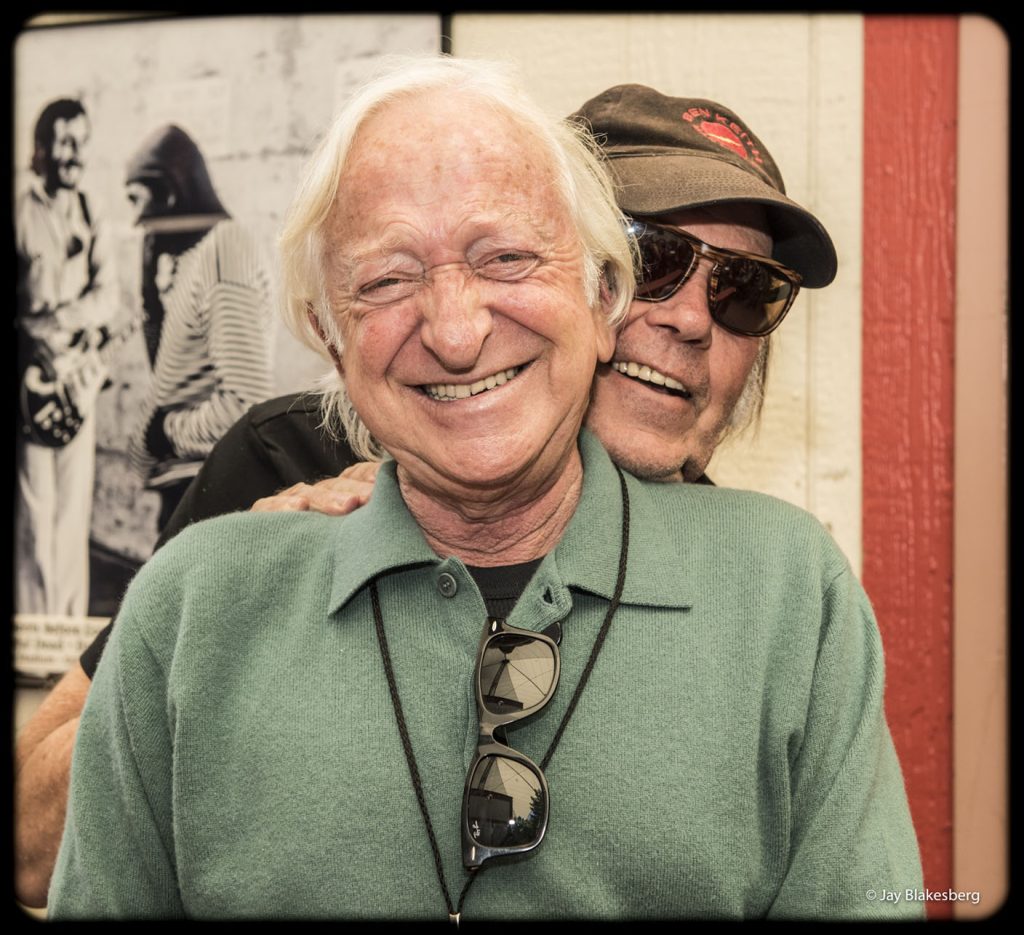
“Something good will come out of all things yet——And it will be golden and eternal just like that——There’s no need to say another word.” –Jack Kerouac
When I recently read those words again at the very end of Jack Kerouac’s novel BIG SUR,, I thought of Elliot Roberts. And I’m not sure why, so I started remembering the reasons. Roberts, who would have been 78 on February 25, was someone who saw into the deepest center of life, behind the big curtain, and discovered that all things are possible. If you dream.
In October 1968, Joni Mitchell performed at the Big Sur Folk Festival. She was a newcomer in that world, but not for long. Her first album, SONG TO A SEAGULL, had been released a few months earlier on Reprise Records. Manager Elliot Roberts was surely with Mitchell in Big Sur. He had traveled from his home in New York in 1967 to Los Angeles to meet with Mo Ostin at Reprise Records about the singer-songwriter’s record deal. It was Roberts’ first trip to California, and it went well. He moved to Los Angeles shortly after. Now, in Big Sur, the world was opening wide for both Mitchell and Roberts. A new cosmos was beckoning them.
The folk festival was held at the Esalen Institute in Big Sur, home to different realms of self-realization studies that were cutting edge then in the world of human behavior. Of course, Esalen had to be in California. That’s where the Big Wow was really happening, with a coming together for different tribes of the quickly-burgeoning counterculture. Young people were pulling the ripchord on straight reality in the Golden State, parachuting into different ways of looking at exciting new levels of heightened consciousness.
Roberts, who grew up in the Bronx, saw the vista of an unlimited future that day in Big Sur. High above the Pacific Ocean, the blue waters below looked like a magical glimpse of perfection. There the ocean and the sky became one, while the massive redwood trees from centuries past marked the end of the North American continent. Nothing was impossible at Big Sur. And nothing was impossible for Joni Mitchell and Elliot Roberts.. In 1968 everything was shifting. It had started a few years earlier in San Francisco and Los Angeles, but now it was spreading across the United States. Roberts, with a keen sense of survival who could often see a wide-open opportunity before it even occurred, sensed a supercharged life waiting to explode for him. Leaving a New York state of mind, there can be no doubt he needed to go for the brave new world in California. All of it, and all the way. Born Elliot Rabinowitz on February 25, 1943, he was now Elliot Roberts. He once said he needed a new persona for this new land. New life/new name. His future had arrived.
When I read the novel BIG SUR in the mid-1960s, I had realized that writer Jack Kerouac was a wandering visionary, much more than a certified beatnik. Despite all his excesses and revved-up thoughts, instead he was really someone who wanted the best for everyone. A few years after I had finished the book, one of Kerouac’s last, in Fall of 1968 I read in Rolling Stone magazine about the music festival in Big Sur, and immediately got enchanted with what it must be like there. Being land-locked in pancake-flat Houston, I couldn’t imagine a place with such huge redwood trees hovering over the cascading Pacific Ocean below. Paradise filled my mind with an edge of envy.
That 1968 Big Sur festival included Joni Mitchell as a near-newcomer. Though she had released her first album on Reprise Records, Mitchell’s name had not spread very far. Elliot Roberts, in his new life as her manager, was going to help change that. He was grooving mightily on the surroundings he’d found himself in, after growing up in the Bronx and hustling through the William Morris Agency, hoping to break into the music business. I imagine Roberts was entranced in that idyllic setting at Big Sur, in the middle of a whole new world being born and finding himself in the middle of it. Now representing the artist who held one of the golden keys to a new music kingdom, Roberts’ future spread out before his twirling blue eyes as surely as the Pacific Ocean did. It was all right there in front of him as he watched Mitchell mesmerize an audience of those who’d never really heard her. Reality was revving up, and he knew it.
Thinking about Roberts’ early experience at Esalen was when Jack Kerouac’s tingling words came back to me. Somehow they reminded me of Elliot and his way of understanding the world and his place in it. He could survey a confusing situation, turn it over in his mind a few times and then approach it from a laser-like comprehension of who he was and what needed to be done. And instantly it felt like I was sitting 15 years ago right next to him, in his Lookout Management office with the huge wooden roll-top desk, on the first day I started working there in 2006.
I’d already known Elliot twenty years during my time at Warner Bros./Reprise Records, where I was luckily a publicist for so many of the great artists of our time. During those two decades I came to understand that Elliot Roberts had cracked open his own code for how to live, and been able to find a perfect balance between chaos and order. And the day in ’06 I was informed my Warner Bros. Records job was over, Elliot called and asked me to come to work for him and Neil Young. That’s what we call winning the lottery in the music business. Nothing is worse in that profession than being unemployed, and to walk from a record label into Lookout was a time to shine. When I asked Elliot what I would be doing, he just laughed his mischievous laugh and said, “Don’t worry. Neil and I will find something.”
I had always been enamored by how Elliot Roberts’ career had followed such a unique curve. His beginnings with Mitchell and Young, then the awe-inducing success of the Geffen-Roberts company, which included the start and quick ascent of Asylum Records as a record label of the future, were storied. David Geffen with Elliot Roberts had birthed a place that let them establish a new community for not only those they represented, but even better allowed them to fashion their own universe, one where they could define the limits of life in the 20th century and enjoy a view very few others had seen. It reminded me of some of the eccentric cowboys I once met as a child at the YMCA summer camp in the Texas hill country in the 1950s. These wise travelers had lived on their horses their whole lives, and weren’t about to adapt to a place where they’d have to answer to others. They’d created a way of seeing their place in life, based on an honor system of hard work and virtue. I’d hang around them in the horse stalls when they were working, listening to how they talked and what they had discovered. It wasn’t that different when I worked at Lookout Management. I’d listen to Elliot talk and watch how he interacted with people, and think of those Texas cowboys. They had something no one else did, and were envied for it because of the freedom they’d earned and how they used it.
The Geffen-Roberts management company had created its own perch in the music business, where they could build the community they wanted to be in and let others come to them there. The pair would wade into a business full of old attitudes and out-of-date practices, and turn it around to how they felt it should be. Where the artist was at the top of the decision-chain, and their freedom ranked above all else. It didn’t happen overnight, but that was the beauty of what Roberts and Geffen and others in the new brigade were building. They did it because it was right, and they did it because it was fun. The money was no doubt important in the equation, but it wasn’t driving the train. No one could have predicted where the business of music was going, but the early pioneers in this new gestalt were going to be the ones who took it there.
There is a well-told legend of how Elliot Roberts first came to be Neil Young’s manager in 1968. Near the end of Buffalo Springfield, Roberts took over the manager position with the band. But at a group meeting in 1968, Young told the manager he was fired. Gone. The next morning Elliot heard a knock on his Laurel Canyon front door, and there was Young, who came in, told Elliot he was leaving Buffalo Springfield and asked if Elliot would manage him. Which he did for more than 50 years. Without a written contract. As Elliot once told me, “Contracts can just be torn up, and then everyone ends up suing each other. What’s the point of that?”
Over all those years, and working with other artists including Bob Dylan, Tom Petty, The Cars and so many others, Elliot sat in the driver’s seat. During his days with Crosby, Stills, Nash & Young, Bill Graham dubbed the manager The General. Now that is a compliment, coming from a man not known for compliments. One of the true beauties of Elliot Roberts was how he could keep a hundred balls in the air and still smile about it. Usually the funniest man in the room, not to mention one of the smartest, Elliot kept moving ahead with an unbeatable sense of energetic elan, like he knew where everything was going and it was all going to be alright. And even when things might start heading for the cliff, Elliot Roberts kept them from going over. In the end, that was one of his most valuable gifts: avoiding catastrophes. At some of those most chaotic times, when Neil Young would remark, “You know, I actually manage Elliot,” somehow the man from the Bronx would pull the rabbit out of the hat like he knew it was there all along.
Jack Kerouac’s words–“Something good will come out of all things yet—and it will be golden and eternal just like that”–come rushing back, seeming more obvious than ever now. After I’d been working at Lookout Management a few years, I suggested to Elliot his life story would make a fascinating book. Like he often did, he raised his left eyebrow somewhat suspiciously and said, “That will never happen.” Undeterred, I explained that maybe we could tape an hour interview a day for the next year or two and then see if it felt right. “Hmmm,” he said, slightly interested, but then quickly added, “No, I could never do that. My artists would feel betrayed.” Of course he was right. Again. But I wanted to hear his life story so much, I pushed ahead. I said, “You could title it THE MANAGER.” I thought I had him after he said, “Oooh, I like that.” But then said no again. Quickly, trying to change his mind, I stupidly said half-jokingly, “Well, maybe it could be published posthumously.” Not so smart on my part. Elliot gave me his most powerful evil eye, like I was the dimmest bulb he’d ever met, and said, “Great. Now you’re ready for me to die.” Luckily, we both laughed and the book was never mentioned again.
The recent Shakey Pictures film PARADOX, directed by Daryl Hannah, features a set of actors including Elliot Roberts, playing time-wizened cowboys. As they’re sitting around outdoors pondering a future that didn’t look that appealing to them, Roberts says, “Saving the seeds is outlawed. We’ll be the outlaws who save the seeds…” The seeds of music. The seeds of love. The seeds of everything that brings joy to life no matter what century you’re living in. That’s what this Mister Roberts, who had taken a new last name from a favorite movie he’d seen as a teenager in the Bronx, spent his life doing. And we’ll spend our lives ringing the bells he has passed on to us, just as those after us will hopefully do so too. Thank you Elliot, and as I used to say to him, “The ER is always open.” And Elliot Roberts will always be with us. Jack Kerouac was right: “There’s no need to say another word.”
Bill Bentley