
“‘Don’t look back’ I heard somebody say / but the old times feel so good and I’m better that way.” –Allan “Jake” Jacobs
JAKE WITH
THE FAMILY JEWELS
Music is so much about discovery. To find a new album that lights up
the sky is like meeting a new best friend. The world becomes a little
warmer, and the questions that really have no answers become less
important. It’s like the swirl of confusion that modern life often
feels like gets a little less, well, swirly.
Haunting record stores since the 1950s, I have found a world of such
incredible spiritual opulence there that it is impossible to think of
a world without music. And now that the stores are opening up again
after over a year of closure, it often feels like the jail doors have
swung free and we are now allowed to walk out. In desperation I
mail-ordered a new album a month ago because I could not wait to hear
it, but felt like I was cheating doing so. When it took three weeks to
arrive, and via USPS tracking I noticed the package had bounced around
to six cities before it made it to my front porch I knew I was being
punished for that seditious act. No more mail orders for me.
With Amoeba Records in Hollywood reopened after a 15-month closure it
feels like order has been restored in the universe. Even waiting in
line an hour or two when they first unlocked their doors on
Hollywood Boulevard to get in isn’t too much to ask. Because once you
enter, and a John Coltrane or Merle Haggard or Moby Grape album is
playing over the powerful store system, it feels like human life is
truly flowing again. Customers are excited, clerks are excited, the
world is excited. Because without music, where is the excitement?
Nowhere.
In that exalted state of wandering aimlessly through thousands and
thousands of vinyl albums and compact discs, harmony sets in. All the
unhinged thoughts and feelings flying around the brain come a little
more to order, and what sometimes feels like insurmountable odds in
the cosmos no longer matter as much. Music has always been the brave
panacea for confusion. In so many ways, those sounds can eradicate
fear and offer peace instead.
That’s where certain albums come in. For me, it’s many times the ones
that are next-to-unknown. Those are like small treasures. And while it
feels unfair for them to be unheard by the masses, it also gives them
a strong aura of secret goodness, like there is a hidden handshake
involved to discover their existence. There are dozens and dozens of
these kinds of releases, and to revisit them now shores up strength
and shines a special light on incredible joy. Over the past 60
years of scouring record store shelves–in Houston, Austin, San
Antonio, New Orleans, New York, Los Angeles, Boston, San Francisco,
Chicago, Nashville, Portland, Seattle, London, Paris and everywhere in between–there are probably a hundred of these mostly unknown gifts of amazingness. Beautifully, they last forever.
It’s like gambling, in a way, to chase an unheard sound. When you see
an album of mysterious background, there is usually some kind of
unspoken connection that first draws you in. Maybe the artist’s name
is slightly familiar: through a song once heard but forgotten, or a
mention in a magazine article or maybe even a mist-covered television
appearance that came and went so quickly it’s like it didn’t really
happen. And sometimes it’s just the album artwork itself that sends a
flashing light asking for notice. The best album covers are always the
ones that convey what the music inside is like, at least to the extent
that anything tangible can capture sound itself. Because, to me, in
the end music is indefinable. It lives in a time and space of its own
as a separate reality. It’s like trying to hold air. Can’t happen.
Almost 50 years ago I was in a small record store during my first trip
to New York. The city itself was everything I ever dreamed it would
be. Massive buildings, millions of people scurrying around on cold
days, blazing subways roaring underneath the streets, yellow taxicabs
everywhere and an obvious sophistication woven into city life itself.
Then there was the music: jazz at the Apollo Theatre in Harlem and the
Village Vanguard in Greenwich Village, rock & roll at Max’s Kansas
City and blues and folk music everywhere, being sung on street corners and tiny clubs. There was no end to anything. That was New York.
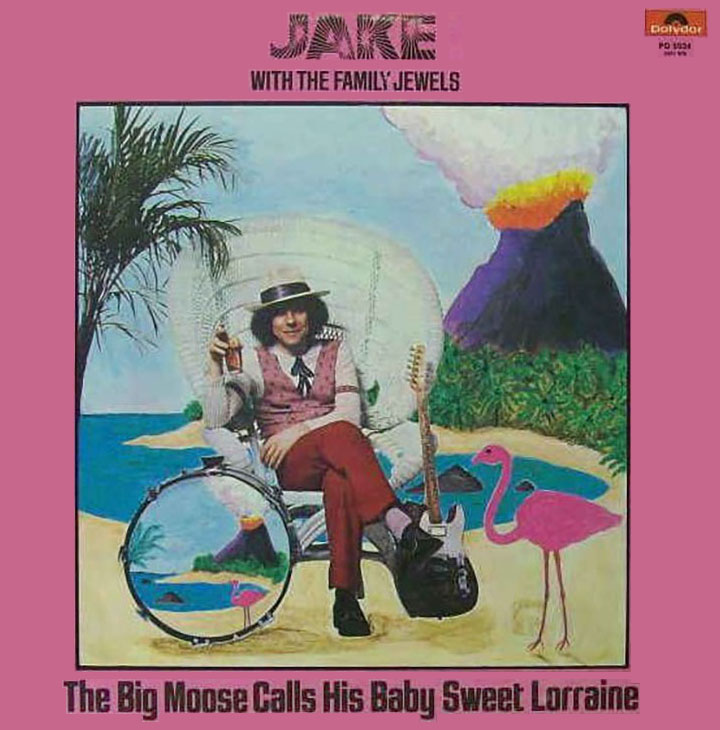
As I flipped the albums in that small record store on Bleecker Street,
a pink album cover that looked a little like a Pepto-Bismol
advertisement caught my eye. That particular hue wasn’t one seen
everyday. And the large photograph centered on the cover was of a
clearly-satisfied man holding a chilled libation and sitting on a huge
white wicker chair in a swanky straw hat, reddish slacks and snazzy
vest, all held together visually by an old-timey string tie. Next to
him was a black Fender Telecaster guitar and a bass drum with a
cleverly painted head which duplicated the scene around him that
happened to be an erupting volcano and a pink flamingo. Why not?
The artist was billed as JAKE WITH THE FAMiLY JEWELS, and the album
title, spelled out in big black letters across the bottom of the cover,
was THE BIG MOOSE CALLS HIS BABY SWEET LORRAINE. Of course it was.
Now, if all this grand mess didn’t call for closer investigation, I
don’t know what would. But here comes the gamble part: spring $3.99
for the unknown or walk away still solvent. There was something abstractly incessant
about it all, though. Like maybe magic lurked within. The songs, mostly
written by Allan “Jake” Jacobs had normal enough names, like
“Penthouse,” “Water Makes Me Sing,” and “Lake Louise,” along with a
couple of covers of Bob Dylan and Everley Brothers origination. So
there were no serious tells about what was really going on here,
except that little bit of twanger excitement about it all. It didn’t
feel quite normal, and those are usually the unfamiliar albums that
bring it all home.
Needless to say, buying this album was one of those small-overhead
gambles that pays dividends for eternity, because the 10 songs became
instant inspirations and continue to throw chills and thrills into
the atmosphere whenever played. There is something so tinglingly
bohemian about Jake and the Family Jewels that it feels like infinity
itself is guiding the band. They swing and rock, groove and pop and
generally just raise a contained uproar with such cool finesse in the
end it all feels completely irresistible. It is no wonder no one has
heard of them, because they thrive outside musical boundaries, and
sound proud of it. The album’s opening song, “Sunshine Joe,” lays down
a marvelous marker by an artist who has invented his own musical
style: “it was last night in the city and the boys are getting tired /
I’m in an awful fix and Delilah she looks wired / say goodnight turn
out the lights and pull the shades down low / we’ll see you in the
morning Sunshine Joe…” And that’s just the beginning. Jacobs’ voice
has the gravitas of a long-term New Yorker, with still a sliver of his
innocent childhood years growing up in Mount Vernon. Mixed into everything is
the feel of someone who’s seen it all–twice–but still walks in
wonder of the endless parade of humanity that is New York City. THE
BIG MOOSE CALLS HIS BABY SWEET LORRAINE is only one song in, and the
sky’s the limit. The micro-risk of buying an unknown album looks like
it’s going to light up the sonic slot machine forever.
The key to recognizing an all-time album is often in the second song,
and how different it is from the first. Not a good sign if it’s a
retread, but a great omen if it’s a change-up that shows an inherent
sparkle in what might lay ahead. “Don’t Look Back (I Heard Somebody
Say)” switches the channels completely for Jake and the Family Jewels,
bouncing into a whole new groove that gives the rhythm a swing band
zing. It also shows Jake Jacob’s allegiance to all he has learned in
the past, when Greenwich Village was on fire in the 1960s with bands
like the Lovin’ Spoonful and Jacob’s own The Magicians. Why not look
back when necessary, even just to recharge the memory bank with
positivity? That’s the mark of the survivors. “Lake Louise” turns up the
swing thing even higher and zips off into Dixieland band land, like
the Family Jewels could be sashaying down MacDougal Street any moment.
The rhythm section are not glued to the beat, while the guitars and
keyboards ride a fun wave across the top of the mix. And the music
feels like one big smile.
There is no doubt Jacobs and the group have pulled the filters off
their instruments and raised the fun flag up the mast, at the same
time they fan the spiritual undercurrents of where they’re going.
“Water Makes Me Sing,” an eerily prophetic look at what would soon be
lurking in the world’s future survival, gathers an air of Eastern
religions in its makeup. Nothing overtly, but the hint of philosophies
outside the Western world wafts through the music and lyrics like a
quiet meditation in the middle of a traffic jam. As an air of
placidness settles in, “Penthouse” brings the heart-lifting New York
skyline back to the forefront in this hopeful urban fantasy, only to
be tempered by the lyric, “All my friends have come and gone nothing
left at all to do / just some joker waving madly, ‘I’ll be
seeing you’…” Nothing lasts forever, not even on records. No wonder
the band ended Side One with that sentiment. Time to decompress.
It is an easy adage that you can tell a band by their covers, and for
many years dozens have been turning to Bob Dylan to find one. The
secret there, though, is that it better be a song lurking in the weeds
and not one already known by half the world’s population. Jake Jacobs
moved to Greenwich Village about the same time Dylan did in the early
1960s, enrolling in the School of Visual Arts, so he knew the
landscape enough to dig deep. Coming up with a gem from the Bard’s
BASEMENT TAPES collection, “Minstrel Boy” hits the bulls-eye. Sounding
like a modern antique, it lets the Family Jewels throw in their best
harmony chops and walk down Broadway with their heads held high. “Down
on My Knees” revs the tachometer up to the redline with a pulsating
kick. It appears to have just a touch of magic, as Jacobs flirts with
lonely desolation–“Whiskey whiskey whiskey I’m on fire / help me get
my feet across this bed because I’m lonely and I’m tired”–only to
hear the calling of the street and swing back into the chase: “With my
shoes tied tight it’s a whole new night / whole new night..” Ask any
New Yorker: it’s all about never giving up. Everyone there needs to
stay close to their own hearts and seek out a personal magic touch of
indomitable proportions. It’s the only way to find a way.
And when it comes to musical magic touches, there is no finer pair
than the Everly Brothers. Born great but growing into even bigger
greatness, Don and Phil Everly were out of the gate with perfect
voices. Once they found their deepest musical center in their own
songs, well, rock & roll would never be the same. Ask The Beatles.
Jacobs’ takes on the Brothers’ “When Will I Be Loved, ” and even with
his scruffed-up urban edge, slightly ragged but always right, he makes
a classic song come alive in a different set of clothes without a
hundred-dollar haircut in sight. After passing the Everlys Test, it’s
back to the streets with “When You Were Just a Maid.” New York is
known for its Cinderella stories, where women born in the Bowery could
end up on the Upper East Side, but Jake & the Family Jewels keep the
eyes and ears on their real roots and aren’t fooled by any flim-flam
finery. As in this verse: “I still have my visions but sometimes I
think they’re fake / but I can still remember when you were just a
maid.” They know the upper crust ain’t for everybody, and never budge
on keeping their roots in the dirt and their sound close to the
ground.
It’s only fitting that the man’s sophomore album last song “Motorcar
(Oh What a Dream),” ends on a dream, because in many ways that is Jake
Jacobs’ life story. After an older friend once told him while watching
the early hipsters in Washington Square Park when he was just 12 years
old, “You can do anything you want down here,” that’s where Jacobs’
ended up as soon as he could finish high school. He found a place in
the rock & roll band The Magicians in 1965, did a brief stint in the
ultimate Village beatnik outfit The Fugs, and then partnered up with
singer Bunky Skinner as Bunky & Jake for two albums.
He then founded Jake & the Family Jewels in 1969 and after a brilliant
but ignored debut album, got a second chance with THE BIG MOOSE CALLS
HIS BABY SWEET LORRAINE. Unfortunately, it arrived to equally-ignored
reaction. But taking New York’s ethos to heart, Jake Jacobs has never
given up. He’s painted other people’s apartments for a living while he
paints his own murals in his apartment, writes soul-grabbing songs
that he still sings in nightclubs wherever he can, and stays true to
the musical spirit that first took over his soul all those years ago.
The singer-songwriter released his 2012 album A LICK AND A PROMISE
himself, and now, almost a decade later, is recording the fourth Jake
& the Family Jewels collecton on a home computer he’s just learning
how to operate. Nothing can stop him as he strolls toward his 80s,
content in his small Greenwich Village apartment living a dream born
so long ago. Jake Jacobs has his eyes squarely on mortality, but
doesn’t flinch. “I’m here now. I’m not sure what’s next, but I don’t
really have to know. Because whatever it is, that’s what it will be.”
Shoes tied tight or not.
By Bill Bentley