
Music That
Matters to Me
Twenty years ago Starbucks started selling CDs in their stores, and soon created a series of releases titled ARTIST’S CHOICE: music that matters to her/him. It featured various musicians assembling albums of some of their favorite songs. Everyone from Bob Dylan and Lucinda Williams to Elvis Costello and Norah Jones joined in. Each one was an eye-opening chance to see what these participants put on their list that really moved them. In the album booklets were brief descriptions by the artists about why they chose those songs, or what the music meant to them. It was all supremely fascinating.
In 2002, working for Warner Bros. Records I was asked by Starbucks to produce an ARTIST’S CHOICE album with Eric Clapton. So Clapton and I spent a couple of hours in a hotel room with a tape recorder as he talked about some of his favorite songs. It was utterly illuminating and an inside glimpse on what the man held close to the heart as his favorite music. Unfortunately, Starbucks discontinued the program before the Clapton set ever came out, and now somewhere in the company’s vaults hopefully lives the tape from that day. One of my many memories of what we talked about then was when the Englishman was reminiscing about a 1970s George Harrison track he played on, and as he was talking about Harrison, who had died the previous year, Clapton’s cell phone rang and the person calling from England just happened to be the former Beatles’ best friend, a man nicknamed Moosh. When the call was over Clapton looked at me and said, “George is still checking in from the other side…” I got a sweet shudder and we went back to the interview. What a world.
I decided recently, just for fun, to put together my own ARTIST’S CHOICE list, choosing songs that weren’t always the biggest hits but still hit my monkey nerve square on and spiked the emotional meter through the roof. While the coffee giant’s releases were usually 15 songs, since we’re living in a virtual world so much these days and my endeavor here is basically a fantasy, I decided to dream up a double-disc edition and include 30 tracks of “music that matters,” to me at least, as the Starbucks’ album cover would have said. So here’s a new ARTIST’S CHOICE release chosen by a non-artist. Why not?
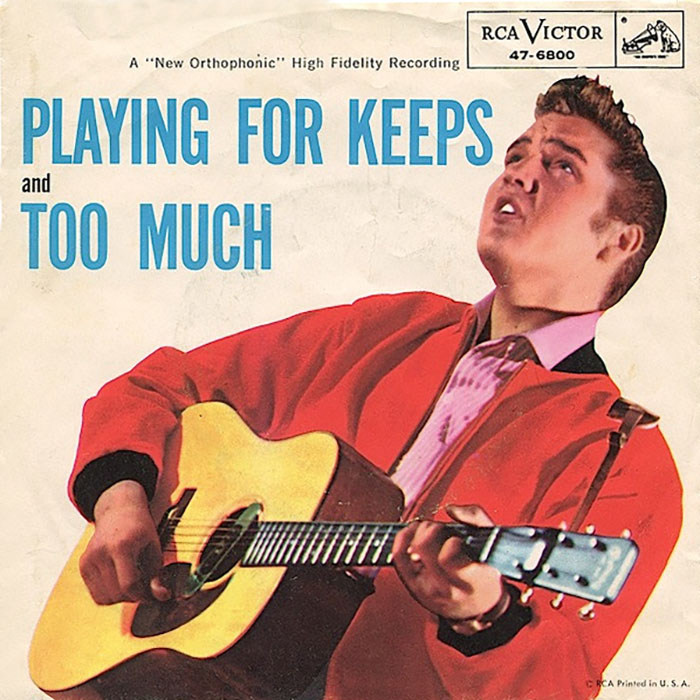
Too Much, Elvis Presley (1957)
The neutron bomb 45 “Hound Dog” by Elvis Presley exploded in 1956, and the Memphis whirlwind ruled the planet almost instantaneously. In under three minutes, rock & roll was the new religion for the youth of America. A year later, “Too Much” slipped onto the charts with a quieter arrival, but the sound of the song immediately pinned my soul. Presley himself sounded slightly unhinged, and Scotty Moore’s lead guitar break, even to 7-year-old ears, had a completely hypnotizing power to it. Distortion became a new pursuit. The groove felt like it came from a secret place where D.J. Fontana’s snare drum backbeats ruled the universe, and Elvis Presley’s voice had originated in its own cosmos. It wasn’t long before The King went into the Army, and gave away his keys to this new kingdom. But oh what a ride.
Lucille, Little Richard & His Band (1957)
The feral wild man Little Richard had already cornered the market on outrageousness with songs like “Long Tall Sally” and “Rip It Up” by the time “Lucille” smoked on jukeboxes everywhere. There was something about the song that had the gait of a riverboat ride up the Mississippi River, while Earl Palmer’s chooglin’ rock & roll beat has never been nailed better. It was almost like a slight sign of sophistication had invaded Little Richard Penniman’s style, showing how the door was wide open for him to express his endless fantasies. Cosimo Matassa’s recording studio in New Orleans had become the music’s shrine, and would stay that way all through the 1950s. America, of course, would never be the same.
She’s Nineteen Years Old, Muddy Waters (1958)
The man who will forever be the maestro of Chicago blues had a run of stunning singles throughout the 1950s that got him that crown forever. His voice had such a defining authority it was like no one else could ever challenge him. Not really. And Muddy Waters always had the best band in the Chess Records studio. Like on this salivating single, where Little Walter Jacobs is blowing harmonica like a man trying to get out of jail on his musical talent alone. It would have worked, too. There is never any rush in Waters’ recordings. He knew the ribbon sometimes went to the runner who could finish the race, and he always did. There was never anyone like him, and his face would be a perfect addition to Mount Rushmore if there’s still room.
Found Love, Jimmy Reed (1960)
Out of all the irreplaceable blues artists that graced America, there is one who really spread that elemental music the farthest, and that is Mister Jimmy Reed. His unforgettable songs actually were hit singles on American radio beginning in the 1950s, and showed the whole country what real blues sounded like. These were sounds right out of the alley, and for those who were zapped by Reed’s voice, guitar and holy harmonica, nothing ever came close again to evoking that passion. “Found Love” is a particular favorite, because it had such a singular attack, not to mention a harmonica solo that stops time. When Jimmy Reed sang the chorus that at first sounded like, “I found true love one of the ways to f–k,” all bets were off. Of course, there might have been some wishful listening to that insinuating phrase, but beauty is often in the ear of the beholder. Reed passed away in 1976, and three months before he died he told me upstairs at Antone’s nightclub in Austin right before he went onstage: “I took this gig ’cause I woke up and someone done shoved a contract under my door. I gonna try my best to sing them songs tonight, but sometimes the words be gone. I think the wine got me…” He then went out with his longtime guitarist Eddie Taylor and the Fabulous Thunderbirds backing him and tore that playhouse down one hot night on Sixth Street. Just like the man did every time he took the stage.
Who’s Been Talkin’, Howlin Wolf (1962)
He was the biggest man of the blues–ever. Chester Burnett, aka Howlin’ Wolf, looked up to no one. They say he struck out on his own as a child in Mississippi, and later was too nervous to stay in the Army so once again went rambling solo. When he started singing around the Delta it was clear blues would never be the same. Howlin’ Wolf had a voice that not only rattled the windows, it shook the rafters. When he and his treacherous band began recording for Chess Records it was impossible to forget the sound. The Wolf had a near-Halloween touch to his vocals, like he really was a wild animal on the prowl, and he wrote songs that defied gravity. With guitarist Hubert Sumlin by his side for most of his life, Howlin Wolf carved his name into the history books of music. “Who’s Been Talkin'” has a threatening tone to it, like whoever has been dealing in gossip better take off down the road, because the Wolf don’t take no mess. The track’s rhumbaized beat puts the backfield in motion, and Sumlin’s circular guitar fills keep everything swinging. By the time Howlin’ Wolf gets to the first chorus and sings, “I’m the cause it of it all,” is no time to correct the grammar. Best to drop deep into the rhythm and let the good times roll, because Howlin’ Wolf has taken over the world and there is no turning back. Thank goodness. Hubert Sumlin, when I asked him in 1977 what it was like when Howlin’ Wolf died the year before, said with a tear in his eye and a catch in his voice, “It was like losing your Mama and your Daddy on the same day.” Lord have mercy.
Share Your Love with Me, Bobby Bland (1963)
There has never been a singer like Bobby “Blue” Bland, and it’s almost a real certainty there won’t ever be one in the future. Bland’s voice was like velvet soaked in gin: it could get inside your heart and make everything warm and wonderful, but at the same time tear at your mind that there was a world of pain waiting just outside the door. It’s unexplainable to really put into words, but the man had to be heard to be believed. He was superhuman in his ability to make a song become the only thing that mattered in the world. This unbeatable single, written by Al “TNT” Braggs, who used to open Bobby Bland’s shows with as energetic a set as was ever delivered, became a centerpiece of the evening. “Share Your Love with Me” still stands as a monumental example of what a singer can really do. Bobby “Blue” Bland will always be the man. When he performed at the Palladium Ballroom in Houston in the mid-’60s, and it came to the mind-blowing line in “Stormy Monday” where Bland would sing “On Sunday I get down on my knees to pray,” he would pull a white handkerchief out of the breast pocket of his impeccable white suit, put it down on the stage floor and then kneel on it. There is no way the large star was going to get any dirt marks on the knee of his pant’s leg. Because he was the man: Bobby “Blue” Bland.
I Just Want to Make Love to You, The Rolling Stones (1964)
When the Rolling Stones burst onto the American music scene in 1964 it felt like an existential event had steamrolled across the country. The Beatles had shown what excitement and good intentions could be like, but the Stones personified the great Jack Kerouac quote describing those times: “A frozen moment when everyone saw what was on the end of every fork.” This was not music for a teenage sock hop, but rather it was a shove into adulthood and the real moment when there would be no more fooling around. The way the Rolling Stones played the jacked-up Muddy Waters song, throwing a Bo Diddley-beat into the mix and roaring around corners and flying down straightaways was when the 1960s really began. And we’re all still traveling down that lonesome highway. When I saw the band in Dallas on November 22, 1965 on the second anniversary of President John F. Kennedy’s assassination in that dreaded Texas city, the wounds were still open. Watching the Rolling Stones play 8 songs in 45-minutes that cold night in the Municipal Auditorium was a wake-up call that the future would never be the picnic we all hoped for. The bill had come due and we’d be paying it off for a lifetime. But with music like the hyperventilated blues of this British band there might be a payoff in the end. Just maybe.
Everybody Knows (The River Song), O.V. Wright (1965)
Overton Vertis Wright is a superlative soul singer who stayed in the shadows for much of his career. He began singing professionally with Memphis gospel groups, and then recorded the song “That’s How Strong My Love Is” for Goldwax Records. Unfortunately a legal dispute about contracts caused his label to kill the single, and Wright started working with Don Robey’s Duke/Peacock company on the Back Beat imprint. That began a new era of modern soul, with songs like “I’m Gonna Forget About You” and “Nickel and a Nail.” This selection “Everybody Knows” is a top-rank achievement of O.V. Wright’s ability to zero in on the reality of urban life for Black Americans in the ’60s, capturing the struggle for not only their civil rights but their unbelievable attempts to find hope for the future. The song has one of my favorite lines ever when Wright sings the verse: “My life is so confused / but I don’t wanna die / I wanna go to heaven / but I’m scared to fly…” Yes! That was the bleakness of the mid-’60s for an entire population of people, and their attempts to hang on to a degree of positivity. O.V. Wright never really found the audience he deserved, and had some bad breaks that would have stopped some artists in their tracks. In 1980, Ry Cooder called the Wright household to ask the singer if he would join his touring band. Mrs. Wright answered the phone and told Cooder the bad news: “I’m sorry to say, but O.V. done passed yesterday.” No doubt O.V. Wright had flown away.
Wish Someone Would Care, Irma Thomas (1965)
There will only ever be one Soul Queen of New Orleans, and that would be Ms. Irma Thomas. Starting as a teenager in the City that Care Forgot, Thomas was recording songs with Allen Toussaint for Minit Records, and it was just a matter of time before the public found out what a force the young woman was. When “Wish Someone Would Care” became a national hit in 1965, shortly after the Rolling Stones covered her single “Time Is On My Side,” it looked like the sky was the limit for a singer of such wondrous depth. Unfortunately, things stalled out shortly after and Thomas ended up working at a Montgomery Ward store in her new home of Los Angeles. Still, the artist was simply too good to give up, and made a comeback a decade later back in her home town, and has been thrilling and chilling audiences ever since. There really is no one in her league, including the business venture she and her husband/manager Emile Jackson opened in the ’80s near the parish prison in New Orleans–Irma’s Bail Bonds and their next door nightclub the Lion’s Den. She became even more famous. But this heart-wrenching single still sounds like her calling card. And it’s the only jukebox song that ever got me 86’ed from a bar–Wanda’s in the French Quarter–for playing it over and over one long night in 1978. All worth it.
Don’t Answer the Door, B.B. King (1966)
It was a cold night in late November 1965 when my older brother and I went out to the Club Delta in the Sunnyside area of Houston. Before arriving at the nightspot, it became clear that it was surrounded by tiny houses with open sewer troughs that ran alongside the streets, and it didn’t look like there was much joy to be had close by. Once inside the bar, though, Club Delta was decorated like it was one big Christmas tree, and all those inside were already halfway tilted towards the promised land. B.B. King was in town, and ready to blast-off. King had a small trio backing him: fellow Houstonian Sonny Freeman on drums, Duke Jethro on Hammond organ and Bobby Forte on tenor saxophone. They sounded like heaven on wheels, and when B.B. King took the stage after several group instrumentals, the club exploded with complete cosmic delight. Nothing was going to stop anyone within earshot from finding real happiness that evening. King played and sang blues of such depth that listeners came out the other side, wrapped in terminal bliss. Because, really, that’s what the blues did: turned pain into positive passion. It was the secret of the sound that continues to this day. That night, “Don’t Answer the Door” was a newer item in King’s repertoire, but when he played it in 1965 it became obvious by the first verse it would live forever: “Woman I don’t want a soul / hanging around my house when I’m not at home…” The large bluesman wasn’t kidding either, and when he came to the verse where he told the preacher to stay away from his home, and that his wife would see him Sunday down at the church, jealousy got hiked to a new level. But that’s what love can do, and for his whole life B.B. King found ways to communicate those seismic feelings into song. When he played the blues on the big black electric Gibson guitar, there was no doubt he meant it with all his power. There would never be another like him.
Slip Inside This House, 13th Floor Elevators (1967)
In the history of music there are some songs that take on the properties of ecstasy, and provide a road map on how to traverse the paths of spiritual travel that can lead to a higher plane. The 13th Floor Elevators were a ’60s Austin band formed in the belief that through experimentation with LSD a higher world could be found. Their lyricist/electric jug player Tommy Hall had created the band with the explicit attempt to show others the way there. “Slip Inside This House” was his seven-minute scroll on how to move higher. In some ways, the song has never been equaled, and there are those who continue to study its words seeking a way to evolve. The opening verse sets the tone: “Bedouins in tribes ascending from the egg into the flower / alpha information sending states within the heaven shower / from disciples the unending subtleties of river power / they slip inside this house as they pass by.” If that’s not enough to send up a flag of belief then what is? Singer Roky Erickson was able to sing Hall’s lyrics like the acolyte he was, and pull willing listeners into the fold of true believers. It was a process of purity and power that only started to crack apart when band members had ingested so much LSD over their first year that the ability to persevere began to dissolve. In a way, they were an army that could not continue to survive the regimen needed to stay enlightened. After two years of performing, the Elevators were heading for the cliff that would crash their caravan. Erickson ended up in the Texas Hospital for the Criminally Insane, and the others scattered wide and far. For those still seeking, “Slip Inside This House” is available on the band’s second revelatory release, EASTER EVERYWHERE, and the song’s last words, “Don’t pass it by…” say it all.
Strange Man, Dorothy Love Coates (1967)
Gospel music can scare a lot of people off. Maybe it’s the idea that it’s mainly played in church, and has a preachy part to it that doesn’t fit all palettes. Or possibly it’s heard as proselytizing too enthusiastically for one side of the religious coin and doesn’t allow others to walk their own road. The real bottom line, though, is no matter what beliefs the songs are centered in, there are some of the greatest singers who ever lived doing the singing, and as one of Dorothy Love Coates’ many amazing songs was titled, “That’s Enough.” The Birmingham, Alabama native was one of the without-doubt queens of gospel music, and had a long recording stretch where her songs ruled the roost in whatever church performed them. Her vocal backing group, The Gospel Harmonettes made several albums that are still revered around the country and Coates herself is talked about in hushed tones of greatness. But there is one song by the woman which will always stand as the crowning moment of gospel, and that’s the Columbia Records recording of “Strange Man.” It’s a, well, strange song about a sinner’s being stoned in Alabama when Jesus steps in to save the woman’s life, and the way Coates delivers it is 100% ultimate greatness, a song so packed with holiness it is sometimes too much to hear. I saw her sing it one evening aboard a New Orleans riverboat in 1980 and haven’t been the same since. It brought heaven down to earth. Really. Shortly after the concert I found Dorothy Love Coates’ telephone number through Birmingham information and called her to say how incredibly touched I was by her performance. She was very sweet, but then said the evening on the riverboat was very uncomfortable for her because she didn’t know it would actually move down the Mississippi River. That was a no-no for Ms. Coates, as she explained, because “I don’t leave land.” “Yes mam” I said, but told her how much seeing her sing meant to me. It felt like one of “Strange Man”‘s lyrics: “The Lord stopped by one good evening…” Amen.
Song of Everything, Sir Douglas Quintet +2 (1968)
Doug Sahm recorded his first single before he was even a teenager, and after hitting the big time with the Sir Douglas Quintet and “She’s About a Mover,” Sahm took off from San Antonio for Haight-Ashbury hallucinations in San Francisco. Finding exactly what he was looking for there, he soon added a horn section to the Quintet and started capturing his visions with a brand new sound. “Song of Everything” is where he reached his own Valhalla. Careening around northern California in a Cadillac and releasing the album HONKEY BLUES helped announce what a force of nature Sir Sahm really was, while the single–which started with 30 seconds of mid-’60s John Coltraneish cacophony–summarized all that was possible in the new counterculture. Try out this first verse: “Spend my life in ecstasy / underneath the redwood trees / it knocks you to your knees / when you’re there breathe air / it’s Big Sur when you’re there / and you know it’s the season to groove…” Of course it is, and no one in the psychedelic rock scene of San Francisco then captured it quite as vividly as Sahm. Unfortunately, no one really heard “Song of Everything” when it was released, and it would take the man returning to his Tex-Mex roots with the follow-up single “Mendocino” a year later to recapture his commercial success. That was okay, because after that brush with fame Sir Douglas Sahm blew caution to the wind and for the next 30 years zigged and zagged all over the musical map like the actual Texas tornado he was, chasing the next sound and the new groove like a man of everything. With a song for all.
In My Own Dream, The Butterfield Blues Band (1968)
Paul Butterfield completely turned the youthful musical world around with his debut album in 1965. The lead song, “Born in Chicago,” sounded like a supersonic jet plane had just scorched through the living room and delivered a proclamation that the blues was open for business and anyone could play. It just took a heart on fire and the right fuel to get things started. The Butterfield Blues Band would go on to new plateaus on their glorious “East-West’ instrumental the next year, and then turned more toward level earth with horn sections and Butterfield’s gut-warming vocals. On the song “In My Own Dream,” the man tapped into the inner consciousness of the human journey and offered an anthem where the soul could go, starting with his consciousness-raising acoustic guitar introduction. It is a song that could cause a listener to shudder in revelation, and aspire to a higher good. By the time David Sanborn’s saxophone solo arrives to take everyone all the way, there is nothing left but the believing, which turns out to be transcendent. Sanborn once said that the saxophone he played the solo on in the studio was soon stolen after the session, and he could never reach the heights he hit on the original. Maybe the musical gods were in the house when the album was made and delivered the goods to be captured just that once. No matter what, infinity arrives on “In My Own Dream” for five minutes and 48 seconds.
Tecumseh Valley, Townes Van Zandt (1969)
There were moments watching Townes Van Zandt perform in small Houston spots in 1966 where it felt like time had stopped. That’s how powerful the Texan was, even a few years before he ever recorded an album. He had a cloak of awesomeness around him, and an unending gravitas laced with sadness that never went away. Song after song would break our teen-aged hearts as we sat in the Family Hand back then, making us wonder just where in the world this life could go that wouldn’t be a burden. But then one of Van Zandt’s songs would burst through the night and offer salvation, like he knew we all needed that gift immediately. That went on for over twenty years as Townes Van Zandt became known as the artist’s artist. There was no other. “Tecumseh Valley” was always the song that tore me inside out, a story of a glowing young woman who got steamrolled by life in a way that was unforgivable. “The name she gave was Caroline, daughter of a miner”–as Townes sang–“her ways were free, it seemed to me, that sunshine walked beside her.” I hear the song today and my throat goes dry and I still squirm. When the singer closed his eyes onstage it was like he had taken off for another world, and whether he was seeing beautiful images from the past or horrifying visions of the future was never quite apparent. But it was definitely true that the man had fallen into another zone. Van Zandt used to kick around Austin in the ’70s and sometimes he was on top of his life, and others he was obviously heading for the darkness. But he always bounced back, because through his songs he was a survivor. Until that New Year’s Day in 1997 when Townes Van Zandt didn’t make it through. The man is still here though, singing right inside us.
Cool It Down, Velvet Underground (1970)
By the time the Velvet Underground recorded their last album, the quartet had pretty much realized their time might not be coming. Starting in 1965, the new group with Lou Reed, John Cale, Sterling Morrison, Moe Tucker and guest vocalist Nico had polarized the rock world like no other band had, before or since. As part of Andy Warhol’s traveling circus then, they got a stamp of eccentricity that lasted forever. But America was turning towards a subtler lifestyle by 1970, and frontman Lou Reed would leave the band even before their last album LOADED was released. Which didn’t mean that the aggregation hadn’t made their most commercial-leaning release ever. VU guitarist Sterling Morrison had bailed on the band in 1971, and made his way to the University of Texas in Austin to study English literature. When I met Morrison in 1974 it seemed like he was ready to shed his anonymity and start rocking again, so he was promptly enlisted in our band The Bizarros’ ranks. We were a bar band through and through, and proud of it. So when I suggested to Sterling the band try experimenting with some Velvets perennials, he gave me that authoritative look he specialized in and said, we could try “Cool It Down” from LOADED. When I asked why just that one, he said without emotion, “Because that’s the only one the Biazarros are capable of playing.” At first that sounded like a put down, but I quickly realized he was right. The backbeat on that song rung true, and there was even a bit of subliminal funk to it all. And there was no way our band could have taken on anything like “Sister Ray” or “Heroin.” So we promptly jacked up “Cool It Down” and entered the history books as a last page footnote of infamy: a former Velvet Underground member playing one of their songs in a Texas bar band.
Yankee Lady, Jesse Winchester (1970)
Jesse Winchester was fated to record one of the best albums of the 1970s, or any other decade. The Southerner decided during the ’60s to seek asylum from the draft in Canada, and moved there to live. Once there, he continued his music career and when it was time to record his debut release got Robbie Robertson to produce it, with Todd Rundgren engineering. It was for the relatively new label Ampex Records. And what an album it was. There was a suspended animation feel about the music, like it had come out of the 1930s wholly formed, and captured then for posterity. Winchester’s songs went beyond historical right down into the soul of the man. Clearly leaving his native home in America had left scars on him, and the songs he wrote dealt with those scars with a depth of loneliness and nostalgia that could be overwhelming. Winchester’s voice had the ring of his Louisiana roots as well as time spent in Memphis. And the musicians who performed with him in the studio, which included Levon Helm from The Band on drums and mandolin, wrapped their warmth around the music like old hands. “Yankee Lady” encapsulates all that Winchester had to offer: a spine-tingling ring of what it’s like to lose everything, and long for a time when that old world would return. Knowing, deep down, that it never would. Instead, hope alone was the fuel for the future. A verse in the second half of “Yankee Lady” captures the entire essence of the song: “An autumn walk on a country road and a million flaming trees / I was feeling uneasy ’cause there was winter in the breeze / and she said ‘oh Jessie look over there the birds are southward bound / oh Jessie I’m so afraid to lose the love we’ve found’…” The outcome of “Yankee Lady,” and likely part of Jesse Winchester’s life in Canada, surely involves large doses of homesickness, but also the joy of knowing that even past that ache that life and love are still possible. With President Carter’s amnesty in 1977 for those who left America in protest of the Vietnam War, Winchester was able to return to the United States and begin a music career in America, start a family and have a new life in his homeland. The man who gambled with his future saw it through to a different chapter, and continued to write some of the best songs of the ’70s. A Southern man survived and thrived.
Frank’s Store, Ron Nagle (1970)
In the annals of rock & roll live all kinds of lost names that shouldn’t be there. Instead, they should be whispered in awe, after receiving a massive amount of public popularity. What could have been. Ron Nagle, on keyboards and lead vocals, was in one of the very first San Francisco bands of the 1960s. They were called The Mystery Trend, and for whatever reason just couldn’t get over amidst all the outrageousness going on. In 1970 Nagle got the chance to make a solo album, produced mainly by none other than uberman Jack Nitzsche, and featuring players like Ry Cooder and others. On the first side of BAD RICE sat a song so poignant and multi-dimensional, with a Nitzsche arrangement he once claimed as the favorite of his entire credits, titled “Frank’s Store.” It’s a 3-D story of a small corner grocery that San Francisco had hundreds of scattered among the 7-square mile city, owned by, of course, a man named Frank. The other main character of the song is named Eddie, and he did everything Frank asked of him. When one night the store catches on fire there is a nightmare nostalgia that sets in, but life goes on, with the store’s “warmest beer in cans, day old meat and toys made in Japan.” An entire life, all in slightly over four minutes. San Francisco is never more heartbreakingly believable.
Love Has No Pride, Bonnie Raitt (1972)
When the walls wiggle a bit, and then the blood rushes through the veins, it’s often the result of a new song that will not go away. When it happens, the future changes, really, because it’s a good bet that the person singing that song is going to be around if not forever then for a very long time. That is exactly what Bonnie Raitt did on her second album, GIVE IT UP. Raitt’s debut announced that there was a newcomer that needed to be heard, and it was likely that the second album would really put her handprints in the cement. And that was what happened. With a roll call of irresistible songs and a voice that seduced an audience right into submission, the woman announced she was taking no prisoners. “Love Has No Pride” hit the heart like a ball peen hammer. Written by Eric Kaz and Libby Titus, it is a theme song for emotional devastation, tearing apart the human spirit from the inside out when love goes away. If there has ever been a more devastating line than the end of the chorus here–“I’d give anything to see you again”–let it be known now. Because when love goes away, there’s also a good chance life stops. A least the life of the hopeful singer. Everything else slides into a corner where the hurting don’t want to go, but cannot find a way out of. Bonnie Raitt’s delivery here, and on this whole song, is a restrained devastation, which of course is the most devastating of all. Instead of shouting at the sky she takes the tears inside her and lets them burn through her soul alone. No one really knew in 1972 just what a majestic artist had walked onto the stage, but everyone found out soon enough. That Ms. Raitt is still here, still singing with all the glorious emotions any one person has ever shown, is a testament to the ability of someone to share themselves like only the real anointed can achieve. With Bonnie Raitt, that is the path to forever.
Washable Ink, The Neville Brothers (1978)
For many years, the Meters were New Orleans’ creme de la creme of the city’s bands. The quintet featured Art Neville on keyboards and vocals, adding younger brother Cyrill Neville on percussion and vocals in the 1970s. When enough was enough with the Meters, the two brothers were joined by siblings Aaron Neville on vocals and Charles Neville on saxophone for a kind of Crescent City supergroup. Releasing a debut album in 1978 felt like the sky was the limit. For whatever reason, possibly that it wasn’t quite funky enough, not much happened for the Nevilles the first time around on the record front. There is one song on the collection, though, which shines through like diamonds under a Klieg light, and that is John Hiatt’s original “Washable Ink.” The song captures exactly the timelessness of life in New Orleans, and the way that there need be no rush up and down those ancient streets and under the centuries-old trees. So many truths are held there, and there was no hurry to learn them. While the Nevilles’ cover didn’t catch much action then, those that really listen closely to new music instantly realized both artist and songwriter were people to take notice of. One verse of “Washable Ink” feels etched in cement on Rampart Street way down yonder: “Such a life such a long vacation / tourist parade it’s a tourist parade / I’m gonna sleep / wake me up when I’ve got it made…” By the time the song was over, there was no doubt the Neville Brothers were a band to hear–and see. Before fans could say “Fire on the bayou,” the New Orleans foursome was heading for household word-dom and America was about to welcome a new musical family tradition to its ranks. As for John Hiatt, it would take him another decade and several more album releases before he found an individual vibe of his own on the BRING THE FAMILY set. He hasn’t looked back since. Such a life, indeed.
Green Shirt, Elvis Costello (1979)
As the 1970s were winding up, Elvis Costello and his erstwhile band the Attractions had conquered many of the most highly coveted aspirations of rock & rollers. Hit singles, major tours, a Saturday Night Live television appearance and, yes, gold records. All the boxes were checked, and there was a definite sense in the air that Costello was looking for new challenges. One of the songs on his third album, ARMED FORCES, sounded like a clue in the glue of what could come next. “Green Shirt” was driven by a stuttered beat, one jizzed up with a four-stroke snare roll, which might as well have been fired out of a truncated machine gun belt of bullets. There was an eerie sci-fi twist to the song, like some mad scientist in a British laboratory squeezed out the backroom juju from an old test tube and sprinkled it all over the tracks. Things were rolling in a different direction, and the man at the wheel wasn’t looking to repeat himself. That is one of the many constants in Elvis Costello’s career: keep an eye out for left turns and even voyages into the outer limits of so-called pop music, because this is someone who is going to go for broke when least expected. Luckily, it works more often than not, as it does on “Green Shirt,” which just as easily could have been a detective novella or a mini-series asking what the hell is going on here? The chorus lyric, “You can please yourself but somebody’s gonna get it,” might as well have been the rallying cry of the coming 1980s. Costello’s continuing professional assault, right up to today, is a roll call of albums and shows that highlight a guessing game of music like only a handful of other artists have ever accomplished. Lucky us.
Gone, Jerry Williams (1979)
Even today, Jerry Williams is unknown in all but the most rarefied sectors of the record business. He made a half-dozen albums in his life, wrote some of the biggest hits of the 1980s which were recorded by others, but simply could not play the game the way it needed to be played. After recording an album for Atlantic Records and two for producer David Briggs’ Spindizzy label, it looked like Williams hit the jackpot when Lenny Waronker and Ted Templeman signed him to Warner Bros. in 1979. But being a hard-headed Texan, the musician got sideways with the company when he asked for more money to record a new song. But since his album had already been pressed and printed, that wasn’t going to work. Still, Williams showed up in the Warner Bros. parking lot one evening around 6 p.m. with a pistol, pulled it on one of the highest executives and said he had to record another song. Or else. Needless to say, Williams’ album GONE was pulled from release and he was put on the “no fly” list at the company’s headquarters in Burbank. Adios Jerry Williams. Luckily he came back as the songwriter to the stars and made a fortune, but his last album was one he pretty-much released himself. The title song, “Gone,” for the WB near-release in ‘79 still gleams as one of the best blue-eyed soul songs of all time. It’s got a four-on-the-floor beat and Williams’ voice truly comes from a higher place. In his autobiography Elric Clapton described his one-time running buddy as “an incredible, larger-than-life character who looked like Jack Nicholson and sang like Stevie Wonder.” Not a bad combo plate. My years in Williams’ orbit still stand as my vacation on Mars, but I wouldn’t trade them for the world. He died in 2005 when he took his yacht into a hurricane off St. Maarten in the Virgin Islands. Of course he did, because the long tall Texan was surely the real Lone Ranger of rock & roll.
Bastards of Young, The Replacements (1985)
When is it time to finally admit that your last favorite band is from over 40 years ago. It’s not easy to date yourself that much, but what alternative is there? Lie? No thanks. The Replacements crawled out of the Minneapolis underground, winning fans drink by drink. By the time they bounced onto the Sire Records label in 1985, it looked like they were ready for prime time, but not quite. Of all the post-punk bands of that era who seemed like they didn’t care, the ‘Mats really didn’t care. They would switch instruments at major shows, or possibly play songs they didn’t know when it could really damage them the most. It was like they believed that if they showed that they cared but didn’t make it to the top, that was worse than anything. So they messed up their live shows into a beautiful car crash, and later paid for the results. Their first Sire album, titled TIM, was certifiably perfect, except it didn’t sound sonically worth a damn. Hiring the Ramones’ former drummer, of all people, to produce it was probably one of the band’s inside jokes, and in a way it worked on a cosmic level, but songs like “Bastards of Young,” “Left of the Dial,” “Swingin’ Party” and, Lordy, “Here Comes a Regular really did deserve better aesthetics. No looking back now, and to this day TIM still feels like exactly what rock & roll was meant to be in the ’80s. “Bastards of Young” is a roaring anthem of nihilism backed by a large dollop of faith. How about this for a verse: “The ones who love us best are the ones we’ll lay to rest / and visit their graves on holidays at best / the ones who love us least are the ones we’ll die to please / if it’s any consolation I don’t pretend to understand it…” Leader Paul Westerberg’s vocals sound like they’re coming from a man in a sinking lifeboat, while the Stinson brothers–Bob and Tommy–are a blast-furnace on lead guitar and electric bass, respectively. Drummer Chris Mars plays to perfection a beat equal parts chaos and subtlety. There was no way this band could have occurred without divine intervention, and by the next album Bob Stinson was history and an incredibly talented real producer, Jim Dickinson, had taken the knobs. Again, perfection achieved, but maybe a touch too much. TIM stands alone, and while it’s said the album’s name is the same as the drug dealer for the Replacements at the time, that doesn’t matter. The eleven songs on the release are what mean everything, and always will. Stevie Ray Vaughan had decided to record “Bastards of Young” right before a helicopter crash took him away, and the Replacements had such a big hit single in 1989 with “I’ll Be You” that it destroyed the band. Rock & roll strikes again.
The Maker, Daniel Lanois (1989)
Who knew? When Daniel Lanois’ solo album ACADIE appeared almost out of nowhere, the curiosity factor flamed. Many knew of him as a collaborator with Brian Eno, and a wunderkind producer for U2, Bob Dylan and Peter Gabriel, but as a solo artist himself Lanois was much of a question mark. One listen to his song “The Maker” and it was obvious: this musician was an all-timer. Songs like that come around every generation or so, and once planted into the earth live forever. They have a way of growing with a glowing importance, supplying the incandescent gorgeousness that the best music aspires to. It doesn’t hurt that there is such a vivid undercurrent of spirituality in “The Maker,” almost like it was born in the Bible or at some other vaunted origin. Holiness is lurking in its lyrics as surely as Jesus had his disciples. With a stuttered second-line beat that could have been hammered out on Decatur Street garbage cans in the French Quarter, and Daryl Johnson’s elegiac bass patterns which float with easeful ecstasy, the song is imbued with the ethereal from the start. Then, just when liftoff occurs, Aaron Neville’s spine-chilling voice slips inside the chorus to take listeners all the way to heaven. There just aren’t that many songs that do all that, and in such a natural born way that attention isn’t called to the aspiration, but rather glory is felt in the achievement. What takes everything over the top is the humility that is imparted. When Daniel Lanois, a French-Canadian of humble origin, sings, “I’m a stranger in the eyes of the Maker,” we all feel the same. On a mountaintop.
What’s Shakin’ on the Hill, Nick Lowe (1990)
He may have come out of the so-called New Wave movement in England, but Nick Lowe’s roots go all the way back to the 1960s and the English onslaught on American soil. He played in rock bands then like Kippington Lodge and Brinsley Schwarz, and formulated a most raucously mature view of where the music he loved so much came from and where it could go. After manning the producer chair for British whizzes like Elvis Costello and the Pretenders, Lowe struck out seeking his own share of the spotlight again, in both Rockpile and his own solo splashes. While some worked and others didn’t, the man had come to a bit of an impasse when he recorded his sole release on Reprise Records called PARTY OF ONE. He snagged the title while staying at a Los Angeles area motel near the recording studio, and every morning when he’d go to breakfast alone in the coffee shop he’d be met by the same maitre’d with the greeting, “Party of one?” Yes, please. There’s a gorgeous ballad titled “What’s Shakin’ on the Hill” lurking on the Reprise record, and while it didn’t grab any headlines when it was first released, the song still begs for hearing and hopefully a cover version by the likes of Willie Nelson or some other musical institution. It’s got an air of terminal nostalgia in the chords, and words that strike devastatingly home for anyone who’s ever looked through the window into a party they weren’t invited to. So succinctly put by songwriter Lowe: “Though I long so strongly to be inside / the blues is where I do reside…” In other words, it’s a soul shatterer through and through, showing that amazing feat when a single song can turn the knees to jelly and make life seem like a one-way ticket to nowhere. Nick Lowe is the master of that and so much more and as he’s shown over and over during his life, he really is a party of one: musical greatness.
Future Song, Rusty Kershaw (1992)
Doug & Rusty Kershaw had a kickin’ brother act going in Louisiana during the 1950s when they were young, and needless to say Doug was the one who went on to national notoriety as Mr. Cajun, while Rusty took a slightly more twisted trail forward. Of course, it led him to working with Neil Young in the Malibullish ’70s, and points outward ever after. Rusty Kershaw landed back on earth in the ’90s to make this little-heard but lavishly-awesome album with producer Rob Fraboni and the subdudes, along with several special guests, including Young on harmonica and backing vocals. “Future Song” closes the knocked-out set with sublime grace. With a chorus of “Nothing is lonely as forever to me,” it’s hard to do anything after except pack it up and take it home. Which is exactly what Rusty Kershaw did, though he lived another decade. There is something so final about “Future Song” that it’s almost impossible to listen to anything after it for at least another few days. Maybe that’s because on this track, Rusty Kershaw said it all.
Save Your Love, Carly Ritter (2009)
There are certain songs that have to be heard. It’s like they come with a blinking red light on them that says “Listen to me. Something is happening here.” Which is what “Save Your Love” had on it when songwriter Jerry Williams gave me a cassette of it in 1984, when he was squatting at what was left of the Shangri La studio on Morning View Drive in Malibu. The years hadn’t been kind to the compound by the early ’80s and there was an air of decay at the place then. But one listen to “Save Your Love” that afternoon and the clouds parted and sunshine burst through. It took over 30 years to find an artist to record Williams’ song, but “Save Your Love” was special, and when Carly Ritter joined Joachim Cooder, Juliette Commagere, Robert Francis and Ry Cooder they found the absolute sweet spot and made it shine. It never really got discovered on Ritter’s 2013 debut album, but that’s okay. Some things are meant to remain secrets until the world comes calling. That day will surely come, and when it does Jerry Williams will be smiling once again from above.
Don’t Forget Love, Neil Young & Crazy Horse (2021)
Every decade it feels like there is a song that reminds the world that in the end love is going to be the only answer that even remotely matters. History comes and goes, events get redefined and it’s hard to recall what really happened in the first place. But love is always the same. It’s like air in motion, and can answer all questions and solve all problems if we let it. Not easy to do, but the alternatives are slim. “Don’t Forget Love,” Neil Young & Crazy Horse’s album-ender on 2021’s BARN pulls out the psychic telescope to look at love through a new lens, and there it is in all its glory. Right in front of us with exactly the inspiration we all need. The quietly gorgeous musical landscape Crazy Horse lays on the song sounds like a sonic prayer, never wandering far from the heartbeat of life. “Don’t forget love,” feels like a refrain that will ring true through eternity as an answer to questions both asked and unasked. And when the last verse is sung–“There’s a secret in every story in the ways that we remember love”–we’re reminded that even when the day grows dark and the way might be lost, not to despair. The secrets will always be there. And we will remember them.
May the Circle Remain Unbroken, Brogan Bentley (2021)
In 1968 the 13th Floor Elevators’ singer Roky Erickson was on a one-way ticket to the Hospital for the Criminally Insane in Rusk, Texas. It wasn’t a done deal quite yet, but that was what looked certain. But before they locked the doors in Rusk behind him, Erickson was able to record a goodbye song to all those whose lives he had changed during the three-year run of his band 13th Floor Elevators. “May the Circle Remain Unbroken” was a haunting but in the end uplifting message to the artist’s true believers. He wrote it in one afternoon as he looked at a future filled with fear, all the while holding on to the hope that in the end would see him through three years imprisoned in the hospital. There is only one line in the song–“May the circle remain unbroken”–but in the way Erickson delivers those five words becomes a universe of belief. Of course, it’s a prayer as much as a song. When we were producing 2021’s tribute album to Roky Erickson, we not only named the album after the song, but I asked my son Brogan if he would record it. I had been playing him 13th Floor Elevators albums his entire life. With Brogan on mesmerizing vocals, keyboard and acoustic guitar, Daniel Lanois on synthesizer and Greg Leisz on pedal steel guitar, each in various studios at different times, the track was completed. It captures a new world of sound from the Elevators’ original, but also ensures that the wishful desire of what Erickson had written 53 years ago when he faced a horrifying unknown outcome of whether he would even stay alive. And he did until 2019, and we do now here and after in this unbroken circle.
By Bill Bentley