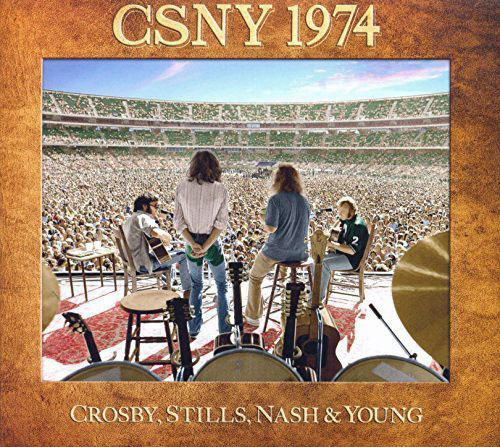
CSNY 1974 – CROSBY, STILLS, NASH & YOUNG
released 7-7-2014
by Cameron Crowe
It’s a grey, rainy day in Seattle. Looking not unlike their back-cover photos on the first Buffalo Springfield album, Stephen Stills and Neil Young sit at the downtown Hilton’s rooftop restaurant chattering nervously and laughing a little too loudly over their old guitar war days. After a while, Young clams up, staring silently down at the nearby Coliseum and the massing crowds. In a little over an hour, David Crosby, Graham Nash, Stephen Stills and Neil Young will find themselves opening their first tour since the 1970 roadwork that spawned Four Way Street.
Outside the Coliseum, gangs of ticket-hungry fans prowl for a chance to crash the sold-out show. One peach-fuzzed fourteen-year-old parades his budding machismo. “Bastards,” he growls, barely out of rent-a-cop earshot. “Looks like I’m gonna have to blast of a few pig heads to get inside.” Strong words from one who hadn’t reached his tenth birthday when the first Crosby, Stills and Nash album was released in the summer of ’69. “They are like the Beatles, man, the American Beatles!”
From the beginning, CSNY represented a sophisticated harmonic oasis amid the parching acid rock of the time. Now they are the Founding Fathers, the inspiration for the current generation of prosperous L.A. country rockers. As Eagles frontman Glenn Frey once said, “I bought that first album and freaked out right along with everyone else. Crosby, Stills, Nash and Young are, in essence, The Great American Supergroup.” And now the kids, even more than the fanatical original wave of fans, seem compelled to examine the sweet-singing artifacts.
Inside, one could easily guess that most of the audience had never seen the band in CSNY’s first period of concert activity. Most likely the majority were initiated into the band through Neil Young. And just as a Joni Mitchell concert seems to draw an abundance of willowy, mountain-fresh blondes, the males portion of tonight’s crowd is predominately clad in patched Levi’s and well-worn Pendletons, with floppy leather hats covering disheveled hair. It will take most of them, including the reviewer from a local paper, three numbers to finally recognize Neil Young behind his electric piano sporting short, slicked hair with a strict center-part that makes him look not unlike Chatsworth Osbourne Junior III from the Dobie Gillis Show.
The lights dim and CSNY – augmented by Russ Kunkel on drums, Joe Lala on congas and Tim Drummond on bass – take the stage at 9:00 with steaming version of “Love The One You’re With.” The 40-song set, which runs through virtually every favorite collective and individual effort, lasts until past 1:30. They are stronger than they were, practiced and intense. There are nine as-yet-unreleased tunes: David Crosby’s “Carry Me”; Still’s “First Things First,” “Bye Bye Angel,” “My Favorite Changes” and “As I Come Of Age”; and Young’s “Traces,” “Human Highway,” “Love Art Blues” (for his dog, Art, the tour mascot), “Long May You Run” (for his car, a customized Southern California Woody) and “Pushed It Over The End.” “Neil’s been writing three songs a day,” Stephen later confides in mock fury. “Damn it, I’m jealous.”
They’re well-rehearsed but loose enough so as not to streamline the original pastoral quality of their arrangements. The harsh cacophony of Stills’ and Young’s strident lead guitar dueling injects a bristling tension to the music. They had always occupied a place of heavenly harmony, but for this tour a new element had been added — tough and steely rock and roll. The wild mercury element that snakes through all it — Neil Young — lends an unpredictable presence to every live performance. Just the fact that he is there with them on stage seems to both delight and mystify and excite the other members. Simply put — it’s a killer show that many never thought would happen. Especially CSNY themselves.
Their onstage personalities are almost intact from 1970. Unless the song demands his presence stage center, Young spends most of his time cruising the amps. His few stage comments are classic Neil (“This is a song for my car,” “This is a song for my dog.”) though some pockets of the huge audience seem slightly unsure if Neil is looking for their laughter or not. Young takes particular pride, however, in delivering the “You’re all just pissing in the wind” line from “Ambulance Blues”; it is his only smile of the show.
Crosby, who looks more like Bozo the Clown every day in his purple flares and sneakers, remains the toastmaster general of rock introductions. “You know, people think we’re doing this for the money, but we’re not. It’s the music man, the music.” Graham Nash is the unobtrusive mortar that binds the other three volatile personalities into a functioning unit, and the soaring vocal ingredient that forever winds above the others.
Only Stills appears to have undergone a major transformation. He is quieter now, more disciplined and less self-indulgent in his solo set (his howling piano-pounding “For What It’s Worth” has been retired). Still, he is fiercely intense and determined to communicate, but not at the expense of those with whom he is sharing the stage. The hostility between Stills and Young that at one time often stopped just short of onstage fisticuffs no longer hangs threateningly in the air. The same lessening of tensions since the last tour has infused the backstage atmosphere with a good deal of genuine warmth, back-slapping, hugging and verbal repartee.
At a quick post-show huddle in the dressing room, everyone is justifiably ecstatic over the performance, but express doubts about the potential effectiveness of a four-and-a-half hour show. It is agreed that tomorrow night in Vancouver the set will be trimmed to an airtight three hours.
They don’t meet that deadline. The concern in Vancouver shifts suddenly to David Crosby’s voice. Launching into the second verse of their fourth number, “Almost Cut My Hair,” Crosby’s vocals first turn reedy, then raspy, then hoarse. During the 15-minute break separating the electric segment from the acoustic set, David curses himself dejectedly. “We’re basically a rock and roll band that sings harmonies over soft and electric numbers. I blew my voice out. And when I blow my voice, I blow the harmonies, which blows it for the entire band. I feel like shit.”
Almost on the verge of tears, David trudges back out onstage for “Suite: Judy Blue Eyes.” With Joni Mitchell rooting from stage left, Crosby, and company just barely pull it off, and for the rest of the evening the former Byrd is de-emphasized. Neil does a longer solo set, the “Carry On” jam is extended and the joyous Canadian throng finds nothing amiss. Still, Crosby is too depressed to join the small gathering back at the Fairmont hotel suite of tour co-ordinator Barry Imhoff.
Ever the showman, Joni finds herself in the center of a picture-window panorama looking out over the Pacific. It is no accident. Eyes shut tightly and voice soaring over the gentle hum of the air-conditioner, she plays her newest songs on Stills’ acoustic guitar, and debuts a haunting new composition . . .
Just like the walls of Jericho
I fall down, down, down . . .
She finishes and lays the instrument across her lap. After a few awkward moments of silence, Stills swoons, “I wish I could think of all those words.” Everyone breaks up. “But then again, I wish I could play with Herbie Hancock too.” (Editor: Years later, it would be Joni who plays with Herbie Hancock, and wins a Grammy for it too.)
“What room is he in?” Nash deadpans.
Stephen picks up the guitar to play “My Favorite Changes” and “Wake Up Little Susie,” the latter with everyone singing along. “I really want to get into the electric guitar on stage,” says Joni wistfully. “Those acoustics, with all their grey tape and wires, are so cumbersome. Neil gave me his Gretsch, I’ve just got to learn to get comfortable with it.”
As the first sunlight glints through the grey, the suite gradually empties to allow a few hours of sleep before the afternoon flight to San Francisco. There are two days off before the weekend shows at the 75,000-seat Oakland Coliseum. For David, Graham and Neil it will be a home-coming.
CSNY 1974, the summer tour that would both define modern rock and roll on the road, and their own lives, had begun.