
By Shanti Das and Jon Ungoed-Thomas
Gambling companies are covertly tracking visitors to their websites and sending their data to Facebook’s parent company without consent in an apparent breach of data protection laws.
The information is then being used by Facebook’s owner, Meta, to profile people as gamblers and flood them with ads for casinos and betting sites, the Observer can reveal. A hidden tracking tool embedded in dozens of UK gambling websites has been extracting visitors’ data – including details of the webpages they view and the buttons they click – and sharing it with the social media company.
By law, data should only be used and shared for marketing purposes, with explicit permission obtained from users on the websites in which the tools are embedded. But testing by the Observer of 150 gambling sites – including virtual casinos, sports betting sites and online bingo – found widespread breaches of the rules.
This weekend, Iain Duncan Smith, the Conservative chair of the all-party parliamentary group on gambling reform, called for an “immediate intervention”. He said: “The use of tools such as Meta Pixel without explicit consent seems wholly in breach of the law and should be immediately stopped. The gambling industry’s marketing practices are now out of control, and our regulatory structure and codes of practice are repeatedly shown to be inadequate. This cannot go on.”
Wolfie Christl, a data privacy expert who has investigated the ad tech industry, said: “Sharing data with Meta is highly problematic, even with consent, but doing so without explicit informed consent shows a blatant disregard for the law.
“Meta is complicit and must be held accountable. It benefits from facilitating problematic and unlawful data practices for its clients and systematically looks the other way, using its terms and conditions as a shield rather than seriously enforcing them.”

Bet442 was among the gambling companies that transmitted data via the Meta Pixel tracking tool without explicit permission.
Of 150 websites tested by the Observer, 52 shared data automatically via the Meta Pixel tracking tool without explicit consent, according to analysis of network traffic. The sites found to have transmitted data to Facebook without permission included Hollywoodbets, Sporting Index, Bwin, Lottoland, 10Bet and Bet442.
The data transfer happened automatically on loading the webpage, before the person clicked to agree or decline marketing. At no point during the testing did the reporter agree to the use of their data for marketing.
In the days afterwards, they were bombarded with Facebook ads for gambling websites, indicating that they had been profiled by Meta as someone interested in gambling as a result of the unlawful data sharing.
In a single browsing session, they were shown gambling ads from 49 brands – not just websites that had shared their data unlawfully, but others too. This included betting companies that were unaware of the unlawful data sharing and whose own use of Meta Pixel was within the rules – among them, Ladbrokes, Sky Bet, BetVictor, Tombola and Bet365 – as well as dozens of smaller brands.
The offers included free bets, a “new players offer” with a 200% bonus and a “gold blitz” with the chance to “win up to 5,000 times your bet”.
Details of the data sharing and profiling come amid calls for a wider investigation into targeting of gamblers. In September, the Information Commissioner’s Office (ICO) issued a reprimand to Bonne Terre Ltd, trading as Sky Betting & Gaming, for unlawfully processing people’s data through advertising cookies without their consent. The brand said at the time it regretted a “technical error”, which had been rectified.
As the Observer reported last week, in a separate case, Sky Betting & Gaming collected hundreds of thousands of pieces of data about a problem gambler who was sent more than 1,300 marketing emails. The high court found the data use unlawful, ruling that the compulsive nature of the man’s gambling meant his ability to give consent was impaired. The company said it had made significant changes since the claimant’s experience in 2017-19 but “fundamentally disagrees” with the ruling and is considering an appeal.
The Gambling Commission has announced measures to prohibit cross-selling, where companies target existing customers with ads for other parts of their business. But there is nothing to prevent brands relying on profiling by third parties such as Meta to try to recruit new customers.
Meta did not comment on the Observer’s findings but pointed to its terms and conditions, which stipulate that companies should obtain consent before sending it data. “We educate advertisers on properly setting up business tools,” a spokesperson said.
The Liberal Democrat peer Don Foster, chair of Peers for Gambling Reform, said: “It is critical that gambling companies and online platforms act lawfully, and it is concerning to see evidence of continued unlawful practices.” Prof Heather Wardle, a gambling research specialist at Glasgow University, said: “This kind of untamed marketing is hugely risky. If you are already experiencing difficulties from gambling, it is likely to make you gamble more.”
The Observer has previously reported on the misuse of Meta Pixel in other sectors, including by NHS trusts that were inadvertently sharing sensitive health data. The ICO said last year that it was conducting a “wide-ranging review” of tracking pixels, which must be used “fairly, lawfully and transparently”, and that it would “not hesitate” to take enforcement action if needed, which can include fines of up to £500,000. “Too often, there is a lack of accountability for how these tools collect and use people’s personal information, with poor transparency and deceptive design,” a spokesperson said.
After being contacted by the Observer, several gambling operators updated their websites to prevent automatic data sharing – or removed the Meta Pixel tool altogether.
One betting brand, Bwin, a previous sponsor of Real Madrid and the Uefa Europa League, shared data on people visiting a promotional page for a £20 free bet. The data sharing happened automatically on loading the website, without the person being asked for consent.
A Bwin spokesperson said: “Due to an internal error, the promotional page was not fully aligned with other group sites. We are deeply committed to ensuring that personal data is handled appropriately and have taken immediate action to rectify the issue.”
Twenty-six websites operating under the licence of gambling group AG Communications appeared to be sharing data with Meta automatically and without explicit consent, including Bet442, King Casino, 666 Casino and 24Spin. A representative said it took compliance with its obligations extremely seriously.
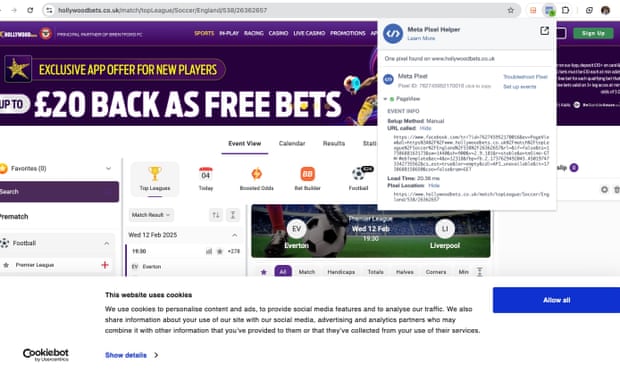
Gambling company Hollywoodbets shared data with Meta despite not being given consent to do so.
Another company, Hollywoodbets, which sponsors Premier League club Brentford, showed website visitors a consent banner telling them that it shared data with its “social media, advertising and analytics partners” – and giving them the option to “allow all”.
But the Observer’s testing found that even if the person did not click accept, data was shared with Meta, including details of which pages they viewed and the buttons they clicked.
The person was subsequently shown Facebook ads for Hollywoodbets, and Meta’s activity logs showed that data had been received from the website. A representative of Hollywoodbets said it complied with all regulatory requirements but declined to comment further.
Shadows of young people against a brick wall
‘Woeful’ DfE blamed as betting firms gain access to children’s data
Read more
Lottoland, which says it has 20 million customers, declined to comment. Its website includes a banner that appears to give people the option to “accept all” or “reject nonessential” tracking. But the Observer’s testing found that it sent data to Meta before the website visitor had indicated their choice.
Sporting Index and 10Bet did not respond to comment requests.
The Betting and Gaming Council, which represents the industry, said: “Advertising must comply with strict guidelines, and safer gambling messaging is regularly and prominently displayed. The previous government stated that research did not establish a causal link between exposure to advertising and the development of problem gambling.”
The Gambling Commission, which regulates betting companies, said: “Operators may only collect and use data to attract custom in ways that are lawful and in compliance with data protection legislation, and their focus should be on preventing gambling harm. Questions around data protection are a matter for the ICO.”
Flutter, which owns several brands that served ads on Facebook but did not share data with Meta unlawfully, said it had “acted appropriately and gained consent at all times”.
Bet365 declined to comment but is understood to deny setting up marketing campaigns that specifically target users of other gambling websites. The other advertisers did not comment.
By Jon Passantino
Earlier this week, Meta made a small but notable change to Threads, its text-based social media rival to Elon Musk’s X. Users can now finally change their default feed to view only posts from accounts they follow, bypassing the algorithmic timeline that had long been forced upon them. Many cheered the update. But beneath the surface, the decision by Meta executives marked a major reversal for the platform that was once referred to as a “Twitter killer,” which has seen its bright future dim as engagement from power users dwindles.
Meta launched Threads in summer 2023 to much fanfare as users looked for safe harbor while Musk tore down the platform formerly known as Twitter. Within hours of its launch, Threads attracted more than 10 million users, including Hollywood stars, big brands, well-known journalists, and technology industry figures. It made headlines as the most rapidly downloaded app in history.
But the good vibes did not last.
Users quickly discovered they weren’t in control. The platform mandated the use of its infamous algorithmic feed and Meta said it would, by default, limit the reach of accounts posting “political content”—a bewildering decision in the run up to the 2024 election. Further, Adam Mosseri, the Instagram boss tapped to run Threads, said in a series of cryptic posts that the platform was not a place for users to post about the news.
Backlash ensued. What was political content exactly and why was it being suppressed? Meta would not offer detail beyond an insufficiently vague explanation describing it as “topics that affect a group of people and/or society at large.”
Beyond the algorithm frustration, Threads also launched without several basic features. There were no trending topics and search was limited to usernames, making it impossible to follow breaking news or discover posts by subject. Users couldn’t curate custom lists to organize their feeds, and there was no option to send direct messages. At first, users were forgiving. Threads was a brand new platform, after all. But Meta seemed surprisingly resistant to implementing these core features, choosing to bizarrely ignore the requests streaming in from their most hardcore users.
For the social media refugees who had fled Musk’s X as he transformed the site into a right-wing propaganda machine, their hopes of building a new community came crashing down.
Mark Zuckerberg made matters worse after the election of Donald Trump, choosing to embrace the extremist political figure who had used social media to whip up distrust ahead of the January 6 attack. That further frustrated much of the Threads base, which skewed progressive and had largely fled Musk’s X in search of a more principled platform, only to watch Zuckerberg dismantle fact-checking efforts, loosen content moderation rules, and kowtow to an anti-democratic figure. For users who once believed Threads could be a better kind of social network, their optimism dissipated.
In the weeks after the election, millions of users flocked to Bluesky, which quickly became the new home for many of the power users who had once dominated early Twitter. The platform stood in stark contrast to Threads, giving users significant control over their feeds and empowering them to build vibrant and niche communities. The platform felt electric with a type of energy that cannot be artificially manufactured. While still imperfect and relatively small, it offered something that Meta had not: a sense of authenticity and user-driven momentum.
That’s when Meta panicked. The platform suddenly started to give a damn about what its users had been pleading for all along. Threads rolled out trending topics. It rolled out advanced search. And this week, it rolled out the ability to finally ditch the algorithmic feed as the default option. But it has all felt like too little, too late. The early magic that Threads briefly held had slipped out of its hands.
Now Threads feels rather lifeless. While users still post there, for many has become something of a second-tier platform—a place that they dump content out of habit, not because they’re having real conversations or finding meaningful engagement. It’s like a social media purgatory; in a strange intermediary state after life, but also not quite dead. During its latest earnings report, Zuckerberg said Threads had amassed 320 million monthly active users, but to many observers it sure doesn’t feel like it. Influencers on the platform have noticed stagnant follower counts, minimal interactions, and a broader sense that no one is really there anymore.
A number of users have raised this issue. Kara Swisher, the renowned tech journalist, noted this week that her Bluesky following now dwarfs her Threads count, adding that her audience “has grown glacially” on the Meta platform. Social media consultant Matt Navarra added that he’s observed the same phenomenon: “The number of people I’ve seen post about zero growth on threads is insane for a newish platform as big as threads. Mine hasn’t grown at all in 9 months.”
Meta seems acutely aware of the issue too. In recent days, Meta sent users, including myself, an email encouraging people to post on the app more frequently. “It’s a great time to get back into Threads,” it said, highlighting some of its recent changes. But the anecdotes suggest that Meta’s antagonistic relationship with power users has backfired. While the company is adding new features long requested by users, it is clear that its indifference toward those powering the platform has sent many packing up.
The long overdue policy shifts serve as a cautionary tale about the risks of prioritizing corporate interests and political appeasement over user trust and engagement. Meta bet that threading the political needle and protecting its brand from controversy would help Threads grow safely, but instead it alienated the very users it needed most. Meta sent a clear message from the start: user input came second. The result wan’t just backlash, but abandonment once another viable X alternative came along. When social platforms lose the trust of their most active and engaged users, they rebel—and no amount of growth metrics can mask the hollowed-out reality left in the wake.