
Deprived of once plentiful seagrass, more than 900 have died this year. Some experts contend they were taken off the endangered species list prematurely.
By Amy Green, insideclimatenews.org
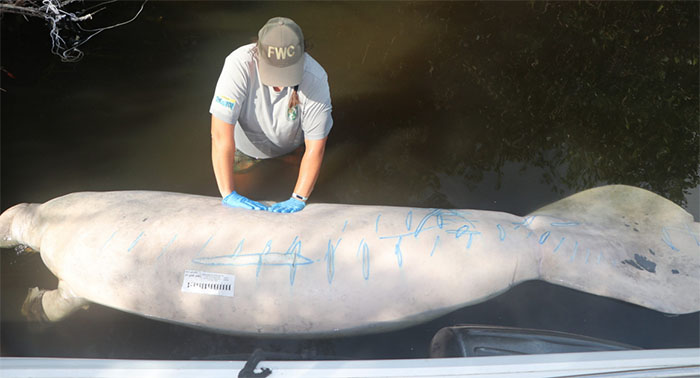
The vast majority of manatee deaths have been in the Indian River Lagoon, a biological diverse east coast estuary that has been plagued with water quality problems and widespread seagrass losses. Photo Courtesy of The Florida Fish and Wildlife Conservation Commission
ORLANDO, Fla. — The manatee was too weak to swim.
She lay still in a medical pool at a SeaWorld rehabilitation center, only lifting her whiskered snout every so often to breathe. Her snout rested upon a pipe to make the effort easier. Her body was slender, hardly that of the chunky manatee—a relative of elephants—that she should have been. Her underbelly was concave. The manatee was near death from starvation.
“You are looking at the body shutting down. You’re looking at the body eating its own fat reserves. You’re looking at the body doing a lot of things to try to save the core,” said Jon Peterson, vice president of zoological operations at SeaWorld, who supervised the manatee’s care along with the veterinary staff. “When that goes on, would that be discomfort? Absolutely. Would that be painful? More than likely.”
Peterson called the manatee No. 37, because she was the 37th manatee to be rescued this year from Florida waters. She weighed 1,170 pounds, up to 630 pounds less than she should have at 12 years old. Her recovery would be long and grueling, if she survived.
“Right now every calorie I’m putting in is trying to care for the body’s decay that’s going on,” he said. “It’s trying to take care of the infections that are raging. So none of those calories yet are going to put weight on. They’re literally going to try to save her body.”
No. 37 is one of the lucky ones. During 2021 an unprecedented 937 manatees have died in Florida, more than double the five-year annual average only nine months into the year. The staggering loss represents 10 percent of the animal’s population in the state, estimated at 8,810.
More than half of the deaths are in the Indian River Lagoon, a 156-mile East Coast estuary that is among the most biologically diverse on the continent. Ongoing water quality problems have led to a widespread loss of seagrass, the manatee’s preferred food. Many of the deaths are related to the kind of starvation No. 37 suffered from, although manatees also face threats from toxic blooms of red tide, habitat loss and boat strikes. Environmental groups say on Florida’s east coast, some 20 percent of the manatee population has been wiped out.
The calamity comes four years after the U.S. Fish and Wildlife Service (USFWS) effectively declared the manatee on the way toward recovery and downlisted the animal from endangered to threatened, a decision that generated widespread opposition. Now some experts say the downlisting not only was premature but neglected scientifically documented warning signs at the time that manatees were in trouble, leaving the animals vulnerable for the latest in a series of mortality events. Two congressional leaders—Reps. Vern Buchanan (R-Fla.) and Darren Soto (D-Fla.)—have filed legislation aimed at restoring the manatee’s endangered status.
“If you don’t believe it’s a serious issue and it’s going to be a short-term problem, you’re not going to put the scientific effort into it, or the political effort, or the management practices into place to prevent those declines in the future,” said Pat Rose, an aquatic biologist at the Save the Manatee Club who has spent 40 years working on manatees for the group and also the federal and state government. “That’s what I call neglect—that they misjudged how serious the problems were and didn’t take the appropriate actions to prevent this from declining further.”
Harmful Algae Blooms Have Killed the Seagrass
Among the most important habitats in the world for the iconic charismatic manatee is the Indian River Lagoon, which stretches five counties from Brevard near the state’s midsection south to Palm Beach County. The estuary’s warm brackish waters and historically lush seagrass provide a haven especially during the winter for the animals, which are stressed in cold water.
For the past several years ongoing nutrient pollution associated, for instance, with fertilizers, produced mainly from natural gas, and septic tanks have triggered harmful algae blooms that can cloud the lagoon’s historically crystal-clear water, preventing sunlight from reaching the seagrass undulating beneath the surface. Since 2009, at least 58 percent of the seagrass in the northern Indian River Lagoon has been lost. In the Banana River, part of the northern lagoon, at least 96 percent of the seagrass is gone.
For manatees the paucity means that when a cold snap occurs they face a crucial choice: whether to stay and potentially starve or forage elsewhere and freeze. But manatees in Florida were stressed long before now and not just in the Indian River Lagoon. During the past decade there have been multiple mortality events. In 2013 there were 830 deaths, the previous record.
In January 2021 it was clear something was wrong again in the Indian River Lagoon, said Bill Greer, a research associate at the Florida Fish and Wildlife Conservation Commission who is part of a three-person team rescuing dead and ailing manatees in the lagoon. After a series of cold snaps the team began receiving almost daily calls about dead manatees, more than the team had experienced before. The team members reached out to other agencies for help.
“It’s fairly physical work, just handling the carcasses and manipulating them during the exams,” he said. “It also got to the point where we were trying to make sure we were getting enough time, you know, to kind of recuperate.”
Between December 2020 and May 2021 there were 677 dead manatees reported on Florida’s east coast, the highest number ever recorded in the state during a six-month period. Most of the deaths occurred in January, February and March. The animals were up to 40 percent underweight, with deteriorated muscle and fat and severe atrophy of the liver, heart and other organs. Sixty-seven manatees were rescued, some of them taken to nearby Blue Spring because the Indian River Lagoon at the time was considered “too dangerous” for them.